Wailing & gnashing of teeth...

Well, they wouldn't have clearanced them because they were the old Made in U.S.A. ones, and the new ones are still dead ringers for the old ones. They're made off the same tooling, it just got moved overseas. Unless they sat at Lowe's for well over 10 years (which they didn't--those places don't sit on anything that long), they're Chinese.

I'll bet they're still miles ahead of the Tekton ones I have. But the short-jaw ones I bought work great.

I doubt stock that old would still be on the shelf. When the first Chinese ones started to arrive in stores, guys were buying them up like crazy. The difference was that obvious....they are far from dead ringers - the metal on the newer offshore ones is very porous when compared with an older one. Chinese metallurgy is well known to be among the world's worst. I recently broke a brand new pair crimping drapery S - hooks on a job...something that should have been extremely light duty work for them. In comparison I have some that are 35 years old that still work like new, and my Dad has pairs that are easily 20 years older than that. Neither of us or anyone else I know has managed to break a pair even under extremely abusive use.

Funny how they still charge a premium price, even though it's no longer a premium product.
 
The new Irwins are nowhere near as beefy through the body, have smaller adjusting bolts, poorly aligned jaws and weaker springs, just to start. The last pair of welding clamps I bought are Irwin, and they are the last pair I reach for and then only if I don't mind being pissed off trying to adjust them.

I've got a pair of 7" curved jaw VGs that I bought used when I first started out, some 30+ years ago. I use it now almost exclusively for removing stubborn door hinge-pins. It's taken some horrific abuse - BFHs, being pounded with a blunt chisel in an air hammer, heated to almost red-hot... Still works, though it ain't pretty no more.

Old Man Peterson must be rolling in his grave...

The local CarQuest carries a brand called "Eclipse" that aren't too bad.
 
When last we left our story, I was about ready to do the final installation on the roof panel. This was pretty intimidating for me, since I have zero experience with panel bonding adhesive and I'm not much of a welder (although I'm getting much more proficient as this project wears along... :D ).

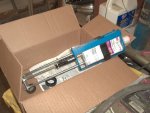
While the roof was still supported on the 2x4s, I ground off the black EDP coating with a Scotch-Brite wheel in the areas where it would be glued. 3M says this wasn't necessary, but I was taking no chances. I didn't take any pictures of that grinding work, because primarily it was almost impossible to get a camera angle on it, and it's self-explanatory while being as interesting as watching horseradish grow. I also did not take any pictures during the application of the adhesive, simply because I was paranoid about working time. If you've ever used a caulk gun, it's pretty obvious. However, one picture I did take, and it's a tool plug, is of the applicator I used. It's made by a company call Cox, model M200LVMR. Rather than being like the expensive 3M applicators, which are specific to the various tube arrangements of their different adhesives, the Cox gun uses adapters and a clip-on tube wedge that allow it to fit anything made by 3M, SEM, Evercoat, etc. Also unlike the 3M guns, it's under $35 on Amazon. It works perfectly. If you use twin-tube adhesives with any frequency, or will be in the future, getchaseff one of deez!

100_0444.JPG


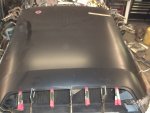
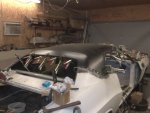
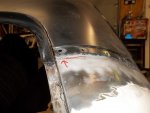
The next pictures I took were with the roof already down, and clamps in place to hold it while the glue set. I left it this way for two days... no point in taking any chances. :D In the second picture, despite the poor focus you can clearly see the relatively large gap where the roof did not sit flat against the quarter panel. I was well aware that this would be the case, so appalling as it seems this was not something that left me reeling. It's just the nature of the reproduction beast combined with production variances and 40 years of not being assembled yesterday.

100_0455.JPG

100_0458.JPG


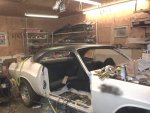
A couple of days later, and boom! She's down for good with the clamps off. Yes, that annoying gap is still present on both C-pillars, but it's not evident in this picture:

100_0461.JPG


I've got no words to adequately describe the sheer joy of removing all those clamps and not hearing a single "pop" where something came undone. Mind you, there are literally no welds holding the roof down at this point. It's all being done by the magic of 3M adhesives technology. That sucker is on there. :dance:
 
So, how does one get the roof to sit flat against the quarters, especially when both are firmly mounted to the car? No, you don't break out the hammer and start wailing away at it. After looking at how everything was sitting, it was obvious that there was simply a little too much C-pillar material in the replacement roof. The solution turned out to be extremely simple, both in concept and execution.

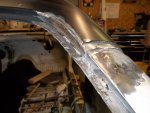
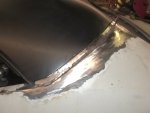
One of the great things about cars is that when you learn the wrong way on one side, you're better prepared for the other side. :D For instance, here's the wrong way to begin the repair. I grabbed my angle grinder and ground away the small bulged area where the roof panel's exterior had deformed the window frame (visible in the previous picture with the red paint showing the gap; both sides were the same). Bad idea. Yes, it got rid of the excess material but it also left very thin areas where I needed to weld. It got rid of too much material. You can see the huge hole left behind in the vertical part of the window frame. Not a disaster, but more prep time and a small patch were needed to undo this error:

100_0466.JPG

100_0473.JPG


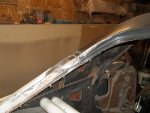
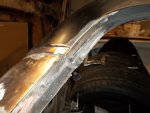
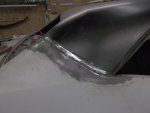
After rectifying that boo-boo and slapping myself in the forehead for not doing it in the first place, I grabbed my air saw and made a nice, clean in the same area on the other side. I then clamped everything where it should be and ground away the excess. This left me with a perfect, narrow gap in which I could make my single line of tack welds. The results are much cleaner and speak for themselves:

100_0467.JPG

100_0471.JPG


And just like that, without so much as a tap from a hammer, the roof sat against the quarter panel exactly the way God, Mopar, and Bill Brownlie intended. :dance:

100_0474.JPG

100_0475.JPG


Before anyone asks: Yes, these areas have been cleaned and filled better since. These pictures were taken right after I got the sonofabitch to fit correctly, not as an example of finish work!
 
I've made some more progress on the car, but haven't been updating this as I should. Heading out to the garage but I don't know how much I'll get to work on it today. However, I'll get this up-to-date soon. I'm very nearly done welding on the car's exterior (I think), so I've got that going for me... which is nice.
 
There will be no money, but on your deathbed, you'll be granted eternal rust-free-ed-ness...
 
3M adhesive, eh? Looks like you're doing some fine work on that Challenger. You're living my dream :)
 
Doing the best I can, Jester. Maybe it's better than most first cracks at this kind of thing, but with Restoman coaching and Stretch as a cheering section things seem significantly easier than I thought they'd be. So far, anyhow. :shifty:

Living your dream? C'mon over for a visit. Live it yourself! I've got plenty of this kind of work that needs doing. :D
 
The Challenger. The Challenger was my dream for years, but around here, even a complete basket-case is astronomically priced.

I got my hands full with work and the new (old) neglected house.
 
I sold my first one when I was 18. They were so insane in the '90s and early '00s that I'd given up hope, but v8440 saved the day and the dream. It took me until I was 43--fully 25 years--to realize that dream. Prices aren't what they once were. They've dropped enormously from the heyday, so don't give up on it. Your time will come too, Jester. :)
 
While I'm updating, this project is coming front and center (finally). Agnes burned up a lot of my time, and she's still not done, but I'm getting itchy on this one.

I haven't gotten much further on the bodywork, but I did replace a large section of one sail panel below the roof and repaired a bad section of trunk rail, both cut from a full repro quarter panel and leaving as much OE steel in place as feasible. Hoping to get back after it soon; I'd like it to be in paint this summer.

In the meantime, a lot of other details were covered. I have the completely-restored Rallye dash awaiting assembly, which is probably going to require happening at work on a weekend... I don't have any of the fasteners for it, so I'll need to sit by the hardware assortment and figure it out as I go. ABC Moparts redid my dash pad; a good OE pad came with the car but it wasn't a 3-speaker as original so I had them restore the car's original pad. They did a phenomenal job and were one of the less-expensive restoration options. Just Dashes re-uses as much original foam as possible; ABC Moparts strips the metal clean and molds all-new foam. I can't recommend them enough!

The plan for the engine was, uh, downgraded? from a relatively-crazy 340 with EFI to a much-milder 340 Six Pack. Instead of a high-strung street beast, I decided a mild build would be more enjoyable... and the Six Pack was a dream I had for the '73 way back when. I picked up a complete (and original-equipment) Six Pack setup, air cleaner to manifold with all the accessory bits, for $1,550 shipped to my door. I already had the dirt-cheap T/A heads I picked up a couple of years back, so the top end will be all OE Challenger T/A stuff.

The block turned into a bit of a nightmare because of the machine shop, but they didn't screw anything up--it just took them a year and a half to do a full race prep on it. Deck height/angle/parallelism etc. all corrected to .0001" and .005°; bores straight and round to .0001" at 4.060" (.020" over). The mains and heads are studded; the main studs are also girdled. Absolute, complete, unwarranted overkill for a mild street engine... but the devil's in the details and it should be a strong runner. Pistons are SRP forged, rods SCAT Pro I-beam, crank is an OE steel unit. Compression will be in the upper mid-9s depending on what milling the heads need. I'm still camless, but will call around and see what kind of recommendations I get.

This car will absolutely be a driver, and as such I've decided to build two transmissions for it: a "daily use" transmission that will use an early A-body close-ratio gearset with the 3.09:1 first gear in an E-body case, and a "road trip" transmission that will be built using pickup-truck overdrive gears in a non-overdrive, small-bearing close-ratio case. If I decide to come visit you personally, that .67:1 overdrive fourth will make for comfy cruising at speed. The main reason for the switch to the smaller case is to both rid myself of the floating countershaft and make the transmission a simple swap (same front bearing retainer) rather than muss and fuss with bellhousings, forks, etc. The clutch is a McLeod Borg & Beck 2,800lb pressure plate with a Centerforce Dual Friction disc. I still hate diaphragm clutches, mostly for their awful feel.

The floorpan part of the 4-speed conversion is done, but I haven't hung the pedals. This actually worked in my favor, since after buying a reproduction '70-'72 pedal setup from Brewer's, I found a correct '73-'74 clutch and brake pedal (just the pedals themselves) for $15 at a swap meet. The early pedals are trapezoid-shaped, whereas the later ones are rectangular and I've always preferred that design.

Realistically, this car is a week's worth of bodywork and a paint job from starting reassembly, although I do need to get the reciprocating assembly sent out for balancing (more overkill). I'm on vacation after one more week of work, and I'm hoping to get motivated during that week off. Time will tell.
 
Sweet. Git 'er done and drive it all Summer. Eff covid in the seat of your 340 Challenger.
 

SiteLock

SiteLock
Back
Top