
You are using an out of date browser. It may not display this or other websites correctly.
You should upgrade or use an alternative browser.
You should upgrade or use an alternative browser.
The abuse continues...
- Thread starter Dr.Jass
- Start date


Dr.Jass
Pastor of Muppets
Which had, y'know, more than a Slant Six's worth of additional displacement. It seems a wee bit, uh, radical for a shade under 345 cubic inches, no? I filled out a few cam recommendation forms last night to see what the men who grind such things might think about all this.I don't think that's much smaller than the one that was in my 572.
My boss stopped by near the end of the day yesterday and I told hiim about the engine, and from whom I'd purchased it. He said, "When you were getting the engine, you should've called him and asked 'Is there anything else you're thinking about selling? Anything?!'"

Dr.Jass
Pastor of Muppets
Also, I think I forgot to add that the minimum recommended compression ratio is "12.5:1+" on this thing. That makes sense, since I imagine there's a ton of overlap and a late intake opening point and hence, not a lot of dynamic compression happening with it (I wish I could find a full cam card with the actual timing events). Even milling even the W2 heads down to 63cc chambers isn't enough to get anywhere near that kind of squeeze. They're the only heads I have that could easily withstand such a cut. I'm not buying a set of pistons for this thing. It goes against the "cheap speed" groove I'm in.
Dr.Jass
Pastor of Muppets
According to what I've found, it's a bracket-racing cam... one with the word "nitrous" in the description. :doh:Short track circle racing cam?
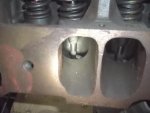
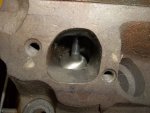
If the guy had the intake, carb, etc. he would've had it for sale at the swap meet. Keep in mind, I bought the slicks that came out of the same storage area as this engine. Also remember, the seller didn't build this engine. He knew nothing about it other than it was a 340 with a roller cam and forged pistons. He also had a set of rebuilt J heads he assumed were for this, but I doubt whomever built both this shortblock and those heads intended to use them together. There is a tiny bit of damage at the top of the #1 bore that could be nitrous (detonation) damage, but even with a healthy dose of spray I don't think unmodded J heads would be enough. The ports looked to be stock in the auction, and with the amount of hand work done to the block and rods I have a hard time believing he wouldn't relieve the heads a bit. When I saw the heads in person, the valvesprings did not appear to be anywhere near enough to support an aggressive roller cam like this, much less a steady regimen of eight-grand nitrous passes with one.
Stretchy has a theory that this was his backup shortblock, or one that was out for freshening and he lost interest, died, or whatever caused him to not clear out or pay for the storage locker. I think this was his race engine, and he'd put something more streetable in his car. Either way, the heads, intake, and carb were probably on a different engine still in a car at the time, which he may have been street-driving. That would explain the total lack of suitable top-end parts for this engine--as well as the presence of the slicks 'n' skinnies--in the locker.

restoman
The paint fumes have cleared so I'm
"If you can leave black marks from the time you exit a corner till the time you brake for the next turn, then you have enough horsepower."
--Mark Donohue
Words to live by... I get a lot of flack from time to time for my love of oval track racing, but like the above quote implies, it's a drag race from corner to corner, several hundred times over and over.
--Mark Donohue
Words to live by... I get a lot of flack from time to time for my love of oval track racing, but like the above quote implies, it's a drag race from corner to corner, several hundred times over and over.

thrashingcows
Drowning deep in my sea of loathing...so I'm
Those are some serious RPM and gear recommendations for that cam. And as you stated you don't have the compression, or heads to fully utilize the cam properly. I would do as suggested....E-bay the cam and pick up a more appropriate cam for your motor and parts combo.
Little more of a sedate example....When I restored my coronet 'vert...383/4bbl car....I thought I would upgrade to the "hemi grind" cam. Well the 383, 4spd and 3.23's really didn't like that cam....it would bog down low until about 2500rpm, then it would take off. If I had been running 3.55 or 3.91 gears the cam would have worked great. So I put in a OEM grind cam and the motor performed much better.
Little more of a sedate example....When I restored my coronet 'vert...383/4bbl car....I thought I would upgrade to the "hemi grind" cam. Well the 383, 4spd and 3.23's really didn't like that cam....it would bog down low until about 2500rpm, then it would take off. If I had been running 3.55 or 3.91 gears the cam would have worked great. So I put in a OEM grind cam and the motor performed much better.

Dr.Jass
Pastor of Muppets
Yeah, and we'd had what, approximately five minutes to look at it when you did? I was still trying to figure out exactly what I had, and you were already looking for reasons to go "Ha, ha, you got screwed."Stretchy also pointed out the possible nitrous damage.
Actually, I'm glad you were looking more closely right off the bat than I was... you kept me grounded while I was floating around on Cloud Nine. It should be pointed out, though, that said damage is so minimal as to be literally inconsequential. I'll just carefully polish those two areas so they're not hot spots that could cause pre-ignition. I doubt that a couple of cubic millimeters (.002cc) will seriously affect compression. The more I think about it, though, the nitrous makes total sense. The guy that built this engine may well not have had killer heads to feed such a cam, and nitrous would be the obvious solution to getting enough oxygen into the cylinders at such lofty RPM. Not that it couldn't be done with seriously-ported factory heads, but it also explains the too-low static compression ratio. Those little spots at the top of #1 could very-well explain why the engine was pulled and freshened in the first place. I'm still at a loss as to the damage to the #5 piston crown, though. It's shaped too consistently to be caused by a broken part bouncing around.
I have a good set of heads and absolutely no intention of spraying this thing, hence the reason (well, one of 'em) I started shopping for a cam more suited to the lower compression ratio. I'm sure it'll still be a pretty silly cam, but the one that's in there is just plain ridiculous. It's like a Super Comp cam, and I'm all out of rail chassis.

71ChargerRT
Well-known member
I suggested that, and methanol.use the lack of comp and put a truck hairdryer to it!
thrashingcows
Drowning deep in my sea of loathing...so I'm
use the lack of comp and put a truck hairdryer to it!
I suggested that, and methanol.
Great idea but I think it would go against Doc's low budget, and fast....

Dr.Jass
Pastor of Muppets
10:1 is pretty high for any kind of serious boost. It could be done with computer-controlled timing to some extent, but with iron heads anything over 5PSI would be pushing it.
Here's the deal: My intention is not get all caught up in this and end up doing a hardcore drag car. The nearest strip is 120 miles away. What Stretch and I are going to do, with minimal expense, is slap this thing together using stuff I already have for the most part. I need a clutch disc, I need headers (or I may replace the flanges on a set I have), and I need 4-speed pedals and linkage. I also need tires and a carb. We'll fiddle with it, tune it, whatever, but I'm not tossing a bunch of money into it... though I will admit, I was eyeballing 'glass fenders.
It has to remain marginally streetable. I'm not saying it has to be driven the 120 miles to the strip, but if it can't be street-driven occasionally it's of no value to me whatsoever.
How're you doing for pedal setups, 69.5? Got any spares lying around?
Here's the deal: My intention is not get all caught up in this and end up doing a hardcore drag car. The nearest strip is 120 miles away. What Stretch and I are going to do, with minimal expense, is slap this thing together using stuff I already have for the most part. I need a clutch disc, I need headers (or I may replace the flanges on a set I have), and I need 4-speed pedals and linkage. I also need tires and a carb. We'll fiddle with it, tune it, whatever, but I'm not tossing a bunch of money into it... though I will admit, I was eyeballing 'glass fenders.
It has to remain marginally streetable. I'm not saying it has to be driven the 120 miles to the strip, but if it can't be street-driven occasionally it's of no value to me whatsoever.
How're you doing for pedal setups, 69.5? Got any spares lying around?

69.5CUDA
Blah Blah Blah
actualy i know for fact i have some...finding them is another story.....now "if" you can ID them from pics that greatly incresses the chance
this is all assuming on the off chance that the pedals(not linkage) doesnt still remain in one of the 2 shells that need cut up....if thats the case no hunting required just a yank out
we have BOXES of organized "like" stuff..so a box of pedals n linkage...nothing truely ID'd....of my 5 bay 10car shelf..there is a full 3dr floor of 3ft high 4x8ish shelves packed full of labeld boxes of stuff like that
this is all assuming on the off chance that the pedals(not linkage) doesnt still remain in one of the 2 shells that need cut up....if thats the case no hunting required just a yank out
we have BOXES of organized "like" stuff..so a box of pedals n linkage...nothing truely ID'd....of my 5 bay 10car shelf..there is a full 3dr floor of 3ft high 4x8ish shelves packed full of labeld boxes of stuff like that
thrashingcows
Drowning deep in my sea of loathing...so I'm
I hear Ya 69....when I was at the old house I could find pretty much anything I had, now after the move with much of my stuff still in storage I "know" I have the stuff....but where the Heck is it!

68R/T
I got drunk and swallowed my teeth, now
....when I was at the old house I could find pretty much anything I had, ....
After 40+ years of collecting & my old place had a 2-1/2 car garage and barely room for one car and room to walk around it, I still knew where everything was. Now I have room so "everything has its' place" I can't find about 80% of it.

thrashingcows
Drowning deep in my sea of loathing...so I'm
After 40+ years of collecting & my old place had a 2-1/2 car garage and barely room for one car and room to walk around it, I still knew where everything was. Now I have room so "everything has its' place" I can't find about 80% of it.
...too funny.