Patriotic Challenger Ass

TheIronSausage

Two brain cells left.. rubbing together for warmth
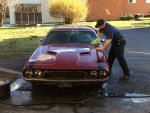
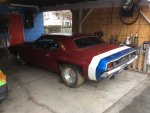
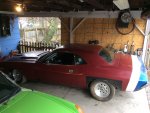
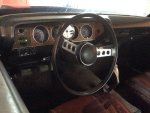
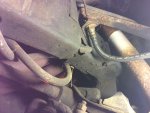
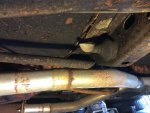
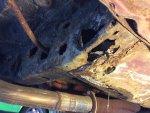
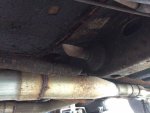
I just got my buddy's '73 Challenger in to recommission. Most of this has been covered in the gawldammed throwout bearing thread, but a quick recap won't hurt. It's sat for six to eight years. It started out life as a 318 autotragic with a pea soup paint job. It was bought as scrap and built as a 340 four speed car with a pistol grip and a 3.23 posi 8 3/4 rear and painted for $4000 in the early nineties. My buddy Dave bought it in the early 2000s, and ran the snot out of it. He parked it due to a running issue around 2009. When last we left our story, I'd discovered that it had a broken driver's side torsion bar and was a massive pile of rust. Dave had been welding patches onto the unibody frame before he parked it, and when I crawled under it today I found another broken frame rail behind the front shock on the passenger side. image.jpegimage.jpegimage.jpegimage.jpegimage.jpegimage.jpegimage.jpegimage.jpegimage.jpeg
 

Attachments

  • image.jpeg
    image.jpeg
    1 MB · Views: 44
I've also found out that the running condition it was parked for is a wiped cam lobe on the #2 intake valve. So, the list is as follows.

Camshaft/valvetrain
torsion bars
full brake rebuild
full suspension rebuild, bushings, ball joints, everything..
Weld more frame parts together.
Whatever else falls off of it while it's on jack stands in my garage.

Which leads me to some tech questions. First is, given a 340 with mildly worked heads, an ld4b intake with a Holley street avenger 750 (I think) double pumper, A833 non OD trans, and a 3.23 sure grip rear with some meaty tires out back.. What cam does this motor want?

Second, it needs torsion bars. It had 9.03s (according to my calipers). Firm Feel has 9.4 and 9.9 or 1 as an upgrade. I'm going to push Dave back towards rubber bushings, and the Chally has front and rear aftermarket anti sway bars.. What T bar is appropriate for spirited driving without shaking the car apart? If he's got the scratch, I'll have him get Edelbrock IAS shocks.. I really like them on my Valiant. They're almost like a koni, instead of super stiff bilsteins or gas-a-justs.. I'm aware that gas-a-justs don't even rank here, but you know what I mean.

Thoughts?
 
What's the definition "mildly worked heads" in this case.

Any idea of the compression ratio as built?

I have had great luck with the street avenger on the Demon.... More time driving/less time effing around with the carb, but I question the value of the carburetor on that particular intake. Others can elaborate on that with greater eloquence that I can.

All that said, assuming decent compression, the early 1968 factory 340/4 speed camshaft seems like a good choice with those gears. But I'm sure others will chime in to tell me how wrong I am. [smilie=f::D There's certain to be more modern grinds that may serve you better.

Doc?
 
Last edited:
By mildly worked, I mean that one's a J head, and one's an X head.. This leads me to assume that they were machined to similar specs, and I'm sure they've got big valves.. I know the intake is mismatched, and since he never mentioned problems with pump gas, I'd guess at 9.5 CR tops? No real idea. The small ports in the intake speed up the charge, right? What happens when it hits the head.. The ports may have been hogged out to match, I haven't pulled anything apart besides the valve covers yet.
 
On the torsion bars, I'd suggest going up one size to the '70-'71 big-block bars, and no further. The more stiffness you add to the front, the worse it's going to plow in corners. You've already got aftermarket F/R swaybars. Jumping up to the road-race T-bars without a corresponding increase in rear stiffness will turn it into a wallowing pig. One size up from OE will be about perfect.

Neither Bilsteins nor Gas-A-Justs have ever been stiff in my opinion, other than when they're new. After a couple weeks' break-in (driving it daily) they break in and work exceptionally well. Edelbrock doesn't make shocks, so I'm not sure whose they're relabeling, but I'm sure they're pretty good. They don't make EFI computers either, but the companies from whom they source theirs make very good ones as well as the dumbed-down Eddy stuff.

There's nothing wrong with poly bushings except their propensity to squeak and the fact that they are an absolute no-no on the strut rod bushings. They will hammer your LCA bushings, ball joints, etc. to death in short order. I had no ill effects with poly on my '72 SE, but I knew better than to use the poly strut-rod bushings.

Last word on cornering: The biggest room for improvement on the car is the tires. From personal experience, I can tell you there aren't a lot of good cornering options for sub-17" wheels. In fact, that's why I bought my Minilites in 17", after much soul-searching due to my hatred of huge-diameter wheels. If they've got white letters, they're basically shit. The Radial T/As everyone loves (they do look damned good, I won't deny) are 50-year-old tires rated M+S. When was the last time you bought mud/snow tires to burn corners? Then again, his/your version of spirited driving might not equate to mine. To hell with knuckles, I turn people's fuckin' hair white. As such, I ended up with Nitto NT555s in P255/50ZR-17 on custom-offset Minilite reproductions.

There's not nearly enough information about the engine to thoroughly recommend a camshaft. Making assumptions is the best way to end up with the wrong cam. The head mismatch needs to be corrected ASAP. The J head flows better than the X (assuming equal-size valves; most Js are 1.88 intake), particularly on the exhaust side. While my initial thought was to tell you to find another J, the machining and attempting to match whatever porting was done is more money and effort than they're worth. As Nodda axed, what does "mildly worked" mean? Gasket-matched? Port-matched? Bowl work? Just go ahead and upgrade: Go to the junkyard and find a set of '89-'91 318/360 truck cylinder heads, casting number ending in 308 (not 302!). They outflow even the J heads once 2.02" valves are installed, and have a spectacular exhaust port. By far the best of the LA heads, and they've already got hardened exhaust seats, which neither X nor J heads had originally. We have no idea on a compression ratio, since all 340s were open-chamber heads and were either 10+:1 or 8.5:1. Mid-9s isn't possible without custom pistons, a scary amount of milling or head shims. Plus, odds are about even that it's different side-to-side with the different head castings, since Js tend to have 3-4cc larger chambers than Xs. Don't make the assumption that anyone did anything right when they couldn't even be bothered to use the same heads. Before you spend any money, I'd definitely check that lifter bore for roundness. While you're in there, look very closely at the lifter galley about halfway up the lifter bores. 340s are notorious for cracking in that area, front to rear. I've seen cracks that extended through all 8 lifter bores.

I haven't seen a picture with the air cleaner off; is it an actual dual-accelerator-pump, mechanical-secondary carb or is it just a dual-feed (two fuel lines)? The latter is commonly confused with the former. It looks like he's running manifolds, but which ones? Any plans to open that cork? While I do agree with Nodda on the '68 4-speed cam, it can be a trick to find. That or the other factory 340 pattern ground with lobes optimized for the .904" lifters would be a spectacular choice. Very few cams are ground with lobes that can take advantage of that huge Mopar lifter. Even the factory cams weren't. There's a Mopar Action article documenting the difference on identical cams, one ground on standard lobes and one ground on lobes that would not work on a lifter smaller than, I think, .850". The difference was astonishing. I know Howards Cams out of WI makes Chrysler-lobe-specific grinds.

Beyond that, I'd say what I always say: call a cam manufacturer with all the pertinent information on their cam recommendation form (as much of it as you have, since I assume you lack head-flow numbers), and tell them what it is you're wanting from the engine. Max power? Best economy? A decent compromise? Call said company; they never respond to e-mails in my experience. If you're willing to pay extra to get the most of your grind, specify that you want the lobes ground for a minimum lifter diameter of .850" Buy whatever valve springs they recommend. You don't know what you've got now, and it's cheap insurance.

A set of 273 adjustable rockers and their attendant (hydraulic) pushrods would be an excellent upgrade. You can set the lifter preload precisely, and the ratio is far more exact than the later stamped stuff. The correct adjustment procedure for hydraulic lifters is simpl. Just tighten the adjuster until the pushrod spins freely but has no up/down play between the rocker and lifter. Tighten 1/2 turn further. Bam: .021" preload, which is awfully close to the optimal .020". Stamped rockers can preload as much as .050". There's extra RPM in them-thar rockers that you'll appreciate with a rev-happy 340.

No matter how you slice it, that engine wants more gear, especially with "meaty tires" which I'll assume to be relatively tall. 340s like to rev, and the party starts north of 2,500RPM. I'd suggest a 3.91, unless he's a sissy that can't stand an engine at ~3,000RPM on the highway (depends on tire size) but if that's the case he'd still better enjoy a 3.55. My first 340 had 4.10s with the 4-speed. Hoot city, and damn the highway revs. Overdrives were uncommon back then and had not yet turned everyone into a bunch of mewling pansies. It's a red-blooded American musclecar, for fuck's sake. There is a reasonable compromise, though: The truck (long-tail) A833OD, using his existing rear gear. The first-gear ratio in his current transmission is 2.45. On the OD, it's 3.09, so it comes out of the hole like a 4.10 in first. The downside to the swap is the huge drop to 2nd gear, which is 1.67. It's better suited to an engine with a wider torque peak, like a 360. "Third" is direct, and the .73 overdrive gear is actually placed in the 3rd-gear position inside the transmission. The shifter acts normally because the 3-4 lever is installed inverted. Yes, that means you'll encounter some minor linkage-rod difficulties to overcome. You'll also need to have the bellhousing bored out to 4.805" and have the front bearing retainer turned down to that size (or buy one of the reproductions with the 4.16" bolt circle). The overdrive 4-speed will handle anything that 340 can throw at it unless you're doing full-throttle clutch dumps with nitrous already flowing.

I plan on using an A833OD in my Imperial with the turbo engine, where the wide ratios will actually work to my advantage in loading the turbochargers. I'm not yet sure whether I'll use a 2.76 or 2.93 gearset, but I'm leaning toward the latter initially. It'll still come out of the hole like a 3.5 ratio with the 2.76 ring and pinion.
 
So, I forgot to mention this is limited by a budget of about $1000.. What this means is that unfortunately, the heads are staying with the car for the time being. FFI wants $330 plus shipping for the torsion bars. I can rebuild the brakes and suspension for another $250 or so shipped from RockAuto. That's spec-ing everything Moog or better instead of the real dirty Chinese stuff. Yes, Moog is also Chinese now, but I've seen some Mevotech stuff look worse than the part I pulled off. Not to say that he won't want to build it properly later, but right now its just getting put back into service. So, after a gasket kit, we've got a little less than $300 to buy a cam with. He's got new lifters in boxes that are serviceable. He mentioned selling stuff to scratch up a little more, but I never count that as funds until cash is in hand. This is all assuming of course, that the block is still serviceable. I'll pull the heads off, and send them out to be checked, but machining a new pair is as of now out of reach. He was really happy with the car the way it was when it was running, possibly because it was his first muscle car, but also possibly because back then nobody had internet bench racing such as this to compare it to. He's my age. In our early twenties we thought any four barrel on an aluminum intake was tits. Building a motor and a car as a package was beyond us. I understand the concept now, but still haven't had the money to build my own performance V8 yet. I rebuilt my FE 428, and it was still a fucking turd, because.. Well.. FE motor. I've put together performance fours and sixes, but those are totally different animals because British tractor motor, and Italian DOHC.. Just like I know nothing about working on a Chevy because everybody else does it, I didn't learn about building a proper muscle car motor, because that knowledge was "easy to come by", and I focused on learning things that would make me a specialist.

So, full circle, and I look like a teenager again because I don't know the math to put a engine to rear axle package together to make a car perform in a specific range. Unless you're scrapping a drivetrain and building a full on race car, nobody swaps axles in things like a Triumph unless they break one. For the most part, the British enthusiast is happy to waffle about in their 95 hp, "sliding pillar" suspension, half wooden, lever shocked, rattle trap with Lucas electrics that sports three settings.. Dim, flicker, and off. As for the Italian enthusiast, they're mostly happy to keep all of the poorly engineered rubber mounts and plastic bits from disintegrating, leaving them sitting in a pile of burning rubble with a bread crumb trail of broken parts behind it. Neither genre has a quality reliable source for parts let alone an easily attainable catalog of speed parts. 69.5 Cuda aside, nobody I know has ever tried to drive more than 200 miles at a time in a GTV6 without towing a parts car behind it. That's not an insult.. That's a huge compliment to either a great mechanic, or a guy who has to tow a trailer behind his Alfa to transport his massive balls in instead.

Long ass diversion aside.. I've had a bunch of Mopars, but don't yet know the sweet spot for a build. Bear with me.

Edit: Thinking about it, muscle car guys know the math behind this because of empirical data from timed drag racing events.. Sports car guys are probably more concerned with keeping any speed they've got through a corner, not straight line acceleration. As a generalization, that is.
 
Last edited:
Also, I didn't know that poly strut bushings were such a problem.. I've got them in the Valiant on the '73 strut rods. That suspension is full poly except for the LCA bushes, which I absolutely didn't like the design of. I've got full articulation without binding, and the alignment guy (purported to be the best in town with antiques) said that he had no problem getting it in spec. I didn't think that the rearward pulling forces on the front strut rod bushing would have such an impact on the rest of the suspension if the bushes were made of a less compressible substance.
 
Well, I don't know about around you, but around here a set of junkyard heads costs $100-$150. Being later-model heads, if the truck doesn't have a zillion miles on it (and very few do) the heads could probably go on as-is with nothing more than new valve seals and a good lapping with a drill. You'd have better heads and they'd match. It's not a matter of building a great engine, it's a matter of undoing something that's totally half-assed. eBaying each head individually would probably get you nearly enough to pay for the 'yard heads. Someone out there is looking for a single casting, either X or J.

Get the .920" torsion bars (440 R/T spec) from Mancini Racing and save $70. Or, get the .960" version if rear spring upgrades are on the to-do list. I only buy from Firm Feel if they're the only ones that have something because (obviously) they're wildly overpriced. Their power steering boxes are second to none, and I can't get the solid-aluminum K-frame bushings elsewhere, but just about anything else I need I can get elsewhere at a better price... and it's all comin' out of the same factory.

The '68 four-speed cam is out of the question, then, as that's a custom grind as far as I know. If you're gonna leave the heads the way they are, buy the larger of the two Summit-brand split-pattern camshafts (SUM-K6901). $118. Free shipping. No point in throwing good money after bad, and it leaves more money for heads and maybe some upgraded valvesprings. It's a mild upgrade over stock, and with a proper break-in it will last as long as he needs it. It's not a Chinese cam, either. It's a Speed Pro/Wolverine/Pioneer/etc. depending on whom you ask. Several companies market that same cam, and it's been US made since the '70s.

FYI: Hydraulic roller cams are for idiots with too much money. They do not make any more power, they just cost more. No, the reduction in friction is not enough to even find on a dyno, nor was it the reason for the invention of roller cams in the first place. Don't waste good money on one. Ever, unless you're replacing the factory cam in an engine that had one.

The strut rod on the Chrysler front end is the forward arm of a lower wishbone control arm assembly (yes, they're a double-wishbone front end, decades ahead of their competition in terms of geometry). That huge rubber cushion is there to allow the lower control arm proper to travel in a straight vertical line. Polyurethane doesn't allow enough compression. The car would handle much better with poly LCA bushings and rubber on the strut rods, but in your case I think it would still be an improvement--it definitely would be from a longevity standpoint--to simply go back to rubber strut-rod bushings. To illustrate my point, drive an F/M/J-body sometime (Aspen, Volare, Mirada, Fifth Ave, etc.) with stock suspension, and try to power through a sweeping corner at speed. The Ackerman geometry changes drastically, as in "snowplow to snap oversteer", before you can say "I'm looking at where I've been!" if you don't correct. This is due to the fact that Chrysler tried, not very successfully, to make the strut rods into the torsion bars. Suspension engineers actually quit over that design rather than be associated with it. There's almost no give on the bushings that replaced the strut-rod bushings. Having one on an alignment machine (with all the tension removed from the torsion bars) and moving the suspension from full jounce to full compression will give the machine fits. Caster, camber and toe all change. It can be improved, but it can never be fixed.

On the flip side, for a cruiser you won't beat in the twisties, the F/M/J arrangement is hard to beat as an upgrade to an ancient car to get modern steering and brakes, and great parts availability. That whole suspension is completely self-contained--swaybar, steering, control arms, shock towers, all steering--everything--and attaches with only four bolts. It will hold up an all-iron big block just fine (ask 68R/T). I'm putting one under my '61 wagon. :D
 
Last edited:
I sure do enjoy your long "Informative" posts Doc...always learn something, and I'm always humbled by your knowledge.
 
I can only imagine how nose-heavy it would be if it weren't a waGOON. :doh:
Actually, horrible front suspension geometry and all, even a stripper Aspolare coupe with an all-iron big block is light-years ahead of a big-block A-body in terms of weight distribution (and hence, handling). Surprising, given that there's so much suspension weight in front of, as well as on, the front axle centerline of the F-body, but facts is facts... and while one may say it's because A-bodies are so much lighter, that's really not the case. In '76, a Slant Six Aspen weighed about 125lb more than a similarly-equipped Dart--and most of that added weight was up front. :hmmm:

The big difference is that with enough suspension work, eventually you can get the A-body around a corner faster. Just replace everything with road-race/'70s "kit car" parts. :D
 
when you can eat TA's in and out of every corner..whats the point of a big block?

i have my straight line cars..dont get me wrong...but ive ALWAYS veiwed a big block in an A a total WASTE unless its an elephant and its an SS/AA car
first off..they dont actualy fit in the first place...."exhaust"..nuff said....steering..yeah nope that car goes straight....

its kinda like i look at b-c bodys and think..anything but a big block is a waste
 
Doc, Okay.. Questions follow.

308 heads.. $150 from a junkyard or so. This town used to have an awesome junkyard. It is still a pick and pull, but here's the standard conversation I have at the counter now that it changed hands

"Are there any Volvo 240s out back?"
"What year?"
"They made them mostly unchanged from 1975-1993, any year will pretty much have something I need on it"
"What year?"
"1981?"
"No"
"1982?"
"No"
"Are you going to make me keep guessing every year they were made just to tell me there aren't any?"
"Depends whether or not somebody who knows what they're looking for shows up".

Anectdote aside, after the money is spent on the heads, what's the machining for the valves cost? It runs about $300 a side here for a basic valve job per v8 head. That's $600 before new valves and embiggening of the holes. I doubt you're suggesting dropping small valve heads on a 340, no matter what the casting flows. I just spent $600 on an entire suspension, bushing, and brake rebuild (all were needed long before the car was parked). Thanks for the cheap torsion bar tip, by the way. I knew firm feel was expensive, but at the same time I normally object to Summit for the same reasons I object to Walmart. Funny, considering how much money I've thrown at Rockauto.

The headers are Hooker super comp, or whatever..

Next.. F Body suspension.. I'm confused. In one paragraph, you shit all over it. In the next, you say it's better for a cruiser than the A body setup that was years ahead of it's competitors. The waters seem to be muddy here. Is the standard torsion bar setup better if modified? Is the F body an easier modification because it's four bolts, but lacks the potential?

Roller cams.. Yup, exactly what I've suspected all along.. Most things shiny or billet in design or aesthetic make me suspicious of their function. However, the adjustable 273 rocker preload tip is exactly the kind of thing I like to know.

Also, thanks for the cheap cam tip. I haven't spent a dime towards the motor yet, not until I pull it apart. Also, not until the damned car rolls and stops. It starts up, and with a little work will run and idle. Any shitbox junkyard $200 motor will fit in that engine bay until a proper one is built if the 340 is crap, but the car will still happily collide with a school bus full of puppies if it can't track or stop. The way I've figured, I'll come in just at my $1000 budget with suspension, brakes bushings, and enough valve train to get this car back to it's owner long enough to make him save up to make the motor right.

So you mentioned that the Fucked body is only 125 lb heavier than a '76 Dart. How does that compare to an early A? I think the empty weight on the 64 v8 4 door Dart 270 was 2600 lb.. I don't know what the F body was.

By the way, none of this is meant to be aggressive. I just object to emoji as a form of legitimate expression.
 
Yards are exactly like that around here too.

And forget about finding small block mopar heads - heck forget about finding anything that isn't FWD..... Everything else goes straight to the crusher.

I'm sure the yards are a bit better in DW's part of the province, (my home town) but nothing closer than a 2 hour drive....
 
im watching the dodge trucks vanish out here...down to seeing maybe 2 per yard these days

its better to enter a yard and not bother telling em what your looking for and just go for a walk
 
Only one of the local yards lets you do that. And I couldn't even find parts for the astrovan there.

The others subject you to the quizzes Iron Snausage described before granting you entry.... Or pulling the part for you.
 
Doc, Okay.. Questions follow.

308 heads.. $150 from a junkyard or so... after the money is spent on the heads, what's the machining for the valves cost? It runs about $300 a side here for a basic valve job per v8 head. That's $600 before new valves and embiggening of the holes. I doubt you're suggesting dropping small valve heads on a 340, no matter what the casting flows.
Chrysler put small valve heads on 340s at the factory for two years. It worked just fine. The idea here is to put heads on that are a known quantity, not two mismatched, ported-by-God-knows-who, unsure-of-exhaust-seats, different castings. My suggestion is to literally put lapping compound on the valves, spin them against their respective seats, clean, and install new valve seals and springs. He can upsize the valves, have them ported, and whatever else he wants later. No X head, and very few J heads had hardened exhaust seats (I have yet to own one, much less a pair, despite having had about a dozen sets), so if it takes a couple of years for a full-boogie proper build to happen, he can fart around and not either A) spend a fortune on lead or lead substitute in every single tank of fuel, or B) pound the valve seats out so badly as to ruin any value the X and J head might have. I will almost guarantee that no one installed hardened seats in the existing heads, just based on the "junkyard warrior" status of the car. On an otherwise-stock, worn engine with a mild cam, it's not like the small valves are costing you 50HP. I would almost bet the exhaust valves are already pounded into the seats on the existing heads, too. That's a twofold power loss: Poor sealing and a larger chamber volume.

The headers are Hooker super comp, or whatever...
Literally couldn't see headers, which is why I asked. With the improved scavenging they provide, the blowdown events in the cylinder and subsequent filling on the intake stroke could actually improve over what's happening now by using the 308 castings, even with small intake valves. Yes, the exhaust flow directly affects intake, and yes, the 308 has 340/360-sized exhaust valves and the port is that much better. Granted, with a wide-LSA cam the blowdown/scavenging advantage of the better exhaust is more theoretical than practical, but I'm not aware of any situation in which a vast improvement in exhaust-port flow is not advantageous. There's a lot more to it than just clearing a bigger path for the intake charge.

Next.. F Body suspension.. I'm confused. In one paragraph, you shit all over it. In the next, you say it's better for a cruiser than the A body setup that was years ahead of it's competitors. The waters seem to be muddy here. Is the standard torsion bar setup better if modified? Is the F body an easier modification because it's four bolts, but lacks the potential?
Read it again, paying closer attention this time. One phrase that may have caused confusion was "that you won't beat in the twisties", which I think you meant to mean "is unbeatable"--but I actually meant, "you won't drive hard" through turns. I have no intention of attempting to slalom a car more than 21 feet long. I said the F-body suspension is only good as a means for putting a modern suspension/braking system under a car lacking such amenities in one fell swoop. Price out a disc-brake setup that fits my OE '61 fullsize's original spindles. Come visit and help me get the shocks out of the factory tube mounts, etc. The '57-'65 fullsize (bigger than C-body) shares little with the A, and later B/C/E-body suspension design other than the torsion bars. It's an expensive disaster. The F-car suspension has no handling benefits whatsoever, and in fact is one of the worst front ends ever designed in terms of the stability of the Ackerman geometry. The reason a big-block Aspen will outhandle a big-block A-body is because the A-body's load distribution is nothing short of appalling. If memory serves, it's something like 61/39 with a 383, worse with a 440. Anyone that's ever blown a tire in a curve in a B/RB A-body can probably tell you an interesting story of terror and stained underpants. Switch both cars to a small-block powerplant and the A-body wins every time, worse load distribution and all.

Roller cams.. Yup, exactly what I've suspected all along.. Most things shiny or billet in design or aesthetic make me suspicious of their function. However, the adjustable 273 rocker preload tip is exactly the kind of thing I like to know.
Magazines tout hydraulic roller cams hard. Magazines make money by advertising, not newsstand or subscription sales (those are just icing on the cake, which is why subscriptions are so much less expensive). Hydraulic roller cams and their attendant lifters have an enormous profit margin, so Comp, Crane, Cam Motion, etc. want to sell more of them. They buy the ad space that keep magazines well in the black. Case closed, but if you need more evidence I posted pictures of a hydraulic roller lobe compared to a hydraulic flat-tappet lobe in some thread where I had a similar rant a couple of years back. The lobe shapes are identical. Then there's a picture of the solid roller lobe. The difference in shape is obvious--it's got a much more severe ramp angle, because the side of the roller can "climb" the cam... and that's the only reason roller cams were even invented.

Also, thanks for the cheap cam tip. I haven't spent a dime towards the motor yet, not until I pull it apart. Also, not until the damned car rolls and stops. It starts up, and with a little work will run and idle. Any shitbox junkyard $200 motor will fit in that engine bay until a proper one is built if the 340 is crap, but the car will still happily collide with a school bus full of puppies if it can't track or stop. The way I've figured, I'll come in just at my $1000 budget with suspension, brakes bushings, and enough valve train to get this car back to it's owner long enough to make him save up to make the motor right.
For the ~$250 it would take to install the known-quantity 308 heads, the time allotment to save up for a truly batshit motor becomes a lot longer. Has it occurred to you that an ovalled valve guide could've killed the cam? It's also entirely possible that there's an ovalled lifter bore. Make sure you check before reassembly. An ovalled lifter bore will wipe out a cam in under 100 miles.

So you mentioned that the Fucked body is only 125 lb heavier than a '76 Dart. How does that compare to an early A? I think the empty weight on the 64 v8 4 door Dart 270 was 2600 lb.. I don't know what the F body was.
Weights are all over the map, depending on year, engine, etc. However, remember that by '76 an A-body got pretty porky due to the idiotic, long-rescinded '70s 5MPH bumper laws. Also, I forgot the word "Sport" after "Dart". Stone stock, a '76 Aspen V8 would've tipped the scales between 3,500-3,600lb. A friend had a /6 '75 Dart Custom (formal roof) that was in the 3,300 range, which I know is hundreds of pounds heavier than my similarly-equipped Signet, which I've not yet scaled but I'm guessing at around 2,800 (it being the lightest widebody A built).

By the way, none of this is meant to be aggressive. I just object to emoji as a form of legitimate expression.
It wasn't taken that way, nor are any of my responses meant to be as such. As far as emoticons ("emoji" sounds like a name for a depressed gay mixed-breed schnauzer), I find them useful since print provides very few means for invoking inflection or sarcasm.

As far as finding Mopar small-block heads, Nodda, all you've got to do is ask. I can't remember if I have four or five sets of J heads at the moment, some W2s, and the X castings that came with the Signet.

 

SiteLock

SiteLock
Back
Top