Doc, Okay.. Questions follow.
308 heads.. $150 from a junkyard or so... after the money is spent on the heads, what's the machining for the valves cost? It runs about $300 a side here for a basic valve job per v8 head. That's $600 before new valves and embiggening of the holes. I doubt you're suggesting dropping small valve heads on a 340, no matter what the casting flows.
Chrysler put small valve heads on 340s at the factory for two years. It worked just fine. The idea here is to put heads on that are a known quantity, not two mismatched, ported-by-God-knows-who, unsure-of-exhaust-seats, different castings. My suggestion is to literally put lapping compound on the valves, spin them against their respective seats, clean, and install new valve seals and springs. He can upsize the valves, have them ported, and whatever else he wants later. No X head, and
very few J heads had hardened exhaust seats (I have yet to own one, much less a pair, despite having had about a dozen sets), so if it takes a couple of years for a full-boogie proper build to happen, he can fart around and not either A) spend a fortune on lead or lead substitute in every single tank of fuel, or B) pound the valve seats out so badly as to ruin any value the X and J head might have. I will almost guarantee that no one installed hardened seats in the existing heads, just based on the "junkyard warrior" status of the car. On an otherwise-stock, worn engine with a mild cam, it's not like the small valves are costing you 50HP. I would almost bet the exhaust valves are already pounded into the seats on the existing heads, too. That's a twofold power loss: Poor sealing
and a larger chamber volume.
The headers are Hooker super comp, or whatever...
Literally couldn't see headers, which is why I asked. With the improved scavenging they provide, the blowdown events in the cylinder and subsequent filling on the intake stroke could actually improve over what's happening now by using the 308 castings, even with small intake valves. Yes, the exhaust flow directly affects intake, and yes, the 308 has 340/360-sized exhaust valves and the port is that much better. Granted, with a wide-LSA cam the blowdown/scavenging advantage of the better exhaust is more theoretical than practical, but I'm not aware of any situation in which a vast improvement in exhaust-port flow is not advantageous. There's a lot more to it than just clearing a bigger path for the intake charge.
Next.. F Body suspension.. I'm confused. In one paragraph, you shit all over it. In the next, you say it's better for a cruiser than the A body setup that was years ahead of it's competitors. The waters seem to be muddy here. Is the standard torsion bar setup better if modified? Is the F body an easier modification because it's four bolts, but lacks the potential?
Read it again, paying closer attention this time. One phrase that may have caused confusion was "that you won't beat in the twisties", which I think you meant to mean "is unbeatable"--but I actually meant, "you won't drive hard" through turns. I have no intention of attempting to slalom a car more than 21 feet long. I said the F-body suspension is only good
as a means for putting a modern suspension/braking system under a car lacking such amenities in one fell swoop. Price out a disc-brake setup that fits my OE '61 fullsize's original spindles. Come visit and help me get the shocks out of the factory tube mounts, etc. The '57-'65 fullsize (bigger than C-body) shares little with the A, and later B/C/E-body suspension design other than the torsion bars. It's an expensive disaster. The F-car suspension has no handling benefits whatsoever, and in fact is one of the worst front ends ever designed in terms of the stability of the Ackerman geometry. The reason a
big-block Aspen will outhandle a
big-block A-body is because the A-body's load distribution is nothing short of appalling. If memory serves, it's something like 61/39 with a 383, worse with a 440. Anyone that's ever blown a tire in a curve in a B/RB A-body can probably tell you an interesting story of terror and stained underpants. Switch both cars to a small-block powerplant and the A-body wins
every time, worse load distribution and all.
Roller cams.. Yup, exactly what I've suspected all along.. Most things shiny or billet in design or aesthetic make me suspicious of their function. However, the adjustable 273 rocker preload tip is exactly the kind of thing I like to know.
Magazines tout hydraulic roller cams
hard. Magazines make money by advertising, not newsstand or subscription sales (those are just icing on the cake, which is why subscriptions are so much less expensive). Hydraulic roller cams and their attendant lifters have an enormous profit margin, so Comp, Crane, Cam Motion, etc. want to sell more of them. They buy the ad space that keep magazines well in the black. Case closed, but if you need more evidence I posted pictures of a hydraulic roller lobe compared to a hydraulic flat-tappet lobe in some thread where I had a similar rant a couple of years back. The lobe shapes are identical. Then there's a picture of the solid roller lobe. The difference in shape is obvious--it's got a much more severe ramp angle, because the side of the roller can "climb" the cam...
and that's the only reason roller cams were even invented.
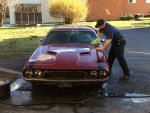
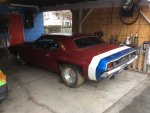
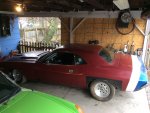
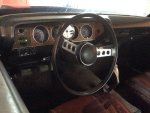
Also, thanks for the cheap cam tip. I haven't spent a dime towards the motor yet, not until I pull it apart. Also, not until the damned car rolls and stops. It starts up, and with a little work will run and idle. Any shitbox junkyard $200 motor will fit in that engine bay until a proper one is built if the 340 is crap, but the car will still happily collide with a school bus full of puppies if it can't track or stop. The way I've figured, I'll come in just at my $1000 budget with suspension, brakes bushings, and enough valve train to get this car back to it's owner long enough to make him save up to make the motor right.
For the ~$250 it would take to install the known-quantity 308 heads, the time allotment to save up for a truly batshit motor becomes a lot longer. Has it occurred to you that an ovalled valve guide could've killed the cam? It's also entirely possible that there's an ovalled lifter bore. Make sure you check before reassembly. An ovalled lifter bore will wipe out a cam in under 100 miles.
So you mentioned that the Fucked body is only 125 lb heavier than a '76 Dart. How does that compare to an early A? I think the empty weight on the 64 v8 4 door Dart 270 was 2600 lb.. I don't know what the F body was.
Weights are all over the map, depending on year, engine, etc. However, remember that by '76 an A-body got pretty porky due to the idiotic, long-rescinded '70s 5MPH bumper laws. Also, I forgot the word "Sport" after "Dart". Stone stock, a '76 Aspen V8 would've tipped the scales between 3,500-3,600lb. A friend had a /6 '75 Dart Custom (formal roof) that was in the 3,300 range, which I know is hundreds of pounds heavier than my similarly-equipped Signet, which I've not yet scaled but I'm guessing at around 2,800 (it being the lightest widebody A built).
By the way, none of this is meant to be aggressive. I just object to emoji as a form of legitimate expression.
It wasn't taken that way, nor are any of my responses meant to be as such. As far as emoticons ("emoji" sounds like a name for a depressed gay mixed-breed schnauzer), I find them useful since print provides very few means for invoking inflection or sarcasm.
As far as finding Mopar small-block heads, Nodda, all you've got to do is ask. I can't remember if I have four or five sets of J heads at the moment, some W2s, and the X castings that came with the Signet.




 There's certain to be more modern grinds that may serve you better.


