
You are using an out of date browser. It may not display this or other websites correctly.
You should upgrade or use an alternative browser.
You should upgrade or use an alternative browser.
How to replace the dash speaker in a '63 Valiant.
- Thread starter TheIronSausage
- Start date

Dr.Jass
Pastor of Muppets
The worst "reproduction" panel I've ever seen, and I saw a lot of 'em, was Sherman & Associates' mid-1990s quarter patch for, according to them, 1971-'74 Charger (never mind that there were three different panels in those four years). Body lines that didn't exist, others that crossed each other, all the while having no contour to it whatsoever, much less anywhere near the right outside dimensions. It made that floorpan look like NOS Chrysler; I joked that we'd need to expand the old YOCLASS system to at least 8 for that one. EFI Ed joked that it looked like one of those cheap tin backyard sheds got tossed against a '73 Charger by a tornado. Sherman wanted $250 for it, plus truck freight, in 1996 dollars. :doh:
For a scosche over $100 shipped for the pair, those really aren't that terrible. They're something from which you can work, anyhow.
A pair of full-length '67-'76 pans from AMD will set you back nearly five bills with the shipping, and Auto Body Specialties wants $479 plus shipping for four patches for the '62-'66 A-bodies. The A.B.S. pans are still sorta shabby-looking; it doesn't look like whomever stamped them has quite nailed the process. They're much better than what you've got there, and the price reflects it. They're also really the only option available as far as I know.
I've worked with more reproduction sheetmetal already than I'd ever planned, and I'll be working with more before I'm done. I'm not claiming to be anywhere near a Restoman-level expert, but I can say the AMD pans I bought for the Valiant were noticeably better than the Goodmark deck-filler panel and quarter panel (from both of which I only used pieces, but regardless) and the Golden Star (?) roof for the Challenger. The adage about getting what you paid for applies. Both cars suffered considerable hits to the same area (RH front) but I had the Challenger put on a frame rack to straighten it; the Valiant got no such luxury. The AMD panels still fit better; I suspect they'd be almost perfect if the car wasn't bent--and make no mistake, she's bent. It's worth mentioning that no reproduction panel I've yet seen is the same gauge as original. If OE was 14, repro will be approximately 16. 16 OE means ~18 repro, and so on. I don't think the Asian factories are using straight-up US Standard gauging for their sheetmetal, so it's not a straight variance.
For a scosche over $100 shipped for the pair, those really aren't that terrible. They're something from which you can work, anyhow.
A pair of full-length '67-'76 pans from AMD will set you back nearly five bills with the shipping, and Auto Body Specialties wants $479 plus shipping for four patches for the '62-'66 A-bodies. The A.B.S. pans are still sorta shabby-looking; it doesn't look like whomever stamped them has quite nailed the process. They're much better than what you've got there, and the price reflects it. They're also really the only option available as far as I know.
I've worked with more reproduction sheetmetal already than I'd ever planned, and I'll be working with more before I'm done. I'm not claiming to be anywhere near a Restoman-level expert, but I can say the AMD pans I bought for the Valiant were noticeably better than the Goodmark deck-filler panel and quarter panel (from both of which I only used pieces, but regardless) and the Golden Star (?) roof for the Challenger. The adage about getting what you paid for applies. Both cars suffered considerable hits to the same area (RH front) but I had the Challenger put on a frame rack to straighten it; the Valiant got no such luxury. The AMD panels still fit better; I suspect they'd be almost perfect if the car wasn't bent--and make no mistake, she's bent. It's worth mentioning that no reproduction panel I've yet seen is the same gauge as original. If OE was 14, repro will be approximately 16. 16 OE means ~18 repro, and so on. I don't think the Asian factories are using straight-up US Standard gauging for their sheetmetal, so it's not a straight variance.

restoman
The paint fumes have cleared so I'm
Most domestic car companies used lighter gauge sheet for floors, firewalls and door posts than they used on exterior panels. Sub-structures were heavier (like inner door post supports), and frame rails and crossmembers in the Chryco line usually went with 12-ish gauge sheet.
Just about everything domestic from the 50s on up used 19 gauge or lighter for exterior panels, with rapid declines in thickness around the mid-seventies. Modern cars run somewhere around 24-28 gauge for exterior panels...
Sherman & Associates... if I had a knickel for every piece of shit patch panel from them I had to install, I'd a be a fricking' gazillionare. The worst I've seen is a lower quarter panel section for an A body Mopar. Cookie cutter panel is what we used to call them...
You did a decent job on that floor, all things considered. Who cares about pein marks - that's what carpet is for!
Just about everything domestic from the 50s on up used 19 gauge or lighter for exterior panels, with rapid declines in thickness around the mid-seventies. Modern cars run somewhere around 24-28 gauge for exterior panels...
Sherman & Associates... if I had a knickel for every piece of shit patch panel from them I had to install, I'd a be a fricking' gazillionare. The worst I've seen is a lower quarter panel section for an A body Mopar. Cookie cutter panel is what we used to call them...
You did a decent job on that floor, all things considered. Who cares about pein marks - that's what carpet is for!

TheIronSausage
Two brain cells left.. rubbing together for warmth
Got the car up and running today. Interior's back in and doesn't look half bad. I guessed at the color for the vinyl on the dash pad, and the defroster vent paint was from a Challenger model I made in 2002 or so.. last half of the little can was just enough. In some light, the vents are a little dark, but that's the metallic talking. Since I mixed and matched super six manifolds, I thought it'd be more important to seal the mating surface to the head with both manifolds.. Wrong. That riser gasket farted worse than me after a pot of chili. I could fit an 18 thou feeler in between them on the inside. Loosened everything up, and tightened that center bolt first, then everything else. Runs way better, but still slow as shit. It's got a 205 75 14 (I think) tire on a 2.76 rear.. cruises great on the highway, the second barrel helps a lot there. I'm in line to pick up a 3.90 (3.91?) or so rear next Sunday. That oughta wake the car up a little. 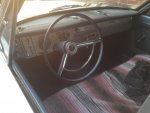
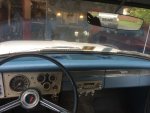
At at least now I want to drive it. It's rough staring at a dashboard that's had the rat shit torn out of it, while driving a totally gutless car sitting in a disintegrated seat.
At at least now I want to drive it. It's rough staring at a dashboard that's had the rat shit torn out of it, while driving a totally gutless car sitting in a disintegrated seat.
Last edited:

Dr.Jass
Pastor of Muppets
Well, the 3.91s should effectively kill the highway joy for you.  It'll be a lot more fun in town, though. The street rubber for my Valiant is 235R/60-15, which is almost exactly a half-inch shorter than your tire, and I'm hesitant to put a 3.55 in it outside of track use.
It'll be a lot more fun in town, though. The street rubber for my Valiant is 235R/60-15, which is almost exactly a half-inch shorter than your tire, and I'm hesitant to put a 3.55 in it outside of track use.
TheIronSausage
Two brain cells left.. rubbing together for warmth
I had 3.55s in the car when it was a small bolt 7 1/4 rear.. my tires were smaller then. It would highway, but I wouldn't have done it for any length of time. Also, I was just under the car yesterday. They're 195/70/14s with a 2.71 rear. It was originally a 3.23 car, with whatever the stock tire size was, and it was pretty happy there. I got the 3.55 axle out of the '63 170 slant donor car I had because the 3.23s had awful bearing noise, and I decided that swapping axles was easier than pressing bearings.
Dr.Jass
Pastor of Muppets
Luckily, the location of my Valiant makes it a bunch easier.You are making it hard to not work on mine.
TheIronSausage
Two brain cells left.. rubbing together for warmth
I heard that the sure grip units weren't terrible. A guy I met at the drag strip is running in the 15s with a 318 and an open 7 1/4. He bangs on it all of the time, and hasn't broken it. At any rate, that anomaly aside, he was saying that the spider gears are the ones that shred, so the sure grip units would actually hold up to a v8. Which would be nice, because my original plan was to swap the big bolt stuff from the Valiant into the Dart when I finally get around to putting my 'teener in it. If I could find a 3.23 sure grip unit, I'll just throw the Kelsey Hayes discs on the Dart and call it good.

69.5CUDA
Blah Blah Blah
i could actualy see a SG actualy maintaining life in a 7 as 9 out of 10 its the spiders that fail followed by inputshaft issues....even with a 273 i was destroying 7's..the ONLY reason i wouldnt give up on em was i was running smallbolt crager ss front and rear..but the rears were 8's with full reverse offset IE rare as hens teeth, i was handed a crazy deal on both a 8 3/4 as well as 10inch bigbolt cragger ss rear sooo..yeah i swapped it..still runnin 10inch drums up front tho
Dr.Jass
Pastor of Muppets
My '84 Fifth Avenue had a 7.25" Sure Grip, 2.26:1 ratio. That was a low-mile car, bought new and always driven by an elderly woman, and the broken gears inside that diff made so much noise that driving it around the block was a "will I make it home?" proposition. Stretch swapped the axle from my '81 LeBaron into it because my then-fiancee wrecked her Buick and needed a car post-haste. I was on a state-sponsored vacation so I couldn't do it. The 7.25" went into the LeBaron so I could still move it, and it nearly didn't make the trip from the back side of the garage around to the front to put it inside. Post-mortem showed a complete internal failure in terms of gears.
I don't know if there's a difference between the '65 Sure Grip and the later units, but that one was garbage with less than six digits on it. A friend's younger brother killed the original open 7.25" in his '75 Dart with its stone-stock 1-barrel Pisa power. :huh:
I don't know if there's a difference between the '65 Sure Grip and the later units, but that one was garbage with less than six digits on it. A friend's younger brother killed the original open 7.25" in his '75 Dart with its stone-stock 1-barrel Pisa power. :huh:
restoman
The paint fumes have cleared so I'm
I had a '72 Duster, buzzin' half dozen, three on the floor (originally column) with a 7.25 axle. I pounded on that thing as much as any other 17 year old kid could and the rear didn't break. There was a ton of play in the pinion though...
It lived through a ton of WOT clutch dumps. I had no idea how hard it is to light them up on a slant six... The transmission protested the only way it could: by spewing it's internals all over the Commercial Equipment parking lot. It was fun while it lasted.
It lived through a ton of WOT clutch dumps. I had no idea how hard it is to light them up on a slant six... The transmission protested the only way it could: by spewing it's internals all over the Commercial Equipment parking lot. It was fun while it lasted.
restoman
The paint fumes have cleared so I'm
Me too. Now.I prefer not trying to break things. :liar:
But 17 year old me didn't really give a shit. If it broke, there were many more like it available for just a few bucks or a trade.
The growing nose thing really isn't necessary...


68R/T
I got drunk and swallowed my teeth, now
But 17 year old me didn't really give a shit.
But every time I start it up & throw it in 1st gear, I'm 17 again. :giggedy:
TheIronSausage
Two brain cells left.. rubbing together for warmth
But every time I start it up & throw it in 1st gear, I'm 17 again. :giggedy:
Which is why I'll never own a modern car as long as there's fossil fuels to be burned. I don't care how noisy, slow, impractical, inefficient, or broken down my vehicles are, they always make me smile. It's my brain's happy place. I'm in a piece of machinery that's too loud to have a phone conversation in. They all make sounds and smells. I have to listen and pay attention to them. Even on the three mile drive to work, I wouldn't trade any of them for the nicest, newest car. Too sterile, too boring. Nothing makes me happier than driving an anachronism.
Every. Time.
Last edited:
Dr.Jass
Pastor of Muppets
For 68 it is. The last two times Stretch and I visited, he did his damnedest to break two very lovely '68 Coronets. He didn't, but not for lack of trying. :dance:The growing nose thing really isn't necessary...
I absolutely, unequivocally agree with TheMagnetMolester. I'd much rather drive something old every day, and when I could I always did. Way back in the married days, we had a relatively new Olds Delta 88, which was absolutely "the wife's car" or "family car" if you prefer. I had an '81 Mirada, and those were the early days of The Black Bitch (when it still had a 2-billion mile 400 in it), which I longed desperately to drive daily. Finances didn't allow it.
TheIronSausage
Two brain cells left.. rubbing together for warmth
Since it's the same car, I thought I'd throw this here. I've swapped the complete suspension and disc brake setup from a '73 Dart into this car. It's a non power boosted master, big bolt discs, and 8.25 rear with 10" drums. I made all new hard lines and replaced all the rubber hoses in the system. I bought a new proportioning block from Inline Tube.. ''twas not cheap. I'm running ATE 200 gold fluid (DOT 4, not DOT 5 silly-cone. Stoopid gov't, can't buy the blue anymore). At any rate, the pedal sucks. It stops hard and fast every time, but my foot travels through 60% of it. It honestly feels like power brakes. I'd accept that feeling on a boosted car, but I expect a rock hard pedal with no travel on this one. I've bled it time and again. I've bled the master, I've bled the block, and I've bled all the wheels. The pedal never pumps up, it just travels a country mile before doing anything useful. There's no leaks, there's no fluid weeping anywhere, and the drums are adjusted correctly. I double checked the line routing tonight, the small reservoir is plumbed to the back of the proportioning block. The outlet for the rear brakes is also at the back. That's right... right? I'm using 3/16" line out of both circuits of the master cylinder. I had to get an adapter for both the front and rear fittings at the master. Is it really possible that I need to run bigger tubes to the proportioning block? I just checked my Fury (front disc car) and it's got the small tubes to the block as well. Which makes me think the different fittings to the master are there to keep idiots from reversing them upon replacement.
I thoroughly detest the feeling of this brake pedal. On the other hand this would be the first American, dual circuit, non boosted, disc car I've ever owned. Is this par for the course? I just replaced the master tonight. I got a non boosted disc brake master for a '73 Dart. The pedal still sucks rocks. Hence the novella above.
Questions? Comments? Criticisms?
I thoroughly detest the feeling of this brake pedal. On the other hand this would be the first American, dual circuit, non boosted, disc car I've ever owned. Is this par for the course? I just replaced the master tonight. I got a non boosted disc brake master for a '73 Dart. The pedal still sucks rocks. Hence the novella above.
Questions? Comments? Criticisms?
68R/T
I got drunk and swallowed my teeth, now
It sounds like your actuating rod might be too short. OR, some later models incorporated a bellcrank attached to the pedal, like so;
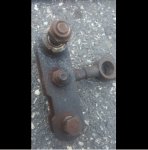
By accelerating the speed of pedal travel it travels less distance to actuate, and the needed effort increases accordingly. The size of the lines won't change anything. You're only moving a certain volume of fluid, regardless. Your master may be too small for your application. :huh:
By accelerating the speed of pedal travel it travels less distance to actuate, and the needed effort increases accordingly. The size of the lines won't change anything. You're only moving a certain volume of fluid, regardless. Your master may be too small for your application. :huh: