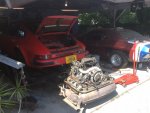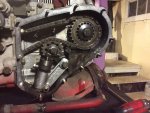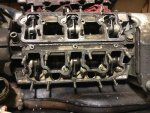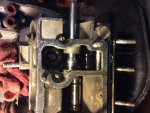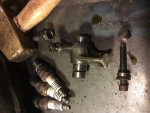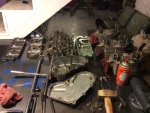
An expensive Beetle broke itself in my shop..

TheIronSausage

Two brain cells left.. rubbing together for warmth
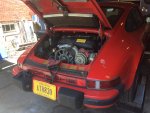
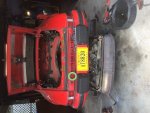
I had a customer bring me his '82 911 SC for a "shaky" oil temp gauge needle, of all things. I've fiddled with this car for about five years, and the owner largely neglects it. He keeps it in the public parking garage downtown except for the spring time. Then he pulls it out, drives it two or three times, and parks it in the grass in his backyard uncovered for the summer. As such, when he brings it to me, I put actual miles on it because it needs to be driven. He's fine with this, and is happy it's in decent hands.

The oil temp gauge is fine. However, the car had no third gear. I investigate, and find a totally disintegrated shifter bushing in the linkage right at the rear of the tunnel. After replacing that, I happened to notice that the engine didn't have the guts that I'd become accustomed to. 200ish BHP in a car with about a 2500 lb curb weight isn't fast, but it's about as quick as you could reasonably want on the street in a sports car. I looked into that, and found that the throttle linkage was only opening the plate just over halfway. Readjusted, and things felt better. A week goes by with me putting a solid hour or so of country driving on it almost every night. The last time I drove it I heard a faint feathering sound from the motor as I brought it back, but chalked it up to air cooled clatter and went inside.

I started it up the next morning, and it sounded like the guts of that motor were clawing their way out of it. I shut it off immediately. I then made a gut wrenching phone call to the owner to basically describe what sounded like rod knock in a motor where a new crankshaft costs $8k. There was other terrible clatter, so it was hard to tell. I wasn't going to run the thing long enough to diagnose it, because if it was the timing chain guides that went, it could bend a valve.. rod knock, new crank, etc.

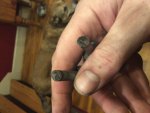
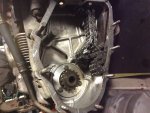
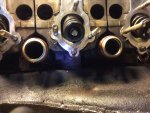
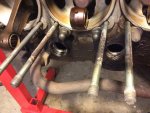
I started digging into it today, and found theseIMG_1622.JPG
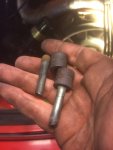
It's possible that 69.5 recognizes those, and knows how much work it entails. For everybody else, those are broken head studs. If you guys take a minute and do an image search for a disassembled 911 motor, you'll see nightmare fuel. 911 motors are split vertically, and longitudinally down the case. Each "head" bolts to the sides of that case individually with studs. Half of the motor (and head studs) is inside the car, and half is under. The head studs on the top, or intake side are made of steel. The studs on the bottom, or exhaust side are made of some proprietary German metallurgy. In short, they're known for breaking on low mileage cars that are exposed to sitting in the elements. Dropping a motor out the back takes about two hours or less if you've done it before, and there's several procedures that require this. R&Ring six cylinder heads bills about 22 hours of labor. That's not parts, broken stud removal, valve job, special tools, or replacing anything else on the engine while it's out.

To sum up, I'm relieved. As much as it sucks for this guy to have to shell out around $5k for a top end rebuild, it's a load off of my mind. As soon as I heard the noise, I was trying to decide what I'd have to sell off to rebuild this guy's motor to make it right. A 911 motor can cost about $8-9k if you do it yourself, and don't need a new crank. I drive the car (and all others) vigorously. I swore that I was hearing rod knock because I had been putting the thing through it's paces the day before. I even pulled the oil filter and dumped it only to find glitter in it. Turns out that I'd previously used that pan to catch the oil from my '63 slant with actual rod knock. The Porsche oil churned up the bearing material I hadn't thought to clean out in my nervousness. That was right before I called him. Code Brown. Turns out that thermal expansion was the reason for the feathering sound after the drive, and the rocks in a bucket sound the next morning. It was combustion escaping the cylinders, also the sharp knocking sound may have been the number six cylinder head contacting the case as the piston in it retracted.

Ultimately, this means it's not directly my fault.

Whew.

but now I have to make another shitty phone call
 
Last edited:
I think we should all pitch in and buy you some new underpants. Also, I'm guessing you've got materials for a new retaining wall with the bricks you must've shit thus far.
 
IMG_3930.JPG

The real relief came when I saw the sheared ends. Those aren't fresh. Have I made a problem worse? Possibly/likely. Was I the cause of the problem? No. Sometimes that's the best possible outcome.
 
those have clearly been breaking slowly over time with only the smallest bit potentialy "fresh-ish" that said tho..i question how many more are close to going that are neerby
 
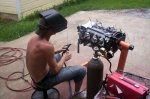
I've got an '81 Targa coming in soon. I'm real tempted to pull his lower covers and check the studs. Better to catch it now than when the head's slapping against the cylinder. It sucks, I don't think this guy's going to fix it. What's worse is that if I get in there and find he's got Alumasil linings instead of Nicasil, Any cylinder I have to touch will need to be replaced. The alumasil is a one time use cylinder.. a set of 6 new Nicasil cylinders runs about $3k. These cars are weird. They're so expensive to fix, and yet half of the forum photos of work being done to them is of some shirtless barefoot dude banging on a block with a hammer in his backyard. 911 owners seem so nonchalant about it. They toss around words like "rebuild" as easily as MG owners waffle about proper thread pitch.1271262782524.jpg

If that were a Chevy 350 and a stick welder in front of him, it'd make sense. That lump of metal is worth up to 10k in parts
 
Last edited:
69, those were just from the passenger side. I haven't looked in the driver's side yet. If there's one, the motor's coming out and they all get replaced. I'm pretty sure he needs the pressure fed Carrera timing tensioners as well. There's a lot of "while you're in there" jobs on these things. I talked to the owner today, he's pretty cool about the whole thing. The guy's probably mid sixties and looks just like Joe from Resevoir Dogs "motherfucker looks just like The Thing". At any rate, he said "I was going to fuck with you about breaking my car, but you sound too serious. I'd feel bad about it". I gave him a figure of around $2500 on the cheapest end, and said it could become a full rebuild. I also explained that I'd feel really bad about giving him a bill for a bunch of labor just to find out his slightly better than beater 911 needed a new motor, and he didn't want to spend the coin for the rebuild. I told him I'd be happy to find out what his car's worth in this condition locally if he wanted to go that route before getting upside down in it. There's a pretty good D.C. P-car forum here called Dorkiphus, they've got a several hundred page thread of their track day failures. These guys would certainly buy a mildly neglected 911 with motor issues. I said to think about it and call me. If he wants me to get into it, I'll do a thread on it if you guys are interested. These motors are brilliantly overengineered, and fail constantly because of it. The closest thing I can compare this kind of dedication to is Subaru Outbacks. "Subarus are so reliable! All I have to do is pay somebody to pull my engine out, replace the head gaskets, and redo the top end when they do the timing belt!" "911 bottom ends and G50 gearboxes never fail! It's the rest of the engine that does! TAKE MY MONEY!"
 
Last edited:
oh yes those one time use internals are always fun..some of the 944s used em too as did some of the mid 80s honda dirtbikes...WTF makes an engineer think thats ok on a dirt bike?!?!?!?!?

on the alfas and most bikes there always seems to be an agrument about presure fed vs manual ....i know the alfa guys swear against the preasure one for the most part and the bike guys swear by manual..its the funniest thing

i wouldnt mind a thread..i suspect everyone could use the entertainment
 
I always enjoy watching someone else work. It's one of the rare pleasures that I never had in my younger days..:shifty:
 
I would be all for a thread on the build if the guy goes for it.
 
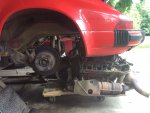
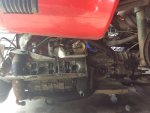
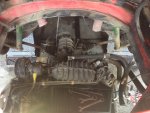
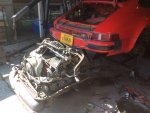
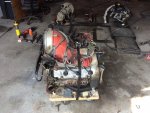
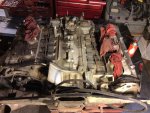
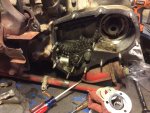
Okay.. update. I got the motor out. It's super easy. Disconnect the shifter linkage, cruise control, fuel lines, evap hoses, throttle linkage, move the AC compressor out of the way, disconnect three wiring harnesses, disconnect two big oil return hoses, undo the half shafts at the gear box, remove the starter wire, remove the clutch linkage, pull the lower rear valance panel and bumper overriders. After removing four mounting bolts, an overpriced German car poops out a marvel of enginerding on the floor.
IMG_3939.JPGIMG_3950.JPGIMG_3952.JPGIMG_3953.JPGIMG_3954.JPGIMG_3955.JPGIMG_3956.JPG

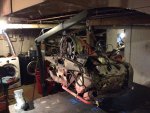
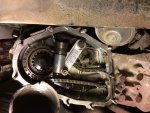
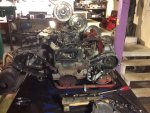
Then I ran into a problem. The original plan was to pull the gearbox off, and get the motor into my basement where I can rebuild it. I've got a eight foot long piece of 1" thick, eight ply plywood I use as a ramp through the cellar door. Turn out that my cellar door is 32" wide, and the motor is at least 34" wide any way I can measure it with the exhaust on. The exhaust bolts on bottom of the engine, and is wider than the engine itself in all directions. Whereas a front engine, rwd setup has the entire length of the car for manifolds, shrouds, converters, mufflers and tailpipes, 911s sort of wrap the entire system around the motor. Meaning that I have to drop the exhaust. Which would have been easier in the car. No matter, I just have to pull a work bench up topside, set the unit on it, pull the gearbox, hang part of the engine over the side of the bench, heat up the exhaust hardware with a torch, remove one side, slide the other half over and do the other. Aluminum cylinder heads and steel studs/nuts that hang out over wet pavement and the elements tend to be difficult. So, after about eight hours of backyard engineering, I should be able to get the motor downstairs..

Stay tuned
 
When we deal with exhaust studs in aluminum heads up here in rust country we cut all the stud nuts (or heads if they are bolts) off flush with the manifold, slide the manifolds off of the cut studs then grab the stud at the head with vice grips, they almost always come right out with minimal effort & stress. The suborn ones get heated up just enough to melt bees wax. The wax gets drawn into the threads much like solder when sweating pipes together. The bees wax frees up the stud (don't ask me how, it's just one of natures many wonders) and they come right out. If you use the bees wax trick, it will take a few application of heat and wax. You are likely going to get the part way to hot the first few times you try. The wax doesn't take much to melt. You must use bees wax. Parafin wax will not work. You can thank me later.
 
yup they bottom drop in a full craddle..flew down to reno to do that job only to be laid up due to not all the parts was given a sweet fetta to drive home and keep, later my friend got lost to cancer a year later i had to go retrieve the car and parts, some day ill have the funds to put it back together since someone STOLE the service kit after he died..i actually have the receipt for the parts too
 
Okay.. long overdue update.. get a glass, and plant your ass.

I figured out that that by removing (cutting) the bolts for the muffler, the motor would slide down my stairs sidewards. I could then disassemble my stupidly massive and heavy cherry picker, take it downstairs, and reassemble it. I pulled off all of the fuel injection/intake parts, as well as the fan and shroud, leaving me with a mostly bare case78147B34-A47B-4919-A55A-57201747C3E5.jpegE6F6F6E3-698F-4570-86DD-C5BE777C88C1.jpeg4A9FB371-D290-46A7-8ACF-C4B379CD3511.jpeg

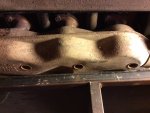
Half of the exhaust studs are accessible with a normal socket and extension. Half are accessed through the heat shroud covering the exhaust manifolds, and are an Allen headed barrel nut. Due to German engineering, only the skinniest of Allen head sockets will fit through said shroud. Due to rust, half of them stripped out even after being soaked in Kroil for days before hand (no access for beeswax) and hit with the torch. 873F4984-B5A0-4367-BE47-0C1A12CAAC27.jpeg

I eventually had had to remove the entire valvetrain just to get at three of the stubborn barrel nuts with a torch and vise grips. This involves pulling the chain covers, sprockets, tensioners, guides, timing seals, timing chain housings, valve covers, weird little rocker arms, cams, and the camshaft housings. D4F366BF-8B14-4847-AE65-B273EF92AC18.jpeg5C785F58-3019-49C0-A277-059CD2CDFFC0.jpeg37CA6848-39E6-48C2-B47C-841AEAEAA92A.jpeg1ABBAC72-7143-4AE9-B544-02895DC37FD6.jpegC0F989BC-BA60-4ACA-91BF-23873D2F640B.jpeg147B6F03-2881-4871-B310-8F47F6F182EB.jpeg

The rocker arms are accessed through each cam cover by two allen wrenches/sockets. They are kept in their bores by the amount of expansion provided by tightening the wrist pins that they float on. The last photo shows the bolt and tapered (washers? Bushings? Caps?) that goes through the wrist pins. You access each cylinder through the cylinder before it, so extensions are needed.
 
AF4DEA7F-4BF1-4DB5-B721-A870832193A0.jpeg510B8E96-4827-4D92-97DB-FD60375250F4.jpeg7BC603EF-DD76-4A5E-A6D8-92B6D39EA9E9.jpeg011EBF53-ADC9-4C08-BEB8-1FC02F54BCF1.jpeg

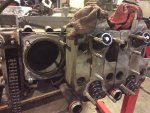
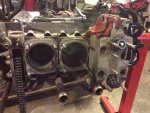
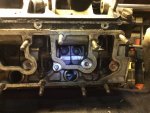
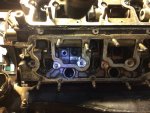
Above are shots of the timing housing disassembly, and the shiny spots under the flashlight are where the broken head studs used to be. Following are pics of the motor with the cam covers off, and the cylinder heads being removed. The second shot shows the motherluvin barrel bolt just down left of the valve spring and to the right of the oil return tube. 6C05B271-3B68-4B20-8F6A-DAB7B6DC3E27.jpeg8DED52FD-7439-45A3-B1B0-69BCCECAF740.jpeg5C91DE83-9D33-45C6-A65B-4D70795F257E.jpegA3BC0A13-8A15-4B3D-8E75-37C1CFDD9B27.jpeg03EFD977-3348-4D33-B75D-CC805EE86DFB.jpeg
 

Attachments

  • 35C987B7-86B1-4DF6-92D5-E9961056667A.jpeg
    35C987B7-86B1-4DF6-92D5-E9961056667A.jpeg
    1.1 MB · Views: 19
Last edited:
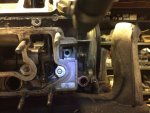
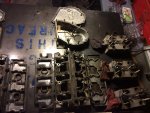
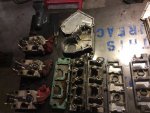
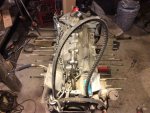
Here’s the entire upper end of the engine on my bench. 43C22730-1147-4768-9A62-E7FD911950FE.jpegB34A5DA3-EA1F-426B-BFAA-E820429C1D9D.jpeg

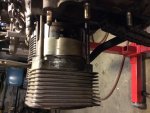
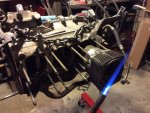
Which brings me to the hard part. This engine has Alusil cylinders. There was a crapshoot as to which cylinders I’d find in here. Nikasil cylinders are essentially a hard cylinder wall with a soft piston and rings. Alusil cylinders are sort of the opposite. They’re a 78% or so aluminum makeup, with the rest being a silicone carbide mix that when cooled after casting correctly, form silicone carbide platelets at the surface creating a lightweight, tough surface that’s also slick. Sounds all well and good. The problem is that any normal hone with a stone, be it the three armed, or dingleball type will grab the platelets and tear them out of the surface, rendering the cylinder useless. Dr. Spock’s idiots guide to rebuilding 911 motors suggests that it’s possible to pull the wristpins out of the pistons, and remove the cylinders with the pistons in situ so as not to disturb the rings. This is only applicable to lower mileage motors with known good bottom ends. If the cylinders are out of spec, scored, or the rings disturbed, the only surefire cure is a new set of Nikasil cylinders, pistons, and rings to the tune of over $4k. The book suggested using “a bent screwdriver” to hook and pull the wristpins, because apparently once you pull the retaining clips, the wristpins are only a snug fit. Bullshit. I had to use a Mapp torch on the skirts of every one of those bastards to get them to let go. Due to the effort and mild violence required to pull the wrist pins, I got an oil ring out of two cylinders, and broke one of them in two. I also scored a wrist pin bushing or two in the process with the “bent screwdriver”, so I get to replace those as well. The screwdriver left a visible mark, but nothing I could feel or catch a nail on. No matter, I don’t want to go in again later to fix it.72E93576-E1E6-477A-AD58-23FC41813917.jpegB64D5746-8791-4E03-9632-72BACB10FD9B.jpegC90825B0-CAE0-4B17-8C15-6445149659F5.jpegB3ADBEDF-4CB5-4567-BA2A-D4385EDF3E6D.jpeg

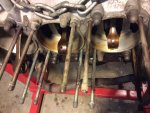
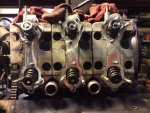
You can see the difference in the upper and lower head studs here, and two pics up. Check out the corrosion on the lower studs.
C5EA8552-2CD6-4017-A930-C94FB71298CE.jpeg
 
Last edited:
SiteLock

SiteLock
Back
Top