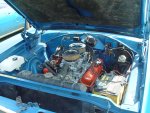
That's the color I think Sausage means. I'm well familiar with it, but in my case it seems to be the exception rather than the rule. You say "almost NOS" except it's been run, a lot, in 49 years of existence. It could be original, or it could be faded from what was originally brighter red. It's obviously not as vivid as what's on my 340 parts (which are freshly painted with the IH red). That's the problem when working with half-century-old paint that's been exposed to different conditions that could fade it.
Another thing worth considering is the nature of red pigment. First and foremost, it's the most expensive paint pigment. We're talking the production world, where every penny counts. Call an automotive paint store and ask the prices of a gallon of W1 white and E5 red. The red's probably close to twice as much money. Figure the percent difference and multiply that times a few thousand gallons. Did a paint supplier maybe leave out some red pigment in order to make their contract with Chrysler more profitable? Entirely possible, and it would not surprise me in the least. The other mitigating factor is red's susceptibility to fade. If you're familiar, the expensive "restoration correct" Hemi orange paint sold by some suppliers is slightly more red than what comes out of the Dupli-Color "Chrysler Orange" (their name for Street Hemi orange) can. The air-cleaner orange is redder yet. Why? Because those hypersensitive pricks used extremely low-mile (or in the case of the air-cleaner red, NOS) parts as samples to get their formulae, where Dupli-Color (and others) just used original samples that may have been million-mile desert junkyard parts. The truth of the matter is that there was no such thing as "engine paint" during that time, other than the color itself. There was no special formulation for what got sprayed on a '66 318 block as opposed to what got sprayed on the car's body... it was just a different color. No one cared how well the engine paint endured; it had to look good on the lot and it was going to be oily and covered in grime in a few thousand miles anyhow. No consideration was given to things like colorfastness or adhesion (the latter being nicely illustrated by 68R/T's valve covers, which are pretty typical) so long as the parts weren't rusty on the lot.
Obviously, all of this makes for a good discussion but does nothing to solve SausageFest's dilemma. It's not about correct so much as it is matching what he's got. In that case, the only real solution is to have paint custom-mixed. Any decent automotive paint supplier is going to have a "color camera" that can pull a formula that will be very close to what's on your engines. Get the widest, flattest area you can--probably a valve cover--on which the camera can sit. You could either get it in a pint or quart, or if you want to spend long green, have it made in rattle cans (they're about $25 each here). Expensive? Sorta, but how much are you gonna blow on rattle cans for multiple engine resprays?
You could also try Dupli-Color's Chevrolet Orange-Red (DE1607) to see how close it is. Don't go just by cap color or the online samples, as the color justification of both is off by a mile. Paint is a totally different animal than plastic or pixels.
Ray Barton Racing engines used to spray all their Hemis with Chevy orange because it was less expensive, and "no one notices or cares" in the go-fast world. :dance: