dont mind me while i bang my head on table

dodgedifferent2

hung like a stud field mouse and
So i drove the dart up to the "pizza man" (weekly thing with my daughter for the last 6 years) its 4 miles one way

we ate our pizza within the hour and we went back out to the car that would not start

i happened to have the timing light in the car .. so i know i had spark

The engine would spin i played with the carb and i could get fuel to squirt out of the accelerator nozzles but it seemed like the fuel would evaporate (white colored smoke) came out of the top of the carbs. I didnt think the engine was hot

any idea what is the problem now? or do i keep fiddling. Almost tempted to bolt on a 4 barrel till i know everything is working better :hmmm:
 
sounds like you may have flooded it.....or....it perkolated the fuel in the carbs and flooded itself
 
A common issue with today's fuel being used in yesterdays carburetors. Ethanol is alcohol and evaporates readily when heated even the slightest bit, Plus the fact that tetraethyl lead, which that carb was designed to use, helped, somewhat to stabilize the fuel. Also, considering the ambient temps of late, I'd bet yesterdays underwear that you had what's known as vapor lock. :toot:

Manually holding the choke baffle shut probably would have started it. To help prevent future issues, always use a good, insulator type, carb gasket. They are available from most auto supplies, though they may need to search a little to find it. Also, wrapping the fuel line with some type of insulator helps. As a last resort, an electric fuel pump is a sure cure. Just allow it to run long enough to pressurize the system. :cool:
 
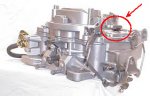
The most commonly used Mopar carb during the muscle era was the Carter AVS. And for some unknown reason they fealt that it needed a bowl vent to be opened during non-operational times.

Bowl vent shown here;

avs.jpg

With a little tweaking this can be modified so that it never opens, preventing evaporation of the fuel while sitting. Most of us are well aware of the long cranking times to get these things going after sitting even as short as overnight. :mad:

Other brands/models of carbs may also have something similar, look it over closely and tweak it as needed. :cool:
 
i grabbed some fuel line heat sheild stuff today and wrapped up three feet of fuel line from carbs down to fuel filter.
Then got to working on the gauges so i can get temp and fuel level working.
At the moment the fuel tank is filled with farm fuel. So next time i get some gas i am planning to get the highest octane i can get at the local macs milk which i believe is petro canada fuel.

some time next week i should be able to get a chance to give dartie another run.
 
i grabbed some fuel line heat sheild stuff today and wrapped up three feet of fuel line from carbs down to fuel filter.
Then got to working on the gauges so i can get temp and fuel level working.
At the moment the fuel tank is filled with farm fuel. So next time i get some gas i am planning to get the highest octane i can get at the local macs milk which i believe is petro canada fuel.

some time next week i should be able to get a chance to give dartie another run.

PetroCan fuel has ethanol. Even the premium.

Shell, Esso, or Crappy Tire all have ethanol free gas if you get the top shelf stuff.
 
The most commonly used Mopar carb during the muscle era was the Carter AVS. And for some unknown reason they fealt that it needed a bowl vent to be opened during non-operational times.

Bowl vent shown here;

View attachment 17390

With a little tweaking this can be modified so that it never opens, preventing evaporation of the fuel while sitting. Most of us are well aware of the long cranking times to get these things going after sitting even as short as overnight. :mad:

Other brands/models of carbs may also have something similar, look it over closely and tweak it as needed. :cool:

i want to do that!!
 
Six Pack carbs have a bowl vent, which should keep the carb from vapor locking when parked. However, ethanol-free or not, today's fuel is garbage compared to years past. You simply cannot get good ol' gasoline anymore; today's unleaded is a mad-scientist potion of additives (reformulations) to reduce emissions whether it has ethanol in it or not.

I've said it time and again, use an ethanol-elimination additive marked "Marine" all the time. I prefer Marine Sta-Bil, based on actual customer experience. Stretch likes Star-brite, but I'm not sure if that's marine-rated or not. There are tons of carbureted boats out there, and they react particularly badly to today's fuels, as do small engines. The golf course where I used to work runs nothing but the Sta-Bil and downtime due to fuel-system issues has been decreased by 75% or more (almost 100% on two-stroke weed whackers).

If you are not using a choke, or are using a carb with an electric choke, block the heat crossover in the intake manifold. Even an aluminum intake will hold heat under the carburetor for a very long time; obviously cast iron is much worse.

An electric fuel pump is only truly effective against vapor lock in a return-type system and works best with a bypass. Simply put, your fuel system goes: tank (with strainer), pump, filter, carb(s), regulator, return line. Don't use one of those shitty "dial-a-pressure" regulators; the failure rate on them is about 99.7% in my experience selling them. Your standard Holley (or copy) three-port is the best option. It's best to mount it higher than the carb inlets, but it's not necessary. After the fuel line has fed the carb(s), you want to run it to the inlet of the regulator, which is generally on the bottom. On one output, mount a gauge for adjusting your fuel pressure--no more than 5 on a Carter/Edeljunk and no more than 7 on a Holley (I use 4.5 and 5 respectively with excellent results). The gauge should dead-head that port; no fuel should flow past it.

On the other output, you want to put a fitting for a return line to the tank, but you must modify the fitting first. You want to know what size your needle and seat openings are, and how many of them you have. On a Holley, let's assume you have a .110" opening on the center carb... it matters; you need to know what's in there. Since the Six Pack setup only uses 1 needle valve about 90% of the time, you only need to be a little smaller than the valve diameter; in this case I'd say ~.090"-.100" would be good.

Have a multiple-needle carb, like a ThermoQuad, that uses both float bowls all the time? Now you have to do some math. Let's assume the same needle valve opening (again, you need to chec this). Calculate the area of the opening, which is done with the equation 3.1416 x radius x radius, in this case the radius being .055". That gives us .0095 square inches, and since we have two of them the total area of both is then 2 x .0095"², or .0190"². Now, you need to reverse-engineer that into a slightly-smaller opening than both valves. Easy enough to do: Divide .0190 by 3.1416 and you get .006048. Find the square root of that (you're gonna want a calculator with that key on it), which is .0778. That's your radius, so multiply by two to get a metered diameter of .1556. Remember, though, we want to be a little smaller, so you'll want a drill size probably in the range of .140"-.150".

Now that you know what size you need--assuming a .110" needle-valve opening--make your return fitting by finding a hose barb or inverted-flare seat (depending on how you plan to hook up the return line) that will fit in the remaining output port of the regulator. Before you install it, though, fill it with solder so that it's now a plug. Then take a drill bit of the appropriate size, which may require a pin vise, and drill your metered orifice. Clean it out well, install it in the regulator and connect it to your return line.

The reason you want a smaller metered orifice is so that the fuel will be more likely to flow into the carbs than back to the tank when the float(s) opens. The rest of the time, the fuel recirculates to the tank. There is more than one benefit to this, the first being that your pump doesn't work as hard pushing against a closed valve. Expect increased pump life, and in the case of a "screaming Mimi" Holley electric expect it to be maybe half as loud if not less. Another advantage is that you always have fresh, cooler fuel at the needle valve... and cooler fuel doesn't evaporate as easily. Oh, yeah, under full throttle it also makes more power by helping cool the intake charge. Pressurized fuel won't evaporate in the lines, either, which is why an electric pump mounted near the tank is recommended, preferably at or below the level of the bottom of the tank. Recirculated fuel flowing into an open area of the tank is also more likely to let the refined-in contaminants evaporate out (ethanol, for example). The car will start more quickly, too, since the float bowls will be filled within a second or two of turning the key to IGN ON, probably by the time you get to the START position. You will always have solid fuel in the lines--by design this system will push vapor through the system initially and not allow for any more in there.

Don't have a return line on your car? Install one. If there's nowhere to put on on the tank, you can install one in the filler neck pretty easily with a piece of metal brake line, a drill, a punch, and either solder or J-B Weld (remove the filler neck for this process).

This sounds like a lot of work, but it's the most-effective way to get absolutely reliable performance with crap fuel on a carbureted engine. The best additive in the world won't solve it alone. The math seems kinda difficult written out, but if you can calculate the displacement of an engine you've already done it. It's the calculation for volume of one cylinder, but you leave out the stroke part of the equation: πr² (pi times the radius times the radius) of your needle valve's opening(s). Multiply the result by the number of openings, then divide the result by pi, square-root the number you get and that's your radius. Multiply that times two and you have the single-opening size equivalent to your fuel inlets. Subract about .005"-.020" and there's your drill size--shoot for a number that's easily found.

I've typed this out at least three times now, but no one ever seems to actually do it. Want it fixed? Do it.

By the way, Petro is notorious in the U.S. for having absolute shit fuel, particularly their diesel--which is their stock in trade. Think about that.

 
Totally inaccurate site. Submissions are made by station employees and no testing is done to assure they're telling the truth. Several area Citgos are listed, and they haven't been Citgos in over a year--not that the fuel was ethanol (or water, for that matter) free at any point in history. The owner is legendary for shenanigans, including pumps that give you about 3.5 quarts rather than a gallon--he actually got busted for that in Michigan, but continues to do it in WI.

There's only one fuel station in this area that actually sells ethanol-free fuel despite multiple ones being listed. Fuel at that station is considerably more expensive than anywhere else (Cenex, listed in Florence, WI but actually located in Spread Eagle). Their 87 is higher than most places' premium.
 
In canada there is a law that all gas has to have 5% ethanol in the mix. So good luck getting away from Ethanol.
Also Canadian tire buys there gas from one of the major refineries that supplies petro canada, esso, shell and etc. Cheapest one gets the contract. Drive around the sarnia refineries and watch where the fuel trucks pull out of. Their placards with fuel are 1203 and diesel is 1202.
I have seen the petro canada truck pull out of the Esso refinery loaded.
So in all honesty the pure gas chart and anyone else that tells you there is no ethanol in so and so's fuel is full of shit!
 
Last edited:
Seems this is a pretty hot topic. I found this. Going to do more digging.

"The mandated 5% ethanol in fuel is averaged over all grades at stations to make them comply so they add a bit more of this rotting crap in the low grade fuels so the premium will remain uneffected yet also tempting the consumer to go for the extra 12-15 cents per litre to get it. Smart marketing, rotten conscience builder....


In case you care to know or didn't know, these are official responses from Shell, Ultramar and Petro Canada


Shell Response: Shell V-Power Premium (91 Octane) is Ethanol Free across Canada.
Ultramar Response: Ultramar does not add any ethanol to the "supreme" gasoline throughout it's network of stations from Ontario to Labrador.
Petro Canada Response: All grades of fuel sold at Petro-Canada contain up to 10% ethanol.
Canadian Tire Response: there is no ethanol in premium fuel.
Esso Response : Our premium unleaded gasoline does not contain ethanol. "
 
Here is the law that explains the averaging. http://www.e-laws.gov.on.ca/html/regs/english/elaws_regs_050535_e.htm

So, there is a good chance they are not lying when they say No Ethanol.
they do seem to have an out clause though because at least Shell adds in a "Where available" to their statement, which means they could swap in ethanol blended fuel if they run short on non-ethanol blended fuel.

I saw a comment about where the ethanol gets blended in - as in "does it happen at the refinery or somewhere else, or what?"

Not sure the answer but it bring to mind the idea that one truck fills all three grades of gas at a station and how some think it's all the same stuff. I don't believe that. And I do know that the station is doing the blending. That's not what I'm saying..
 

SiteLock

SiteLock
Back
Top