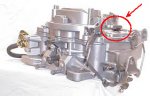
Six Pack carbs have a bowl vent, which should keep the carb from vapor locking when parked. However, ethanol-free or not, today's fuel is garbage compared to years past. You simply cannot get good ol' gasoline anymore; today's unleaded is a mad-scientist potion of additives (reformulations) to reduce emissions whether it has ethanol in it or not.
I've said it time and again, use an ethanol-elimination additive marked "Marine" all the time. I prefer Marine Sta-Bil, based on actual customer experience. Stretch likes Star-brite, but I'm not sure if that's marine-rated or not. There are tons of carbureted boats out there, and they react particularly badly to today's fuels, as do small engines. The golf course where I used to work runs nothing but the Sta-Bil and downtime due to fuel-system issues has been decreased by 75% or more (almost 100% on two-stroke weed whackers).
If you are not using a choke, or are using a carb with an electric choke, block the heat crossover in the intake manifold. Even an aluminum intake will hold heat under the carburetor for a very long time; obviously cast iron is much worse.
An electric fuel pump is only truly effective against vapor lock in a return-type system and works best with a bypass. Simply put, your fuel system goes: tank (with strainer), pump, filter, carb(s), regulator, return line. Don't use one of those shitty "dial-a-pressure" regulators; the failure rate on them is about 99.7% in my experience selling them. Your standard Holley (or copy) three-port is the best option. It's best to mount it higher than the carb inlets, but it's not necessary. After the fuel line has fed the carb(s), you want to run it to the inlet of the regulator, which is generally on the bottom. On one output, mount a gauge for adjusting your fuel pressure--no more than 5 on a Carter/Edeljunk and no more than 7 on a Holley (I use 4.5 and 5 respectively with excellent results). The gauge should dead-head that port; no fuel should flow past it.
On the other output, you want to put a fitting for a return line to the tank, but you must modify the fitting first. You want to know what size your needle and seat openings are, and how many of them you have. On a Holley, let's assume you have a .110" opening on the center carb... it matters; you need to know what's in there. Since the Six Pack setup only uses 1 needle valve about 90% of the time, you only need to be a little smaller than the valve diameter; in this case I'd say ~.090"-.100" would be good.
Have a multiple-needle carb, like a ThermoQuad, that uses both float bowls all the time? Now you have to do some math. Let's assume the same needle valve opening (again, you need to chec this). Calculate the area of the opening, which is done with the equation 3.1416 x radius x radius, in this case the radius being .055". That gives us .0095 square inches, and since we have two of them the total area of both is then 2 x .0095"², or .0190"². Now, you need to reverse-engineer that into a slightly-smaller opening than both valves. Easy enough to do: Divide .0190 by 3.1416 and you get .006048. Find the square root of that (you're gonna want a calculator with that key on it), which is .0778. That's your radius, so multiply by two to get a metered diameter of .1556. Remember, though, we want to be a little smaller, so you'll want a drill size probably in the range of .140"-.150".
Now that you know what size you need--assuming a .110" needle-valve opening--make your return fitting by finding a hose barb or inverted-flare seat (depending on how you plan to hook up the return line) that will fit in the remaining output port of the regulator. Before you install it, though, fill it with solder so that it's now a plug. Then take a drill bit of the appropriate size, which may require a pin vise, and drill your metered orifice. Clean it out well, install it in the regulator and connect it to your return line.
The reason you want a smaller metered orifice is so that the fuel will be more likely to flow into the carbs than back to the tank when the float(s) opens. The rest of the time, the fuel recirculates to the tank. There is more than one benefit to this, the first being that your pump doesn't work as hard pushing against a closed valve. Expect increased pump life, and in the case of a "screaming Mimi" Holley electric expect it to be maybe half as loud if not less. Another advantage is that you always have fresh, cooler fuel at the needle valve... and cooler fuel doesn't evaporate as easily. Oh, yeah, under full throttle it also makes more power by helping cool the intake charge. Pressurized fuel won't evaporate in the lines, either, which is why an electric pump mounted near the tank is recommended, preferably at or below the level of the bottom of the tank. Recirculated fuel flowing into an open area of the tank is also more likely to let the refined-in contaminants evaporate out (ethanol, for example). The car will start more quickly, too, since the float bowls will be filled within a second or two of turning the key to IGN ON, probably by the time you get to the START position. You will always have solid fuel in the lines--by design this system will push vapor through the system initially and not allow for any more in there.
Don't have a return line on your car? Install one. If there's nowhere to put on on the tank, you can install one in the filler neck pretty easily with a piece of metal brake line, a drill, a punch, and either solder or J-B Weld (remove the filler neck for this process).
This sounds like a lot of work, but it's the most-effective way to get absolutely reliable performance with crap fuel on a carbureted engine. The best additive in the world won't solve it alone. The math seems kinda difficult written out, but if you can calculate the displacement of an engine you've already done it. It's the calculation for volume of one cylinder, but you leave out the stroke part of the equation: πr² (pi times the radius times the radius) of your needle valve's opening(s). Multiply the result by the number of openings, then divide the result by pi, square-root the number you get and that's your radius. Multiply that times two and you have the single-opening size equivalent to your fuel inlets. Subract about .005"-.020" and there's your drill size--shoot for a number that's easily found.
I've typed this out at least three times now, but no one ever seems to actually do it. Want it fixed? Do it.
By the way, Petro is notorious in the U.S. for having absolute shit fuel, particularly their diesel--which is their stock in trade. Think about that.