Summer project gone awry AKA Resto's rusty ride

restoman

The paint fumes have cleared so I'm
The ride we took in the Super Beetle back on May 27 didn't go the way we wanted it to, though the end result has been not-so-uncommon with this car.
Let's just say the Bug has a fetish for flatbed tow trucks...
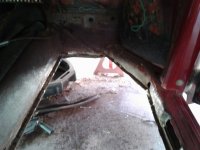
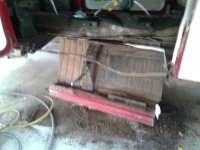
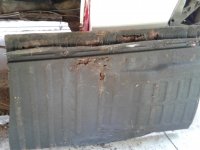
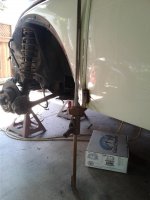
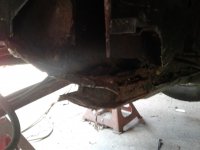
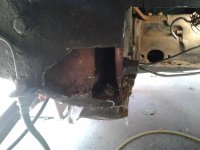
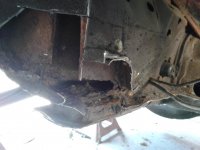
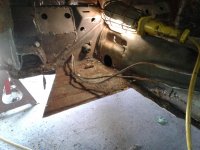
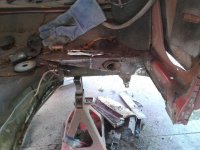
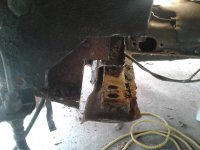
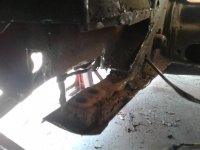
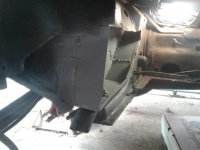
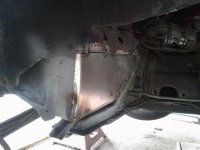
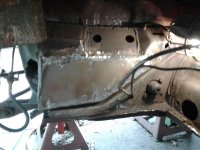
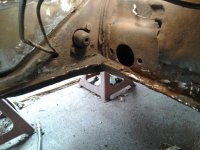
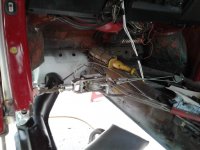
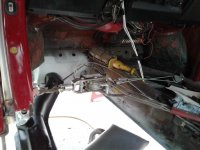
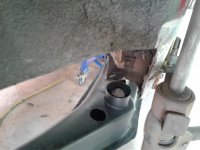
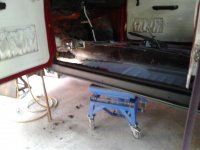
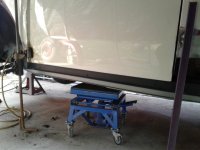
While the driver was unloading it in the driveway, I took quick peek underneath it.
My mobility isn't the greatest anymore, and getting down low enough to see a car's nether regions isn't as easy as it used to be. I took advantage of the chest-high opportunity.
!!!!!!!!
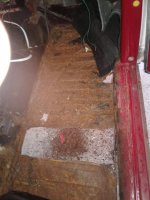
The old Girl wasn't quite as solid as it used to be. Back in '95/'96 when I re-did the car, the passenger side floor was serviceable, needing only a patch panel welded in under the battery. The driver's side floor had been swapped out sometime before we bought the beast. Even though the replacement pan half was thin steel and the wrong year, it was solid. Both left and right heater channels were good, needing only some running board- mounting nuts replaced. The front firewall was tough, as was the rear crossmember at the outer ends.
So, it was patched up, painted and we enjoyed the car since. Probably shouldn't have driven it through two winters, or let it sit outside through three more... :(
I started hacking, cutting, cursing, grinding and crying on June 15th-ish.
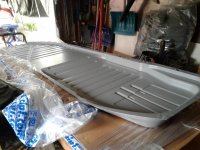
Bought some very nice, Danish-made floor pans, of the proper gauge, and year, left side Dansk (supposedly the best available) German-made heater channel, a roll of pan gasket rubber, lots of cutting discs, a new face shield and hearing protection, and away I went.
Surprisingly enough, the pan bolts on the right side all came out with little effort. Considering they were installed by Hans at the Wolfsburg Assembly Plant in 1974, I was impressed. The dunce who installed the left pan half thought it was a good idea to weld it to the heater channel, so no easy-out bolts to get excited about over there...
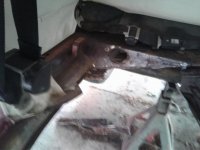
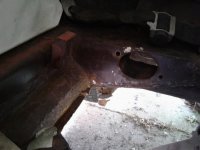
For anyone not familiar with VW Beetle construction, the floors are both bolted in, and welded in. Bolted to the heater channel and rear crossmember, and welded to the center tunnel and front frame head. A bit more complicated than our North American-built mo-chines... and a whole lot more cramped areas in which to work.
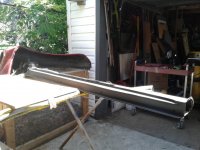
The first pic is a common one to some Beetle owners... waiting for the tow truck to arrive. As an aside, I haven't really investigated why the damn thing quit on the way home. Of course, as soon as the flat bed dropped it in the driveway, it fired back up. More on that later...
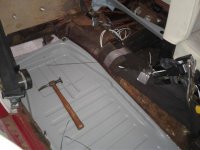
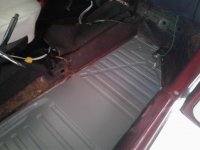
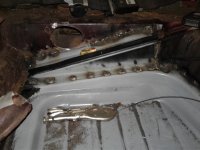
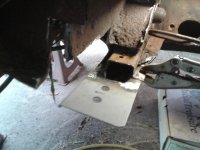
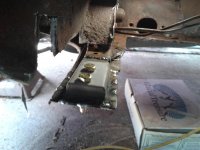
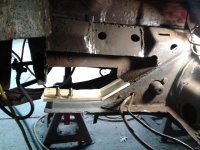
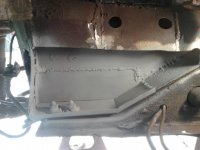
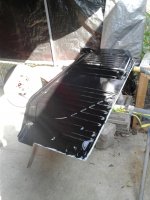
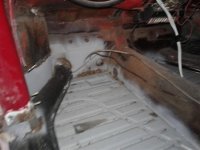
Once the new floor had it's seat rails, jack support, and battery hold-down bolt welded in place, it was scuffed, bare areas got a shot of etch primer and the whole underside got two coats of good 'ol Tremclad. The bare steel areas on the tunnel and frame head, once the factory welds were cleaned away (OEM floors were not spot-welded in place, they were wire welded), they were sandblasted and also got a shot of etch primer. I would have preferred weld-through primer but COVID has fucked up that, too. :(
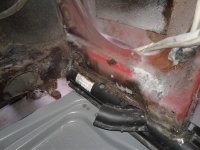
The underside of the right heater channel ended up needing a small patch at one of the captive nut areas, but I didn't think to get any pics of that, so you'll have to take my word that it was done properly. I did take the time to drill some half inch holes along the channel so that I can oil spray it all when it's finished. I am NOT going through this again.
Twenty years ago, a floor half in a Bug would be a two day job, + or - a couple hours. Not so today! I think I spent 3 weeks getting it done. Hey! I'm retired! ;)
I can't find the pics of the completed right side, but trust me, it's completed save for a couple coats of paint next spring.

I'll get to the left side pics another day. Those are where the real fun was...

 

Attachments

  • may 1.jpg
    may 1.jpg
    116.3 KB · Views: 7
  • may 2.jpg
    may 2.jpg
    113.8 KB · Views: 7
  • may 3.jpg
    may 3.jpg
    108.1 KB · Views: 6
  • may 4.jpg
    may 4.jpg
    75.4 KB · Views: 5
  • may 5.jpg
    may 5.jpg
    81.9 KB · Views: 5
  • may 6.jpg
    may 6.jpg
    83.9 KB · Views: 5
  • may 7.jpg
    may 7.jpg
    79.2 KB · Views: 5
  • may 8.jpg
    may 8.jpg
    76.4 KB · Views: 5
  • may 9.jpg
    may 9.jpg
    90 KB · Views: 6
Though I can't judge for others due to lack of experience, that looks like a right properly-made floorpan to me. Right properly-installed, too--that I can say for sure (thanks to you!). ;)
 
It IS a nice floor. One of the best I've seen. Covered in REAL epoxy primer, no less. No wipe-it-off-with-wax-and-grease-remover "EDP" here... ;)
 
I started on the driver's side the first week of August.
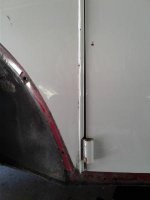
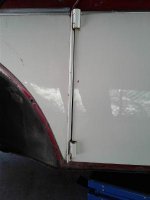
The first order of business, knowing that I'd be doing some wholesale cutting and replacing of structural components, was to deal with a worn hinge.
Back in '95/'96, the lower door hinge had a bit of sloppiness in it. Shortcutting it (yes, I do that once in a while), I simply shimmed it with the smallest one in the box and called it good. It did throw off the door-to-front-post gap, but I wasn't really concerned with it. Who knew I'd still be working on the car 24 years later...?
At some point in it's past life, the car was hit on the driver's side. The door had been changed and some less than stellar metal work had been done to the quarter. More on the quarter later, but I suspect the collision was hard enough to tweak the front post out of whack. I didn't realize how much until it was all painted and I was fitting weatherseals... :( But I made it work. Again, who knew...?
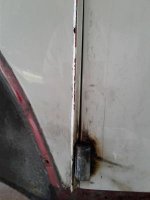
A couple of really good whacks with my trusty BFH did nothing to scare the pin out of the hinge. Soaking it with PBE for a few days did the same: Nadda.
Heat was called for. I managed to not burn the car completely (trust me, that thought has occurred to me many times over the years, including this summer), but some damage was inevitable. The worn section of the hinge was replaced with a spare from the many boxes & bins I've collected, and the new pin was tapped into place. A nice, smooth fit, and a nice even gap with the proper factory shim stock back in place.
But... the door doesn't quite line up as nice on the B post anymore. We'll get to that next time.
Getting the door-to-front post alignment is critical if anything else is to have any hope of fitting. The front post or rear post can be manipulated into the desired position, but if the door doesn't hang properly on the hinge post, you're beating your head against the wall.
It's my plan to try and convert this car to a hidden hinge system next year when the rest of the body work gets underway, so I tapped the hinge pin in only far enough to gain proper alignment. If, for some reason, I don't go the hidden hinge route, the pin will get fully driven in.
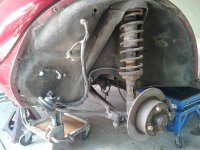
I pulled the front and rear fenders off, knowing that replacing a heater channel would necessitate such steps. I was most pleasantly surprised to see that almost all of the extensive metal work in the front and rear wheelhouses was still looking solid. A little softness at the firewall area, but that spot will get razed when the cutting wheel comes out, so...
How extensive was the previous metal work, you ask? The lower section of the front wheelhouse - a good 7 or 8" forward of the strut, and a an even greater height rearward of Mr. McPherson's invention was fabricated and/or replaced. The lower 4 or 5" of the strut tower support itself was also replaced. Surprisingly, the front sub-frame rail was pretty solid, just the outer sheetmetal was pooched. It was still a big, nasty, dirty job, though...
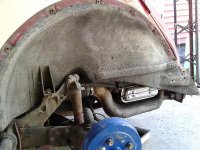
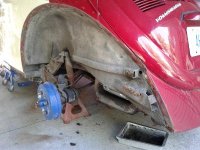
The rear wheelhouse was just about perfect, still. Thankfully.
"Resto, how bad was it back there?" It would probably me more accurate to say "How much of the wheelhouse is still original?"
"Not much, Little Johnny, not much."
I bought a patch panel that allowed me to completely replace the rear body mount section, you can just see the outline of the upper panel edges. Another panel was bought for the rear section, but none of the bumper mount bracket sections on that panel would work on my '74, so the entire, very pretty looking bumper attachment section was hand built. VW also thought it was a good idea to laminate two layers together in the rear wheelhouses. Unfortunately, the inner layer isn't available, and wasn't attached to the repair panels, so that had to be fab'd as well. It's all done with 19 gauge steel, and the bumper mounts are made from stock around 12 or 14 gauge. Only two of the fender mount captured nuts are original as well...
As you can imagine, a LOT of time was spent on this thing back in the day!
The factory undercoat look on this car is nothing more than a wet heavy-oil spray and then a drive down some dusty country roads. It's held up remarkably well.

As an aside note, the heat exchangers I bought used from a wrecked '72 Beetle are still in fantastic condition. That's nice to see, as removing ANYTHING from the aluminum heads can lead to all sorts of fuckery
 

Attachments

  • aug 9.jpg
    aug 9.jpg
    23.7 KB · Views: 4
  • aug 10.jpg
    aug 10.jpg
    16.6 KB · Views: 3
  • aug 11.jpg
    aug 11.jpg
    27.2 KB · Views: 3
  • aug 12.jpg
    aug 12.jpg
    23.3 KB · Views: 4
  • aug 13.jpg
    aug 13.jpg
    9.6 KB · Views: 4
  • aug 14.jpg
    aug 14.jpg
    10.3 KB · Views: 4
  • aug 15.jpg
    aug 15.jpg
    11.6 KB · Views: 5
Last edited:
Writing about burning the paint around the hinge reminded me of back in the mid-late eighties, working at shop that did all of the local Jeep dealer's work.
I don't know how many times they'd bring a brand new Cherokee in with seized rear hinges, Yes: brand new.
My boss's favourite line was "Mikey, got another one! Don't damage the paint!" Ever try using a oxy/acetylene torch on a new car while your boss hovers over you, trying to either free up a seized hinge or drive the pin out, without damaging the paint? Of course, the hinge had to be re-sprayed, but doing the adjacent post or *gasp* the door itself would have sent the dealer into orbit. You know, that's when the "We're not making much money on this car" line comes up, without fail.
And, of course, the boss is there in a purely supervisory position: helping was out of the question. ;)
And, of course, first I had to clean gallons of oil and grease off of the thing, from their mechanics trying to do it themselves. They were never successful, don't know why they kept trying. Putting heat anywhere near their Exxon Valdez spills would have meant the end of the shop tranquility.
I think I averaged 1 or 2 a week for a long while.
Think I'm out of practice...judging by the scorched paint on Da Bug!
 
On to the serious stuff...
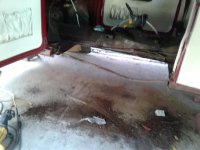
I was surprised, and more than a little dismayed to see how rough the driver side was. The floor rot was expected: it was a light gauge replacement piece and seeing as how it was installed back whenever, its condition was fitting.
The heater channel, however, was not. The last time I took a good look at the under-belly was around 2010, and though it wasn't pristine (it IS an Ontario Beetle, don't forget), it was better than this.
But... a small hole is really no different than a large one, so I plugged in the reciprocating saw and went to work.
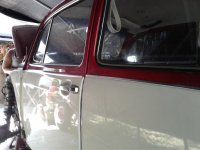
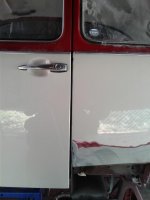
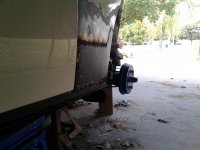
The pic of the side of the car shows just how important door hinge pin integrity is: Without the heater channel to support the post, it all sags. If I had blustered ahead without first addressing the worn hinge, the odds of ever getting a proper fit afterward would be like Trump's hopes of getting a break from the press. It just would never happen!
With the door now solidly square to the front post, all I have to worry about is putting the post(s) in the right position. The door alignment will take care of itself with no added jiggering on my part.
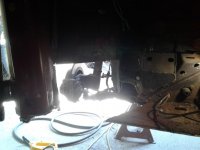
And then... I had a walk-through Beetle!
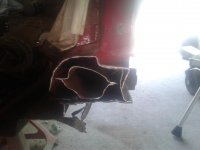
The cross section pic of the soon-to-be-removed heater channel shows just how simple it is. Even though the Beetle construction is relatively complicated, the individual components are simple. A bottom plate (where the floor bolts up), an inner tube to carry the heat from the engine to the passenger compartment, and an upper section where everything is welded together. It don't look terribly strong, but considering that nothing was drastically out of alignment even with the rot, it does the job. Not Mopar unitized construction strong, but ok.
The last pic is the new Dansk heater channel, supposedly the best available. More on the "supposedly" part later...
I went over the new channel, added a weld or two in known-weak spots, scotchbrited it and brushed on two good coats of Tremclad on the bottom plate (where the new floor will bolt up) and underneath the end of the heat tube where getting at it after installation will be tricky.
I added some universal hardener to the Tremclad to help with the this-f*cking-enamel-paint-takes-forever-to-harden situation common with Tremclad. I've used many coatings over the years to protect new pieces and parts, Tremclad is as good as anything out there, provided some hardener is added.
 

Attachments

  • sept 2.jpg
    sept 2.jpg
    94.7 KB · Views: 4
  • sept 1.jpg
    sept 1.jpg
    83.2 KB · Views: 4
  • sept 4.jpg
    sept 4.jpg
    85.2 KB · Views: 4
  • sept 3.jpg
    sept 3.jpg
    92.1 KB · Views: 3
  • sept 5.jpg
    sept 5.jpg
    57.3 KB · Views: 3
  • sept 6.jpg
    sept 6.jpg
    114.2 KB · Views: 4
Next up, putting the front post where it needs to be.
Nothing high-tech here: I removed the striker latch plate so its location wouldn't dictate how the door sat when in the closed position, removed the door seal so it also wouldn't influence the fit, and then jacked up the front post till the door and quarter lined up.
I went by the sheet metal contour lines and the door gap itself. As you can see, the thin chrome trim isn't a perfect match. They rarely are on a Beetle.
Door gaps are just about perfect, so I called it good.
I used a friction jack. Hydraulic lifts can slowly drop, best to have something stable, 'cause I do not want the post dropping in any way. When it comes time to weld it all up, I'll jack it up just slightly so that when I release the jack, it should drop to a perfect fit. Heat does strange things to sheetmetal...
 

Attachments

  • Oct 1.jpg
    Oct 1.jpg
    99.9 KB · Views: 3
  • Oct 2.jpg
    Oct 2.jpg
    63.1 KB · Views: 3
Then the real fun began... :(
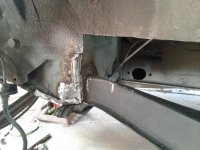
Cutting out the front section of the old heater channel led to this discovery. More rot than anticipated, thanks to friendly neighbourhood rodents.
Lower firewall and the outer frame head are both pretty weak and perforated. This ain't gonna be pleasant!
I had done some repair work on the firewall back when, and wasn't expecting this. Guess I should have looked closer...
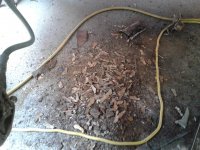
The last picture shows just how tight an area this is - the angular floor cutout isn't anything more than putting the sawsall blade along the heater channel and following it as I cut. Not much foot room in a Beetle. Even less for an old bodyman.
The crap on the driveway is what came out of the firewall and frame head.
I made the cutout on the wheelhouse a little higher than normal, just to allow a bit more wiggle room. That decision will pay off later.
The two steel lines are the fuel and brake line, routed through the passenger compartment back before I got the car. Both ended up breaking as I worked in here, so they'll get put underneath the chassis when done. Originally, they were supposed to go through the tunnel center section.
 

Attachments

  • Oct 3.jpg
    Oct 3.jpg
    64.1 KB · Views: 3
  • Oct 4.jpg
    Oct 4.jpg
    87.7 KB · Views: 3
  • Oct 5.jpg
    Oct 5.jpg
    78.7 KB · Views: 3
  • Oct 6.jpg
    Oct 6.jpg
    161.5 KB · Views: 3
  • Oct 7.jpg
    Oct 7.jpg
    75.4 KB · Views: 4
  • Oct 8.jpg
    Oct 8.jpg
    119.6 KB · Views: 3
When my back couldn't take anymore of the front section work, I rolled back to the rear floor area.
This is one of those times when I would have liked to have whoever put the cheap floor in right next to me, so that I could light them on fire with a thousand flaming arrows. &*$%**!!!#@!!!!!!!
As I mentioned earlier, Beetle floors are welded to the tunnel flange from the factory. Getting all traces of an OEM floor off of the flange is not a joyous task at the best of times. Wolfsburg did some good welding in these old cars!
But... when some schmuck doesn't bother to remove all the floor from the flange, deciding instead to just cut alongside the flange, it makes a more less-than-joyous taks.
When he/she then decides to weld the new floor on top of this mess, with a MIG with LARGE wire, it gets worse. He/she not only welded down onto the old floor, he/she thought that welding it up the side of the tunnel would be better insurance against somehow falling through.
Then, for extra, extra insurance, he/she welded it from underneath. F*ck!
When he/she then decides to coat everything with several tubes of butyl sealer, it gets downright nasty.
It took several 4.5" grinding and cutting discs to get this abortion out of there.
This was one of those jobs where I wished, not for the first time, that I'd never, ever set eyes on this car. :(
But, out it came. Piece by obstinate piece.
 

Attachments

  • Oct 9.jpg
    Oct 9.jpg
    120.3 KB · Views: 3
  • Oct 10.jpg
    Oct 10.jpg
    119.4 KB · Views: 3
Oy vey.

I find myself suddenly quite thankful that prior efforts to, ahem, restore the Valiant were largely adventures in slinging of plastic filler. At least I was dealing with rusty original garbage, rather than some other goober's half-assery. Hell, I didn't even disturb the plastic filler, except drilling through it to install the "V-EIGHT" emblems on the fenders. There are spots on those fenders where the plastic is almost ¾" thick.

I'm surprised the half-wit didn't use a stick welder. 😐
 
EVERY Beetle I've worked on, ever, had loads of this fuckery going on.
I could write a book on what not to do...

Stove pipe sporadically bronzed in, in place of heater channel uppers on a '74 Standard Beetle...
Checker plate bolted around the frame header on another '74 Standard Beetle...
Bed frame angle iron pop riveted to a rotted-out transmission tunnel, and then a floor panel pop riveted to that...
Hammered-over door edges and quarter panels to keep them from binding on a badly sagging '67 Bug...
A hood panel so badly damaged and filled with bondo, that it weighed over 60 pounds. A straight panel weighs around 28 pounds...

And so on, and so on, and so on... :(
 
Once the old floor business was taken care of, the actual repair process began.
I may have mentioned that, at times, I wished I had never set eyes upon this car...
Did I mention that?
The front frame head was bad, but at least it was totally unexpected.
Ugh.
 

Attachments

  • oct 10 11.jpg
    oct 10 11.jpg
    99.5 KB · Views: 5
  • oct 10 10.jpg
    oct 10 10.jpg
    80.8 KB · Views: 5
Out came the heavy sheet metal...
This is the fore-most body attachment point on the Super Beetle.
There is a rubber pan gasket between this frame head and the body itself, a fairly thick one.
From here, building this area will be tricky, as the gasket is thick, but the rest of the body/pan assembly is still bolted down tight. Putting it together while judging how much compression there will be in the new piece of gasket, and then welding it together, will be pretty much by-guess-and-by-gaw.
The floor pan welds to the lower flange on the frame head.
 

Attachments

  • oct 10 9.jpg
    oct 10 9.jpg
    93.3 KB · Views: 5
  • oct 10 8.jpg
    oct 10 8.jpg
    87.2 KB · Views: 5
  • oct 10 7.jpg
    oct 10 7.jpg
    89.8 KB · Views: 5
... And then the firewall gets re-built.
The pan gasket is in place here, never to see the light of day again.
I didn't bother doing much grinding on the welds... largely because at this point, I'm just wanting the job to be over, but also because there is no need. Nothing inside that firewall will ever be seen again.
Sandblasting and etch priming happened, though.
When the firewall was pretty much back together, I tightened the body mount bolts.

Then got rid of the remaining chunk of floor nastiness, in the corner. At least it was easy to get to. %&#!!!)^!!!!
 

Attachments

  • oct 10 6.jpg
    oct 10 6.jpg
    117.9 KB · Views: 5
  • oct 10 5.jpg
    oct 10 5.jpg
    82.8 KB · Views: 5
  • oct 10 4.jpg
    oct 10 4.jpg
    76.5 KB · Views: 5
  • oct 10 3.jpg
    oct 10 3.jpg
    80.7 KB · Views: 5
  • oct 10 2.jpg
    oct 10 2.jpg
    104.2 KB · Views: 4
  • oct 10 1.jpg
    oct 10 1.jpg
    119.4 KB · Views: 5
Then the real fun began...
Stay tuned to this channel for more exciting updates.
 

Attachments

  • oct 11 1.jpg
    oct 11 1.jpg
    93.2 KB · Views: 4
I know it's cliché, and that you already know it, but getting into the same car knowing it's now rock-solid after all the work you've done is a wonderful feeling. Agnes was far more dreadful than expected at time of purchase, but I'll happily and confidently fling her down the dragstrip at a buck-thirty after all that work... if she's capable of such nonsense. :unsure:
 
So... back to the final pic above...
As I mentioned way back, this heater channel is supposed to the best available.
It looked beautiful as I unwrapped it from its shipping box.
It looked really good sitting on my work table.
Heavy gauge steel, proper number of captured nuts on the bottom plate, all spaced as per specs.
The front flange was on a bit of an angle, instead of at a 90 degree angle, but that's minor.
So, in it goes. I'm quite happy that I'm on the downside of the job. :)

Happiness can be a fleeting thing, don't ya know?

I tried all sorts of trickery to get everything where it needed to be, short of a BFH and sparking up the torch. Lighting the whole works up did, once again, cross my mind...

Ultimately, as is the case with most old cars and aftermarket parts, I reverted to the "bend it till it fits" scenario.
Brute force and ignorance, for the win!
Pulled the front post toward the tunnel with my trusty cable come-along...
Pushed the rear post outward slightly...
Lifted the rear post up until the door swung and fit perfectly...
Re-worked the heater channel front flange till it sat tight against the firewall... Re-worked the rear flange till it fit where it should (eye-ball estimate only, as the rear crossmember wasn't actually there in that area)...
Set the floor pan in place with a couple bolts to make sure it was going to go in properly with enough space to weld along the tunnel flange...
Replaced the rusted-away bottom of the inner front post, where it goes around the defrost tube...
Checked and double-checked everything every time something else was done...
Welded a chuck of angle to the rear quarter skin to hold it securely at the right height...
Alternately clenched then gritted my teeth so often that my dentist will be sending me Christmas cards for a long time now...
Said a few prayers (I'm an atheist, so you know how frustrating this job was!)...
And the tacked the whole mess into place.

I could not, without cutting the heater channel apart and altering it, get the front of it to fit OEM-style against the firewall. The channel is just formed wrong. It's only really going to make a difference when I weld up the wheelhouse, so it's ok. I guess.

The captured nuts in the bottom plate aren't actually in the right place as previously thought (or hoped for). The fore and aft spacing is correct, but they're running at a slight angle from side to side. The bolts goes in, but some persuasion with my line-up punch is required. Good enough. I guess.

But, I kept welding. :)

The bottom of the front post had some pieces added, to secure it to the heater channel. Still work to do there, but if I do go ahead with hidden hinges, it will be re-worked so I did just enough to keep it in place for now.

The second pic is what I found the day after I placed the heater channel up close to the car. F$^#ing squirrels, starting early! That is a walnut sitting in the heat tube.
The floor pan had it's seat bracket s welded in place, along with being slightly trimmed where it contacts the flange by the pedal assembly, then it was given two loving coats of good 'ol Tremclad.

Once the rear flange was straightened a bit, the channel fit very well against the inner quarter.

I oopsed the front wheelhouse patch slightly, but nothing a copper backing while welding won't take care of.

19 gauge used throughout... and at this point, I'm just ready for this job to be over! :)
 

Attachments

  • oct 11 1.jpg
    oct 11 1.jpg
    93.2 KB · Views: 7
  • Oct 11 2.jpg
    Oct 11 2.jpg
    83.9 KB · Views: 7
  • oct 11 3.jpg
    oct 11 3.jpg
    80.9 KB · Views: 7
  • oct 11 5.jpg
    oct 11 5.jpg
    83.7 KB · Views: 7
  • oct 11 6.jpg
    oct 11 6.jpg
    129.9 KB · Views: 5
  • oct 11 7.jpg
    oct 11 7.jpg
    125.3 KB · Views: 5
  • oct 11 8.jpg
    oct 11 8.jpg
    114.3 KB · Views: 5
  • oct 11 9.jpg
    oct 11 9.jpg
    72.6 KB · Views: 5
  • oct 11 10.jpg
    oct 11 10.jpg
    82.4 KB · Views: 6
Last edited:
"There are no atheists in foxholes... or restoring rusty cars." 😄

Your perfectionism is showing, which leads me to believe the hidden door hinges are inevitable... "I've done all this work already, so I probably ought to smooth 'er up proper too." Besides, it's restomama's car--and she's your most-important customer. :)
 
Not sure about the hidden hinges... there just isn't much room to work with.
I'll have to bite the bullet and order a set to see if it can be done.
A fair number of Beetles with suicide doors and hidden hinges out there, but I've yet to see one with conventional opening doors...
 
Working deep into October, under a portable shelter in my driveway, has it's drawbacks... namely: weather.
The days warm enough to get anything done have been hit and miss from the end of September through till mid-October. If it was warm enough, either the winds were too high for welding or it was pouring rain. If it wasn't raining or blowing a gale, it was just too cold.
I hit on two nice days, so I wrapped this project up for the season.
With a little luck, there'll be a cement floor in my tiny little garage next summer that will allow me to finish this up inside. Got my fingers crossed... that makes it hard to type. ;)

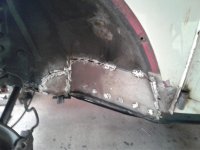
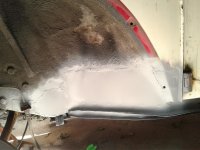
Finished up the front wheelhouse for now. Ground the welds, blasted them, re-installed the bracket for the front flex line, and gave it all a good coat of etch primer. I'll go over it again next year, remove the temp coat of etch primer and bathe it all in a couple coats of epoxy primer. There might be some mods required for the hidden hinges, and some hammer and dolly work on the weld seams, so we'll cross that bridge as needed.

Then it was on to the quarter panel...

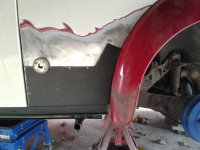
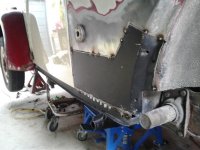
I was originally going to fab a small patch panel here, but as I re-discovered when cutting out the old heater channel, both quarters on this car had collision damage from previous owners. On this side, it was bad enough that, back in '95ish when I did the car, I dug out a good inch of filler from one end of the lower quarter to the other end. I spliced in a door jamb edge to true things up, but other than some pin pulling and a little heat shrinking, that's as far as proper repairs went. A skim of filler (much less than before) and it was good enough for this cowboy.
However... because I cut out the lower quarter this time around, welding in a small patch would only make more work. Adding heat to wrinkled sheetmetal is never a good thing... so I bought the largest panel, short of a complete quarter, that I could find, and cut it to fit. After removing the previous damage, of course.
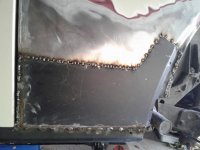
Like most aftermarket patch panels, the fit was... ok, but nothing to brag about. Some hammer and dolly work made it better. Not perfect, but considering the shit that this quarter has been through it was as good as I cared to make it. And, of course, I made the cut a bit too wide when butting it together. :(
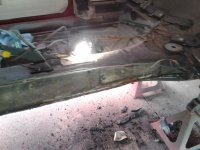
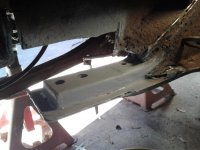
Lots of slow tacks, and some air blowing over them to keep things from warping, and it's coming along nicely. Even though most of the collision damage has been cut away, there is still some residual tension in the steel, so too much heat can send it warping in ways that no one wants to see, so slow and steady is the path to take.

It does fit well.

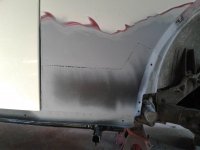
I ran out of nice weather at this point, and it took a wait time of four days before it was dry enough to get back to it, so I ground what I had welded, blasted it clean, and coated it with some etch primer for it's winter slumber.

I'll be able to virtually eliminate all the old filler in this panel, and where i repaired it this year should take only a small amount to get things proper.
 

Attachments

  • oct 12 1.jpg
    oct 12 1.jpg
    118.8 KB · Views: 4
  • oct 12 2.jpg
    oct 12 2.jpg
    93.7 KB · Views: 5
  • oct 12 3.jpg
    oct 12 3.jpg
    98.6 KB · Views: 5
  • oct 12 4.jpg
    oct 12 4.jpg
    111.9 KB · Views: 5
  • oct 12 5.jpg
    oct 12 5.jpg
    89.8 KB · Views: 4
  • oct 12 6.jpg
    oct 12 6.jpg
    68.3 KB · Views: 4
  • oct 12 7.jpg
    oct 12 7.jpg
    74.7 KB · Views: 4

SiteLock

SiteLock
Back
Top