Popping back in after the move....

You don't want a separate incoming line. That would mean the cost of another meter and another, separate bill. Electric companies charge a standard monthly hook-up fee per meter.

Running 220v service is easy if you have basic knowledge of household wiring. First make sure you have ample service to the house. 200 amp service is desirable, but 100 amp will suffice, depending on how much equipment you run.

If your panel has space for another 220v breaker, you're good to go. If not, that's the first thing to remedy. From there run 8 awg underground in plastic conduit to the outbuilding. Most codes specify a minimum of 18" coverage. But if you're on your own, 8-10" is good. Depending on local codes you may be able to do this without a permit. (I did for mine) Then again, what they don't know won't hurt. :silenced: You probably want a 100 amp breaker in-house to the shed. In the shed you can go either with 60 or 100 amp, depending on usage.

I wired my 2 garages as therapy after my rotator cuff surgery. :doh:

Ahhh I see....thank you 68 for that sagely info....;)

Would the 8 awg have to be a multi string? Or just the one main power wire, and ground at the shop end?
 
it will be a 3 strand...

think of it as the shop IS an oven or dryer with a 3 pin connection...the 3 pins are just at the new breaker and then end at the new breaker box......hell for initial wire up on the 40 i had done just that plugged into the neerby doublewide

i got lucky with mine...there used to be a shop here the wiring was simply pulled back into the attic and the 75amp breaker shut off

and he is right about the second meter second line...the old shop at the 40..while wired without permit was never an issue even to get the power co to come out and slap up a meter.....25-30$ a month just for the PRIVILAGE of having the hookup..plus power consumption.....i had ran the new line underground to a neerby pole the power co simply hooked it to the pole and plugged the meter in..the county is none the wiser
 
Would the 8 awg have to be a multi string? Or just the one main power wire, and ground at the shop end?

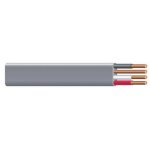
You want to use "Sunlight Resistant" or "Underground" specific wire,(Usually gray color) also referred to as Romex;

wire.jpeg
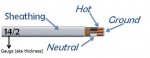
220 volts is achieved by having two separate 110 volt services using a common neutral. VERY IMPORTANT to remember that the black is a service wire, NOT a ground, as in automobiles. RED & BLACK are 110 volt service, WHITE is common neutral and the unshielded is a ground. Older wiring didn't use a ground, but service is the same.

Install a panel in the shed, (with a main breaker, at least 60 or 100 AMP, your choice) and any 220V breakers will use both services to achieve the voltage. 110V breakers will only use one service. Any welders or compressors should use at least a 60 amp breaker. Lights, 10 amp, grinders and outlets 15 - 20 amp.

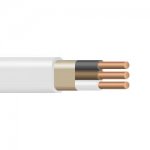
For indoor wiring use 14-2 w/ground, (white sheathing);
wire.jpeg

Depending on how many lights & outlets you want you'll probably use a lot of this. It's cheap compared to the 8AWG. I used over 500 ft. in my 2 garages.
 

Attachments

  • wire.jpeg
    wire.jpeg
    6.2 KB · Views: 30
why on earth did i say 3 wire.....boy its been a while since i ran a main...i got lucky with my shop and came into a "leftover" spool of the aluminum shielded stuff....which in most places if its exposed it must be this stuff..but your not allowed to run it behind a wall

oh and the /2 is how many wires are in the strand NOT counting ground..i often get /4 for doing trailers as its heavily protected wire

better to have a 100amp box and not need it "now" than to pay about the same for a 60 fill it and need more later

plan ahead on your outlets, think about air too

IMO no outlet should be further than 8 feet from the next....less extention cord shenanigans, plan for atleast a few overhead power drops..idealy on cheep HF retracables (as well as garage door openers cheep used)
an exterior feeding air spoool is a HUGE bonus so is a waterproof outlet for those overnight block heater or battery charger
 
why on earth did i say 3 wire.....

You can still get the 3-wire but it's mostly indoor usage, for maybe a dryer, range, etc. It cost a little less and you could maybe use it to run a string from panel to a compressor or welder outlet. But we're not talking a long enough string to be worth the small saving.
 
My only advice here is make damn sure your vehicle doors are on the correct end of the building! What I mean here is you live in the snow belt just like me. I see tons of garages/ shops in our area with the roof sloped so the snow slides off and lands in front of the garage doors. It must suck to constantly have to deal with a frozen pile of snowand ice in front of your garage door from the heat inside melting off the roof.
 
My only advice here is make damn sure your vehicle doors are on the correct end of the building! What I mean here is you live in the snow belt just like me. I see tons of garages/ shops in our area with the roof sloped so the snow slides off and lands in front of the garage doors. It must suck to constantly have to deal with a frozen pile of snowand ice in front of your garage door from the heat inside melting off the roof.

Thank you for the advice.....I had considered that as well. ;)
 

SiteLock

SiteLock
Back
Top