Pissed off

dodgedifferent2

hung like a stud field mouse and
Jumping the gun a bit here.
So since I rebuilt the 340 and spent the bucks on it. It's been burning oil.

Honed the cylinders and installed new rings.
Went over the heads with a fine tooth comb.
I can burn 3 litres in 200 miles after the ring change.
I now have 1000 miles on the rings and still burning oil.
Seems to have blue smoke at idle ... at clutch sidestepping and deceleration.
It just does not clear.
No oil in the pcv valve hose.

Did a leakdown test and I can hear air coming out of dipstick on all cylinders. Wondering if cylinders are out of round.

Engine is bored .040 over (4.080)

Am I safe to go to .060 ( 4.100)? Or should I hunt for another block? (Dad has one in the corner)
 
From what I understand .040 is max overbore. Anymore than that and the walls get to thin.
 
you may be one of those unlucky bastards that they just dont want to seat right away...my 360 was like that..i quit babying and started flogging the hell out of it..they seated within 500miles after that
 
Don't you have to do a bunch of full throttle runs to get the rings seated properly during break in?
 
i know someone who baby'd his motor soo carefully that even after neerly 3k miles it was still smoking....after a day of teaching him how to drive the damn thing a week later they seated
 
The rings should've seated by now, regardless of whether you're pussyfooting or not. In 1,000 miles it's been up and down the RPM range enough, and I know you've beaten on it a few times.

So many variables here to question...

What kind of rings did you use--specifically, the material?
How were the cylinders honed? Using deck plates on a proper machine, or at home?
Were the heads milled? Did you foolishly use the end gaskets included with your intake-gasket set?

You can go to .060" and be OK, but beyond .040" the walls become more flexible and proper ring seal is even harder to achieve, particularly under high loads. But I don't think you need to do that anyhow.

I'm thinking it's the intake sucking oil since the issue seems to be under high-vacuum conditions. Pop it off and inspect the gaskets. I'll bet you find oil tracks between the intake-port openings and the bottom edge. Get a new set of gaskets and throw the end seals in the garbage. Use a 1/8" bead of silicone across the top of the block with a little extra at the corners where it meets the heads.
 
Mahle plasma moly 4080MS
Last time I used the dingle berry in the drill to breakup the glazed cylinder walls.
As far as I know the heads were never milled. They were used w2 heads.

Yes I used the end gaskets with the Smurf shit aka rtv

Last time I opened it up and found tons of oil in the intake runners of the head on number 4. I got a thicker intake gasket instead of the small mopar paper ones.
 
pop it again and have a look?....only gaskets ive ever had a lick of luck with have been the felpro blue HD/performance small block gasket set
 
I had my brother in law take a look last weekend.He builds engines in toronto and i have no clue how good he is or what his resume is. But if I understand correctly his dad has a engine shop in Milton.
He looked at my old rings and made the remark that the wear patterns on the rings show that the cylinders are likely out of round.
When he pointed at the wear marks and explained what he was seeing there were spots that looked like the rings never touched the walls at all and other spots that were worn shiny and sharp.

And I picked up another 340 block with std bore. So may bore .02 over and start again. Just unsure who to trust if I go that route. I plan to pull engine again this winter :-(
 
His assessment sounds legit, I've gotta say. However, it's also possible that the rings were damaged due to improper installation (overcompression). When you did the leakdown test, what was the percentage getting past the rings? You're going to hear hiss no matter what; even with zero-gap rings a 100% seal is impossible. What does get past is going to make noise, but if it was holding better than 90% I'd suggest going back and checking the intake again. Those rings certainly should've seated in 1,000 miles.

Never, ever use the end seals that come with intake gaskets. That way lies madness. A bead of black silicone from corner to corner is all you want or need. It allows the bottom surface of the intake to lie where it wants once the intake/head surfaces have become friendly with the gasket betwixt them. I just ordered my W2 intake gaskets, and after determining that factory-replacement gaskets for standard heads tend to be around .055" (the Fel-Pro "Print-O-Seal" set is .065"), I went with the .060" Mopar Performance set. You're probably aware that Fel-Pro doesn't make a W2 intake gasket... or if they do, it's none too easy to find. Neither Summit nor Mancini list 'em.

You've got no way of knowing whether those heads were milled short of doing a CC test, and even then you need to know the exact part number--not the casting number, since the same castings were often machined differently to make different head configurations and hence part numbers--to know the original volume. Get a new set of gaskets and pop the intake again. When you reinstall the intake, for the love of all that's holy install the end seals in the garbage can. Manifold face gaskets only! :naughty:
 
It's been a while, but I don't recall XL ever mentioning that engine going through oil... did you re-bore it?
 
I had to bore to 4.08 because of a gouge in cylinder wall 5. I believe a wrist pin came loose before I ever got the engine. I got the engine it was already .03 over.
These are the numbers I got for my leakdown test

20170827_222825.jpg
 
The really-bad numbers indicate you've got cylinder-head problems, since I'm guessing the "in" and "ex" mean you've got leakage past the valves on those. The others are more than I'd like to see, but I wouldn't freak about them unless they remained that bad after another 1,000+ miles.

I can't say for sure without seeing everything first-hand, but my guess is you've got bigger top-end problems than you've got in the shortblock. A valve job seems imperative with your notations, and I still think your intake is sucking oil. We don't know if the heads have been milled, but we do know you modified that intake manifold to work with the W2s. Did you mill the gasket faces? Same effect--the front and rear bottom of the intake are too close to the block, and the end seals don't allow the head surfaces to seal correctly.
 
I have a brand new dual plane w2 4 barrel intake on it since I had already thought of the intake being an issue.
Yes the notations do point at the valves and needing a valve job done.
 
Do a valve job, and leave out the manifold end seals when you reinstall the heads. I don't think it's yet time to crack open the shortblock.

Also, sell me your Six Pack setup. Cheaply. :D
 
I popped the intake off tonight since I had some free time while it rained.
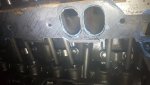
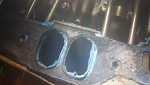
I found that the back of the valves look like they have a pool of oil. A few of the valves look like that have black cake baked there.
I took photos of the ports. To me they look like they sealed to the intake but as mentioned the front and rear gaskets look like they did not seal so they would be pitched next time
20170919_203424.jpg20170919_203429.jpg20170919_203443.jpg20170919_203457.jpg20170919_203532.jpg20170919_203930.jpg20170919_203935.jpg20170919_203942.jpg20170919_203947.jpg
 
OK, first and foremost: Don't you ever, ever let me catch you using silicone on a gasket exposed to fuel again! That's a guaranteed failure right there. If you feel you need to use sealant on the manifold face gaskets, use Permatex 80065 Spray High-Tack only (I'm not aware of an equivalent, though I'm sure one exists). Silicone sealants--all of them--dissolve and fail in the presence of gasoline. High-Tack does not.

That silicone is likely as much your failure mode (or more) as using the end seals, which would certainly exacerbate the dissolving-silicone issue. It's pretty obvious every port was sucking oil past the silicone. I'll bet that blue sealant is extra-floppy and likely slippery to the touch. It's failed, guaranteed.

Suffice to say, I think you've found the source of your oil smoke. Being that far into the engine, you might as well go the rest of the way and pop the heads. Besides, the season's almost over anyhow. Bring the heads in for the badly-needed valve job now rather than later. The sooner they get in, the more likely you'll be ready when springtime cruising season hits. :dance:

Also, you'll find the car much more enjoyable to drive (and way better on fuel) if you fling that dizzy and get one with a vacuum advance. You can still be all racy and billet and radical advance curve and such, but no vacuum advance on the street makes a good car bad and a bad car worse. You give up nothing performance-wise to have it, but a lot of drivability and fuel economy without it. If you need further testimony, ask 68R/T about the dramatic improvement in his Hemi car by adding vacuum advance. Per our conversation last night, "It's like a different car."
 
The dizzy is locked out because I got a sweet deal on a fitech when I was shopping for a carb.
Yes fuel injection everything is controlled by the computer. Controls timing ... sniffs the exhaust and tweaks as I roll. Everything is constantly within desired specs.
 
Controls timing ... sniffs the exhaust and tweaks as I roll. Everything is constantly within desired specs.
Except the timing. The computer can't optimize timing unless you've stumbled into an inexpensive ion-sensing setup. Optimizing timing can only be done by measuring maximum brake torque on a load-bearing chassis dyno--or by using ion-sensing equipment I'm positive nobody on this board could afford.

Fuel tuning should be too, since "self-learning" is a hysterical marketing buzzword that's actually impossible. How do you, much less the computer, even know what the "desired specs" are without determining LBT? Does it make more power at full throttle @ 12.5:1 or 13.2:1? How fat or lean does it go on transient throttle inputs--something essentially impossible to self-learn? What happens when the O2 sensor reads a rich misfire as a lean condition--which it will, every time? Is your cruise mixture best for economy, or the EPA? Could you change it to a different A:F ratio with more timing and gain MPG? Simply put, the EFI controller cannot measure torque, and torque is literally the basis around which every single optimum parameter ("desired spec") is based, be it power, economy, or emissions. That's physics, not marketing wank.

"Self-learning" is the greatest way to exploit a technology that could increase power and economy to continually and repeatedly leave a bunch of both on the table.

And timing is where the real power and economy lies. Timing is everything. Once you've got the engine sorted, get that thing to a load-bearing dyno. You'll pick up both a bunch of horsepower as well as significant fuel economy. It will also drive a whole lot better.

Also, sell me your Six Pack setup. Cheaply. :D
 

SiteLock

SiteLock
Back
Top