
My R/T

71ChargerRT

Well-known member
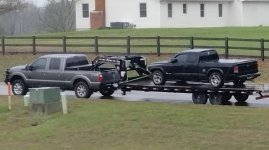
It's home! Thinking of a name, nothing comes to mind as yet. It has few more miles than I thought, miscommunication with my brother, it has 136k. Runs great, my brother replaced the fuel pump and fuel injectors, did an oil change and it fired right up. There are no brakes at all, I don't see any leaks, so I'm going to start with a new master cylinder and work my way through the system. I will end up replacing everything before it gets on the road.

It had a broken 1/4(?) window, so the carpet and headliner ended up getting thoroughly trashed. I pulled both today, really helped with the smell. The seats, panels, etc. are in great shape, worst being driver seat bottom cushion crushed on the outer bolster. All need a good cleaning and I ordered a vinyl floor covering to replace the carpet.

I hate to do it, but I'm going to sell Cletus, my 00 Ram 2500, but not before I swap out the 410 and install the 5.9 from the R/T along with a 5 speed, that'll finance a good portion of the repairs and put a little aside to make my wife happy.

In the trade I got ended up with another K frame, upper and lower control arms, a pair of fenders, a pair of bezels and fair condition marker lights. Doc I need to get with you about the grille.
 

Attachments

  • IMG_20230317_152556128~2.jpg
    IMG_20230317_152556128~2.jpg
    201.1 KB · Views: 3
I yanked the full interior, the cab been sealed up for a year after the window was replaced and the carpet was saturated. I could've probably shampooed the carpet, but I want a vinyl floor because I use my trucks as trucks and I will eventually be climbing in and out with muddy or otherwise dirty boots. I'm in the process of cleaning up the seats, side panels and dash, even the console isn't a totally worn out, rattle trap! I'm pleasantly surprised everything is in great shape.

I got to work on the non-existent brake pedal, started with a new master, after bench bleeding the old one to no avail. Started pumping the pedal and found the front brake lines were Swiss cheese on the left side on the frame rail, so I ordered the Dorman brake line kit, half of which ended up being wrong, so I ordered another. Hopefully I'll have the rest of the correct pieces, no I don't want to bend my own lines.

I also started pulling the motor, figured I'll get that started so I can get a parts list together for this truck.

Anyone have any tips on something I can use to get the foam off the headliner panel? The panel itself seems to be some kind of plastic.
 
The foam that is above the cloth.
 

Attachments

  • IMG_20230402_174149183.jpg
    IMG_20230402_174149183.jpg
    3.9 MB · Views: 2
  • IMG_20230402_174127937.jpg
    IMG_20230402_174127937.jpg
    3.8 MB · Views: 2
ooof good luck, "if" the backing is plastic and not "compressed ridged fiber" you could take a pressure washer to it.....ueualy by now that foams disintigrated and doesnt need removed
 
I think the moisture kept it intact. I watched a couple videos about this, it seems to be a common query. I think I'll take a plastic putty knife and scrape it, then wipe it with goo gone.
 
test the goo gone in a corner of the other side of the liner and see wha happens..give it 24 hours....ive seen it take that long to show weird signs
 
This is inside the club cab portion on the truck on the driver's side. I'm going to hit it with a wire brush on my drill to knock off the roughest portion, use some Evapo Rust to get the rest and paint it with rust reformer on the inside. I'll clean up the bottom side of the truck the same way and undercoat it.
IMG_20230319_184906309.jpgIMG_20230319_185043970.jpg
 
I ordered the brake line kit, front to rear was perfect, the lines from the master to prop valve and ABS unit were great, the front lines were completely wrong. I tried to bent them to fit, but being stainless when I tried to flare them my tool was totally inept. I ordered a roll of tubing to bend my own. I really didn't want to do, but I'll get after it in the next few days. I'm going to replace all the brake components at the wheels and rebuild the calipers to save a few bucks over buying reman.

The previous owner removed the main catalytic converter, but left the pre-converters in place and had a custom 2-1/4" true dual exhaust bent up with pair of Flowmaster Super 10s. I haven't driven it yet, but if they're obnoxious inside the cab they'll end up going away.
 
Here's the cam I'm going to put in my 410, it has 9.5:1 compression, stock heads with 2.02/1.625 intake exhaust valves and it's port matched, a 52mm throttle body and shorty headers.

 
Vacuum it out as much as possible prior to starting. Unless there's a hole in there, I don't expect Evapo-rust is going to do much--it works much better when flowing. If there's room, and it's sealed, you could rig up a little aquarium or sump pump to move it around.

The only rust remover like that I use anymore is Esprit Performance concentrate. They don't sell you any water, you have to add that on your own... which means you can make the solution as strong or weak as you want (5-20 gallons from a single gallon of Esprit). For awhile I was using Safest Rust Remover, which is more effective than Evapo-Rust but not available locally. When Evapo showed up I started using that, even though it was less effective, because I could get it through work without shipping. Last I knew, with shipping the Esprit was around $100/gallon, but considering you'll get 15+ gallons at Evapo strength for your dollar, it's a bargain. Even using distilled water (which is best) it's still far cheaper long-term. Mixed 5:1 it's an absolute beast compared to the others--and still cheaper.

I don't think the rust converter will do much for you, to be honest. Clean it out the best you can, prime it, and spray it. Even rattle-can paint is better than nothing. Do the same on the outside, but I'd suggest passing on the undercoating entirely. Eventually undercoating/bedliner will work loose over sketchy metal, which leaves a void where moisture can collect. You'll have a hole long before you realize it (when the coating finally fails). Watch the video I linked to here and check out the results. You'll see why I'm now firmly in the prime/paint/let cure then Fluid Film or CRC 06026 camp.
 
This is inside the club cab portion on the truck on the driver's side. I'm going to hit it with a wire brush on my drill to knock off the roughest portion, use some Evapo Rust to get the rest and paint it with rust reformer on the inside. I'll clean up the bottom side of the truck the same way and undercoat it.
View attachment 25216View attachment 25217
I hope you don't have rot in the cab mounts like 99.99% of them do.
 
This is the only rust on the body, and it's from a broken window. I still have the entire interior out minus dash and everything above the window line. The musty odor is not going away.

Underneath it's in great shape, save the hard brake lines and rear sway bar being seriously pitted.
 
Last edited:
You're not wrong. I would expect the RPM range of that cam to be even lower on the stroker engine, with the restrictive heads and intake being limiting factors. It'll pull stumps and trailers with ease, but five grand is probably pushing beyond its useful powerband. It'll do the typical Magnum "fall on its face at 4,800RPM" trick, but also do mile-long burnouts effortlessly.
Something you'll want to consider, though, is your fuel injectors. With no other changes, 50 extra cubes means you've increased your displacement--and hence your required airflow--by approximately 14%. One would expect the cam change to increase that requirement further (otherwise, why do it? 😄). A factory injector's flow rating is about 15-20% greater than its maximum duty cycle--i.e., at 100% power output, (and hence injector pulsewidth or "open time") the injectors are only flowing 80-85% of their rated flow potential.
That might lead one to think it's fine--the injectors would theoretically run right around 95-100% duty cycle. However, unlike other examples where duty cycle can be forced beyond 100% (welders, generators, etc.), EFI duty cycle cannot exceed 100%. It's physically impossible--the injector can only be open for the length of one engine cycle before it has to open again. There is no software workaround; there's no tuning that can remedy it. If anyone tells you otherwise, they're a liar (and probably trying to sell you something).
The first problem is heat. To maintain 100% duty cycle, neither the injectors nor their drivers in the PCM can have any cooling time, at 95% component life suffers dramatically. The injector is cooled somewhat by fuel passing through it, but the injector drivers don't have that luxury. A failed injector can be changed, but have you ever looked inside your PCM? Never mind the tricky surface-mount soldering--everything's buried under half an inch of potting compound. You can't even see the drivers.
The other problem is A:F ratio (and hence heat again). If it runs lean--and it probably will--it will run hot, likely to the point of destruction during exuberant driving. You can keep it out of detonation by pulling timing via tuning, but there's not a damned thing you can do about insufficient fuel delivery from the OE injectors. Late timing (if you can even tune that--twisting the distributor does nothing) exacerbates the heat issue. MAP-calculated EFI PCMs are as strict as Catholic school nuns, so any tuning error is hard-coded with no compensation.
I know I've mentioned this in the past, but I've seen the same thing tried by using a 350 EFI setup on a Chevrolet 400. Before that engine was even built, I told him it would melt or detonate itself due to running lean--but I don't know anything about Chevrolets. He was confounded by it always running hot regardless of thermostat rating or where he tried to set timing (similar setup to yours). My repeated explanation of insufficient fuel was worthless because not I'm a Chevy guy. It seized during one spirited example of showing off. The block was scrapped with the piston/rod assemblies still in it. They were melted in place, literally unremovable. That was $2,500 in tuition for the lesson learned. That engine had a knock sensor; yours doesn't. Forged pistons melt; hypereutectics explode.
Since there's no way to know your pulsewidth, either existing or what the new engine will require, I'd suggest increasing the injector flow rate by about 20-25%. 24lb/hr should be fine, and since those are still relatively low flow, high-impedance injectors shouldn't be a great expense (Ford part #M-9593-LU24A would be a wise choice, $227/set from Jeg's). Don't go any larger unless you want to replace the fuel pump too. EFI is fickle.
You've got a lot invested already. This is no place for cut corners or crossed fingers. Long-term, it won't be "fine".
Moved this here so not to add extra, unrelated comments to b-body-bob's Duster progress.

I did swap to larger injectors, I think they're stock 4.6 Mustang replacements (24# ?), I'll definitely be upgrading to larger injectors with the cam swap. I plan on using Flyin Ryan Performance for tuning. I did contemplate converting to e85 in the future, solely for the decrease in cost at the pump 🤣.
In your opinion Doc, should I run dual A/F gauges to keep an eye on both banks, since I have true dual exhaust?

I'll collect the parts for that after I get it back together and moving under its own power.
 
Last edited:
If you've already got 24lb injectors, you're fine. Verify that you do. Switching to E85 probably isn't possible, at least in a dual-fuel configuration, with your PCM which has no input nor algorithm for sensing alcohol content. Plus, you'd need to jump up to 34lb injectors and get a better fuel pump. Then, on E85 you'd burn 35% more fuel (E85 is not a cost savings a'tall). You can add more timing with E85, but the wedge head can't really use much more than 34-36° of timing, so there's no advantage to pushing the timing any further with E85. If you were under boost, it'd be a different tale.
Dual A:F gauges won't really do much good since there's nothing you can do to rectify the mixture issues that the OE PCM won't do on its own with fuel trims. You could run dual WB sensors with a single gauge, and switch between, but even that seems a bit overkill. You won't have distribution issues with the OE manifold, and if you lost an injector all the extra readout would do is tell you on which bank it resides. The OE PCM should be able to diagnose the exact cylinder with a simple code reader.
With your setup, I'd be more likely to run a fuel pressure gauge than a WB. You can do nothing about mixture since you're using a modified factory program, but if your fuel pump fails at least you'll have a chance to save the engine from melting down.
Do not use Bosch O2 sensors, especially not the WB versions, unless you will never run anything but ethanol-free fuel. Both ethanol and methanol kill Bosch sensors. It's a known issue.
 
Do not use Bosch O2 sensors, especially not the WB versions, unless you will never run anything but ethanol-free fuel. Both ethanol and methanol kill Bosch sensors. It's a known issue.
FWIW, you told me that and after about 200 miles or so the check engine light came on.
 
Picked up my camshaft yesterday, fortunately it was in stock at Summit Racing, unfortunately it was a little pricey 😭 I'll start the cam swap tomorrow.

Do you think I'll need to upsize my injectors again Doc, I did verify I have the 24# Ford versions in place.
 
Probably not. Despite the lift increase, the duration is virtually identical to the OE cam. It might be phased a bit differently, but not enough to warrant an injector change.

Picked up my camshaft yesterday, fortunately it was in stock at Summit Racing, unfortunately it was a little pricey 😭 I'll start the cam swap tomorrow.
Man, what a stroke job that is. That's almost $200 more than I paid for a custom-ground Lunati solid roller.
 

SiteLock

SiteLock
Back
Top