Jester's Progress...

Nice...been a long time since I had a collector plated car, the wagon has too many mods and deterioration to allow it to qualify. :(
 
Ah. Now that makes sense, I was baffled until feeling the starter engage for a split second, and followed a hunch. You explain things so well, Jass. Thank you for being smart. 🍻
Well, it took me awhile to add up what I was reading and actually think of flyback, but I'm pretty sure that's your problem. As far as how it would engage the starter without a trip on the solenoid, that's another funny thing about the process: when the flyback generates that voltage through the main power wire, it's an AC voltage, same as an ignition spark. For that split second, every coil in the system (including your stator and field in the starter) momentarily switches polarity--just enough to cause the starter to engage (the other side of the AC voltage being the ground plane).

Ignition spark has no such repercussions because its amperage is virtually nil, as opposed to the huge amount of amperage your battery is capable of supplying to your alternator coils.
 
Nice...been a long time since I had a collector plated car, the wagon has too many mods and deterioration to allow it to qualify. :(

Period correct mods are permitted. If you can work certain angles to take pictures which don't show much deterioration, they just might give you those collector plates.

Unfortunately, ICBC does not allow you to drive the car to work or school, but my commute is 200+km (120 Miles) round trip per day. That's what the old :poop:box Civic is for...
 
Well, it took me awhile to add up what I was reading and actually think of flyback, but I'm pretty sure that's your problem. As far as how it would engage the starter without a trip on the solenoid, that's another funny thing about the process: when the flyback generates that voltage through the main power wire, it's an AC voltage, same as an ignition spark. For that split second, every coil in the system (including your stator and field in the starter) momentarily switches polarity--just enough to cause the starter to engage (the other side of the AC voltage being the ground plane).

Ignition spark has no such repercussions because its amperage is virtually nil, as opposed to the huge amount of amperage your battery is capable of supplying to your alternator coils.

I've never even heard of flyback, but my memory is like swiss cheese. You explained what most everyone would consider dark voodoo "The starter engages itself! It's Christine!".
 
Well, I removed the relay and wired the car back up. Started the engine and turned it off. Then turned key to ign on, and off again. The starter engaged for a split second like before.

Now I know it is voodoo! Lol, maybe I have a bad alternator or ign switch.
 
Well, with it doing it on just a key on/off then my hunch is the ignition switch. I thought this was something that only happened when you shut the engine off. A simple key cycle has nothing to do with the alternator. If charging was normal while it was running, I wouldn't worry about the alternator.
 
Ah. Actually it happens at various times when turning it off. I suspect ignition switch, but maybe something to do with the MAD electrical bypass done a few years back.

Oh yeah, going to unhook that broken voltmeter too... Ghosts. Ghosts and voodoo.
 
I say ignition switch Jester.

Also as a side thought. You said you used dielectric grease in the bulkhead connector. I have found over the years that most people use way too much of the stuff! It does NOT conduct electricity. People think it does and they pack the connectors full then slam them together actually causing more connection issues because the grease hydraulically expands the contacts. I see this exact issue A LOT at work.
 
I say ignition switch Jester.

Also as a side thought. You said you used dielectric grease in the bulkhead connector. I have found over the years that most people use way too much of the stuff! It does NOT conduct electricity. People think it does and they pack the connectors full then slam them together actually causing more connection issues because the greas1e hydraulically expands the contacts. I see this exact issue A LOT at work.

Thanks, Stretch. Going to replace the ignition switch and go from there.

I barely use any of the dielectric grease. Checked some connections earlier and saw just a trace of it, so was thinking "where did it go?" I guess it just dried up. I'm too cheap to use lots 🤣
 
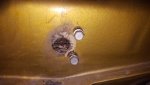
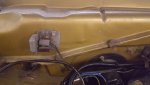
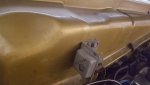
Was following wiring in the engine bay last night, and noticed this little doodadamabob. Had no idea what it is/was, and went to bed.

Laying there, I was thinking wtf is it? Then it hit me. California car... Emissions crap. Wiring looks like it goes to the friggin' ballast resistor.

Wee! Should I remove it and the wiring?
 

Attachments

  • 20200420_105521.jpg
    20200420_105521.jpg
    3.9 MB · Views: 5
  • 20200420_105529.jpg
    20200420_105529.jpg
    4.1 MB · Views: 5
There's a hole behind it full of junk. And the wires ran to the ballast resistor, a speed sensor thing between the speedo cable, and a random wire by the coil (which wasn't connected to anything)
 

Attachments

  • 20200420_112004.jpg
    20200420_112004.jpg
    5.5 MB · Views: 2
I tried an online search for the part number and there seems to be some speculation as to it being part of a NOx system, but the NOx parts usually control the spark advance (at least in some applications). The hole is just open to the cowl to aid in cooling the transistor mounted to the back of the unit, so that garbage is rodent/treefall/generally being outside crap that usually collects in cowls.|

I'm not sure how it works, but I'm guessing it does something with the spark intensity based on speed, if it's got a sensor in the speedometer cable. It possibly re-amplifies the voltage input to the coil under certain circumstances. Not really sure, but it does seem to be a CA thing.

Another result thought it was something for AC, but I don't think that would have anything to do with the speedometer cable. AC cutouts (cop cars had 'em) were implemented differently, and obviously you'd have a wire going to the AC clutch that I don't even know if your car has. 😁
 
I tried an online search for the part number and there seems to be some speculation as to it being part of a NOx system, but the NOx parts usually control the spark advance (at least in some applications). The hole is just open to the cowl to aid in cooling the transistor mounted to the back of the unit, so that garbage is rodent/treefall/generally being outside crap that usually collects in cowls.|

I'm not sure how it works, but I'm guessing it does something with the spark intensity based on speed, if it's got a sensor in the speedometer cable. It possibly re-amplifies the voltage input to the coil under certain circumstances. Not really sure, but it does seem to be a CA thing.

Another result thought it was something for AC, but I don't think that would have anything to do with the speedometer cable. AC cutouts (cop cars had 'em) were implemented differently, and obviously you'd have a wire going to the AC clutch that I don't even know if your car has. 😁
Non A/C car as far as I know :unsure:


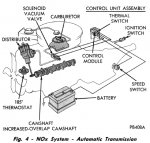
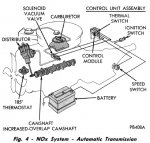
Found it. Nox for sure...

I'll just delete the wiring and plug the hole with a rubber cap if I can find the right size. The rest of the system is missing and original carb and intake are long gone.
 

Attachments

  • nox.jpg
    nox.jpg
    114.8 KB · Views: 6
  • Demon Emissions Speed Switch 001.jpg
    Demon Emissions Speed Switch 001.jpg
    87.8 KB · Views: 6
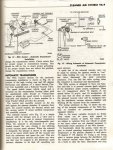
The confusion in the few results I'd found were because apparently there's a different apparatus in that location on some cars that also has vacuum lines going to it.

There's apparently a factory block-off plate for that hole as well, complete with gasket. I'm not sure why, since cars that didn't use it apparently just have dimples in the firewall where the screws would go--they're not drilled/stamped for it. :unsure:
 
Hmm
The confusion in the few results I'd found were because apparently there's a different apparatus in that location on some cars that also has vacuum lines going to it.

There's apparently a factory block-off plate for that hole as well, complete with gasket. I'm not sure why, since cars that didn't use it apparently just have dimples in the firewall where the screws would go--they're not drilled/stamped for it. :unsure:
That plate would be nice to have. Hmm... maybe attach one of those bolts to the ground loop.
 
I wonder what the increased overlap camshaft is all aboooot, eh?
 

Attachments

  • nox.jpg
    nox.jpg
    114.8 KB · Views: 4
The increased overlap hangs the exhaust open longer to increase "natural" EGR (exhaust restriction leaving spent gases in the chamber). It's a trick Chrysler has used for years to lower oxides of nitrogen without the expense of adding an EGR valve. Chrysler taught the Cummins boys this trick; one of the hop-ups for the later 5.9s was to use the earlier (24V) 5.9 cam timing. No parts other than gaskets required, just move the cam.

Being that you've got rather fixed cam timing, in regards to intake v. exhaust, you'd have to swap to a non-CA cam. It's doubtful that the results would justify the expense. You could run an additional bit of lash on the exhaust rockers, but at the expense of additional noise (valvetrain clatter).
 
Finally got around to finishing the ignition switch replacement, and the starter still energizes for a split second when turning from ign to off.

Either something is wired wrong, or maybe the ignition relay is going wonky? I have a new one to try.

on another note, the battery voltage across the battery terminals is 15volts with a fully charged battery, while idling. If I put the positive test lead to the high side of ballast resistor, it reads 14.1ish. So the Voltage regulator is seeing the proper voltage. Voltage drop in the harness somewhere?
 
I'm befuddled. Not sure what could happen inside the relay to make that sort of thing happen... but there's not a lot else it could be at this point. :unsure:

The car's pretty clean, but it might be worth taking apart the bulkhead disconnect in the wiring harness to check for corrosion and clean--or have we already done that? I forget.
 

SiteLock

SiteLock
Back
Top