

Dr.Jass
Pastor of Muppets
I ordered some of these a few months back for the reception area of the diesel shop, and the results have been so good I've started to get them for my own garage as well. They're not inexpensive, costing about $17.50 U.S. per bulb, but with a 5-year warranty and an expected lifespan of 45,000 or more hours I think in the long run it will be a wise investment.
In case you don't feel like reading the ad, they're UL Listed, have the above-stated warranty, and are only marginally less bright than a new fluorescent bulb. However, fluoro bulbs dim 20% or more over their significantly-shorter lifetime (8,000 hours) whereas the LEDs dimming is far less dramatic. My former boss' cousin is a salesman for industrial electrical fixtures and supplies, and recommended replacing fluorescent bulbs long before they actually burn out. We did that in the main shop about a year ago, and simply replacing still-working bulbs with new ones made an enormous difference in the brightness in the shop. Coupled with the fact that these LED replacements should last nearly six times as long, in the long run they'll probably end up costing similar money to buying fluorescent bulbs, if not a little less. Since the ballast is taken out of the equation on the ones I bought, I'll never need to replace a ballast, either (or, as is often the case with 4-footers, the whole fixture).
The conversion is easy; all you do is bypass the ballast and wire the "tombstones" to direct 110V. If you have shunted tombstones, not to worry--replacement non-shunted ones actually come with the bulbs!
Drawbacks? Well, they don't light up all the way around so the dispersion isn't quite as good as it is with fluorescents. Then again, much of that light is normally absorbed by the ceiling anyhow. The flip side is that all the lumens are firing down towards where you're working. Regardless, in most cases your fixtures are mounted high enough that you'll never notice. Also, we ordered the clear lenses for the shop reception area, and even behind diffusers the light is still a bit harsh. I ordered the frosted lenses for myself and the light is virtually identical to the old bulbs, right down to the "heat" or color: 4,000°K. For "around the house" use they also offer a "warm white" which is 3,500°K. It's not as bright (probably a good thing in the kitchen) but much closer to the light cast by an incandescent bulb. They're also avaliable in 5,000°K, which are brighter than a standard fluoro but have that ultra-white, almost blue tint to them. That light tends to give me eye fatigue so I stuck with what I know works.
Another drawback is that the bulbs I bought will only work installed into the fixture one way. When you wire the tombstones hot, you only do it at one end. Put the bulb in backwards, and nothing happens. Hyperikon also offers plug-and-play, ballast-compatible bulbs that wire differently and are hot at both ends; if (when) the ballast does fail you then simply bypass it completely and save 8 more watts of electricity in that fixture. The plug-and-play bulbs can go in either way and work just fine, and the cost is similar.
That's it. Those are the two drawbacks, neither of which seemed even close to a deal-breaker for me. I simply marked the fixture "LED only" and noted the "hot end" so I put the bulbs in the right way. The light dispersion simply isn't an issue.
The big deal here, of course, is the energy savings. The LEDs are wired directly rather than through the ballasts, and consume 18W per bulb while generating 2,100 (clear lens) or 2,030 (frosted lens) lumens. The typical 4-foot fluoro bulb consumes 40W to generate 2,200 lumens, plus about 4W/bulb at the ballast. So instead of consuming 88W per fixture, it's down to 36W. That's a 59% reduction in electricity used per fixture. I have eight 4-foot fixtures, which currently consume a total of 704 watts with ballasts and traditional fluoro bulbs. One remains lit as a security light in my garage 24/7. Changing to the LEDs and eliminating the ballasts will drop that to 288 watts, which should make a considerable dent in the electrical bill during the garage-heavy winter months. To that end, about a year ago I replaced all the bulbs in my home with LEDs (and a couple of CFLs) and noticed an immediate change in my electrical bill so I'm expecting great things from this upgrade.
If you've got a bunch of fixtures like I do, it's possibly an upgrade you'll want to do over time due to the expense involved. But the bulbs at the shop convinced me to take it on at home, and hopefully when I've completed converting all my fixtures I'll be able to report back with any dramatic savings on electricity. Mind you, I still have three 8-foot fixtures in the garage into which I recently installed new bulbs and digital ballasts, so I'm not changing those just yet. Plus, those bulbs are about $40 each and only sold in 4-packs at the moment, so I'm in no huge hurry to drop those dollars. We'll see, though. If the 4-footers show instantaneous value on the electrical bill, I may do it sooner than expected.
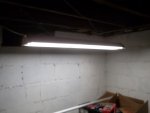
This is the converted fixture over my basement workbench. I didn't take before/after pictures, but trust me--it's a lot brighter now than it was with the two-year-old 40W fluorescent bulbs that were in it. I couldn't get my camera to focus worth a damn, but you get the idea.
In case you don't feel like reading the ad, they're UL Listed, have the above-stated warranty, and are only marginally less bright than a new fluorescent bulb. However, fluoro bulbs dim 20% or more over their significantly-shorter lifetime (8,000 hours) whereas the LEDs dimming is far less dramatic. My former boss' cousin is a salesman for industrial electrical fixtures and supplies, and recommended replacing fluorescent bulbs long before they actually burn out. We did that in the main shop about a year ago, and simply replacing still-working bulbs with new ones made an enormous difference in the brightness in the shop. Coupled with the fact that these LED replacements should last nearly six times as long, in the long run they'll probably end up costing similar money to buying fluorescent bulbs, if not a little less. Since the ballast is taken out of the equation on the ones I bought, I'll never need to replace a ballast, either (or, as is often the case with 4-footers, the whole fixture).
The conversion is easy; all you do is bypass the ballast and wire the "tombstones" to direct 110V. If you have shunted tombstones, not to worry--replacement non-shunted ones actually come with the bulbs!
Drawbacks? Well, they don't light up all the way around so the dispersion isn't quite as good as it is with fluorescents. Then again, much of that light is normally absorbed by the ceiling anyhow. The flip side is that all the lumens are firing down towards where you're working. Regardless, in most cases your fixtures are mounted high enough that you'll never notice. Also, we ordered the clear lenses for the shop reception area, and even behind diffusers the light is still a bit harsh. I ordered the frosted lenses for myself and the light is virtually identical to the old bulbs, right down to the "heat" or color: 4,000°K. For "around the house" use they also offer a "warm white" which is 3,500°K. It's not as bright (probably a good thing in the kitchen) but much closer to the light cast by an incandescent bulb. They're also avaliable in 5,000°K, which are brighter than a standard fluoro but have that ultra-white, almost blue tint to them. That light tends to give me eye fatigue so I stuck with what I know works.
Another drawback is that the bulbs I bought will only work installed into the fixture one way. When you wire the tombstones hot, you only do it at one end. Put the bulb in backwards, and nothing happens. Hyperikon also offers plug-and-play, ballast-compatible bulbs that wire differently and are hot at both ends; if (when) the ballast does fail you then simply bypass it completely and save 8 more watts of electricity in that fixture. The plug-and-play bulbs can go in either way and work just fine, and the cost is similar.
That's it. Those are the two drawbacks, neither of which seemed even close to a deal-breaker for me. I simply marked the fixture "LED only" and noted the "hot end" so I put the bulbs in the right way. The light dispersion simply isn't an issue.
The big deal here, of course, is the energy savings. The LEDs are wired directly rather than through the ballasts, and consume 18W per bulb while generating 2,100 (clear lens) or 2,030 (frosted lens) lumens. The typical 4-foot fluoro bulb consumes 40W to generate 2,200 lumens, plus about 4W/bulb at the ballast. So instead of consuming 88W per fixture, it's down to 36W. That's a 59% reduction in electricity used per fixture. I have eight 4-foot fixtures, which currently consume a total of 704 watts with ballasts and traditional fluoro bulbs. One remains lit as a security light in my garage 24/7. Changing to the LEDs and eliminating the ballasts will drop that to 288 watts, which should make a considerable dent in the electrical bill during the garage-heavy winter months. To that end, about a year ago I replaced all the bulbs in my home with LEDs (and a couple of CFLs) and noticed an immediate change in my electrical bill so I'm expecting great things from this upgrade.
If you've got a bunch of fixtures like I do, it's possibly an upgrade you'll want to do over time due to the expense involved. But the bulbs at the shop convinced me to take it on at home, and hopefully when I've completed converting all my fixtures I'll be able to report back with any dramatic savings on electricity. Mind you, I still have three 8-foot fixtures in the garage into which I recently installed new bulbs and digital ballasts, so I'm not changing those just yet. Plus, those bulbs are about $40 each and only sold in 4-packs at the moment, so I'm in no huge hurry to drop those dollars. We'll see, though. If the 4-footers show instantaneous value on the electrical bill, I may do it sooner than expected.
This is the converted fixture over my basement workbench. I didn't take before/after pictures, but trust me--it's a lot brighter now than it was with the two-year-old 40W fluorescent bulbs that were in it. I couldn't get my camera to focus worth a damn, but you get the idea.


