
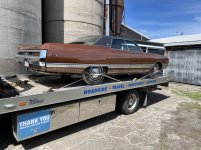
Crap. The New Porker is home.

dodgechargerfan

In a 55 gallon drum, floating down river, and
Staff member
But it needed help.
9E1B5D41-448D-4DEF-929E-BEB695D01D75.jpeg

It started up and run pretty well after a few cranks to get the fuel going.
For about 45 seconds. Then it quit. It turns over but doesn’t fire.
Its getting fuel.
There’s 12.5-ish volts at the coil. Battery is new last year and spent the winter on a charger/maintainer and tested very strong this morning.

I suspect the Pertronix ignition system.

I have the old points still, but I wasn’t prepared to swap them at the storage facility.
I think that’ll be the first thing I try, but not today. I’ve had enough.

Any other thoughts and guidance is welcome.

Oh, yeah. Is it normal to see a puff of smoke come out of the negative battery cable when you’re cranking the engine?
It happens right where the cable and the terminal end meet.
It‘s an old cable. Probably original. I’ve been shopping for a replacement for a few years now. I guess it’s time to bite the bullet and just get what I can get instead of worrying about ‘correct’.
 
Now if I can find something. I think I’m going to have to get something from Painless.
I don’t care about original-looking anymore.
why would you ever order anything from painless?...they only make crap

at that point just go get a new end and clamp it on lol
 
why would you ever order anything from painless?...they only make crap

at that point just go get a new end and clamp it on lol
It’s the only thing I’ve found that looks half decent.
and it’s just battery cables, not a complete harness or anything like that.

There is nothing specific for the 70 and C-Body in the aftermarket.
I haven’t been able to determine, yet, if something from another year would fit.
 
Is there something grossly specific about the negative cable? Multiple take-off leads or something? If you don't like the big plastic butt connector of a parts-store negative cable, cut the plastic off it. Slide on a piece of black heat-shrink tubing, crimp, and conceal.

Did you actually test for spark? Is that voltage at the coil in the run position, or while cranking? Pertronix Ignitors are pretty bulletproof; the one I've seen fail was installed incorrectly. Farmer Bob ran the red wire to the coil and grounded the black wire to the distributor. It blew a hole in the back of the Ignitor when he keyed on, which was how the smoke escaped.

One thing to remember about the Pertronix: It grounds through its baseplate via the distributor body, not the black wire. If you're having severe voltage drop through a bad cable, it may not be enough for the module to work--especially if your block is painted at the distributor's contact point, or there's a gasket there. If that's the case, then it has to ground through the intermediate shaft and camshaft. Oil is not conductive, which exacerbates the issue. Run a jumper wire from the battery (-) post to one of the screws on the distributor body and see if that changes anything.

Probably look at the length of a negative battery cable form a 71-74 B-body...might work?
I'll bet one from a small-block application would be long enough.
 
Is there something grossly specific about the negative cable? Multiple take-off leads or something? If you don't like the big plastic butt connector of a parts-store negative cable, cut the plastic off it. Slide on a piece of black heat-shrink tubing, crimp, and conceal.

Did you actually test for spark? Is that voltage at the coil in the run position, or while cranking? Pertronix Ignitors are pretty bulletproof; the one I've seen fail was installed incorrectly. Farmer Bob ran the red wire to the coil and grounded the black wire to the distributor. It blew a hole in the back of the Ignitor when he keyed on, which was how the smoke escaped.

One thing to remember about the Pertronix: It grounds through its baseplate via the distributor body, not the black wire. If you're having severe voltage drop through a bad cable, it may not be enough for the module to work--especially if your block is painted at the distributor's contact point, or there's a gasket there. If that's the case, then it has to ground through the intermediate shaft and camshaft. Oil is not conductive, which exacerbates the issue. Run a jumper wire from the battery (-) post to one of the screws on the distributor body and see if that changes anything.


I'll bet one from a small-block application would be long enough.
Nope. It’s basic. Runs to the block. I just want a decent connector and a length that is correct or close enough to not interfere with anything.
The stuff that shows up at the parts stores is those thin clamp things.

That voltage was in the run position.

This all ran great for years. Nothing has changed with the hookups.

The battery cables are old and ugly and need replacing anyway. The puff of smoke was a first for me.
 
We (so far) still have good ol' lead clamps on ours. I doubt that'll last much longer.

In the run position, you should not have ~12V at coil (+). It should be lower, around 8-9, because the coil is fed by the ballast resistor. The only time the coil should be fed the full 12V is during starting. A full 12V will smoke the factory-style coil in very short order, although the Ignitor will survive considerably more. Look around the coil for any evidence of leaked oil, which is a sign of failure.

Also, figure out why you've got 12V+ at the coil in Run. Something's amiss there. Ignition switch/wiring? Shorted ballast (can't say I've seen it happen, but...)? Who knows what evil lies in the hearts of rodentia? The stored Mopar knows...
 
We (so far) still have good ol' lead clamps on ours. I doubt that'll last much longer.

In the run position, you should not have ~12V at coil (+). It should be lower, around 8-9, because the coil is fed by the ballast resistor. The only time the coil should be fed the full 12V is during starting. A full 12V will smoke the factory-style coil in very short order, although the Ignitor will survive considerably more. Look around the coil for any evidence of leaked oil, which is a sign of failure.

Also, figure out why you've got 12V+ at the coil in Run. Something's amiss there. Ignition switch/wiring? Shorted ballast (can't say I've seen it happen, but...)? Who knows what evil lies in the hearts of rodentia? The stored Mopar knows...
I left out some info.
I have bypassed the ballast resistor as per the Pertronix instructions.
I have the Pertronix coil as well.

I was leery about bypassing the ballast resistor when I first installed the kit, but it didn’t work at all with the resistor in play. It fired right up after bypassing it and has run like a champ for years…5 or 6, I think.
 
actualy doc, i HAVE smoked a few ballasts in my 69, of course the alt liked to randomly spike above 14v and hold it at idle even under load..it was like 14 was the MIN point often seeing 18+...at the time a battery would last me about 3 weeks being boiled alive, id blow a ballast every couple months ditto for a volt reg..it was a very angry alt, and a reman at that

im pretty sold only high sustained voltage kills those balasts and nothing else
 
I left out some info.
Don't do that.

That puts me back to checking the voltage drop to the Pertronix via its ground through the distributor. The fact that you had to bypass the ballast to get it to even run indicates this may well be the issue. I've never had to bypass the ballast or change the coil to get an Ignitor to work.*

*
I bypassed the ballast internally on the Valiant, but that was due to using an Ignitor III, which requires their high-output non-ballast coil. The Ignitor III actively controls dwell, which is the function of the ballast resistor on Chrysler ignition systems (and the original Ignitor when so equipped
).

actualy doc, i HAVE smoked a few ballasts in my 69, of course the alt liked to randomly spike above 14v and hold it at idle even under load..it was like 14 was the MIN point often seeing 18+...at the time a battery would last me about 3 weeks being boiled alive, id blow a ballast every couple months ditto for a volt reg..it was a very angry alt, and a reman at that

im pretty sold only high sustained voltage kills those balasts and nothing else
What you're describing is a ballast going open circuit when it fails. A short across it is the exact opposite. I've never had a ballast fail personally, but I have failed ones. Not once have I seen one short, where resistance across the resistor went to zero. In fact, I don't even believe that's possible. They can short to ground, but that's exceedingly rare and lasts only a few seconds at most before the resistance wire melts itself free.

Anyhow, your super-high voltage condition was/is caused by a short in the field circuit somewhere. First place to look is the brush holders. They eventually disintegrate and allow a short to the alternator case. At that point, the regulator has no control and they can put out voltage well into the 20s. Another bad spot is the '69-older electromechanical (thermal) voltage regulators. They have a nasty reputation for sticking when they're old. It's why I trashed the one on the Valiant and uprgraded to the bulletproof '70-up electronic regulator.
 
Don't do that.


* I bypassed the ballast internally on the Valiant, but that was due to using an Ignitor III, which requires their high-output non-ballast coil. The Ignitor III actively controls dwell, which is the function of the ballast resistor on Chrysler ignition systems (and the original Ignitor when so equipped
).
I left out more info.

It’s an Ignitor III kit.


Where’d the smilies go?
 
oh your sooo busted on the lack of full disclosure LOL

doc funny enough the alt was a reman and it was the fault, but hey that was back in the early 90s i was young n dumb and shotgunning parts at the problem till i eventualy figured out it was the alt

i DID however find that someone made a heavy duty adjustable voltage volt reg...i managed to find a handfull of them over the years and can tell you that if you can get your hands on one....they actualy work and survive..i feel like it was a vintage echlin part? black case like OE with orange lettering...its been forever since i had to play with that stuff..id have to actualy go check in the cars for it lol

as for my ballast fails they would typicaly just stop outputting any voltage of any kind, to which i assume is an internal melting of the wires..even had 1 or 2 go on my ramcharger...i trust them soo much that EVERY mopar ive got has a spare in the glove box
 
So yeah.
I finally got around to looking at this issue.

Fuel.

There was none.
Or there was just enough to make it fire up for about a minute and smell like the carb was getting some.

The tank was full when it went into storage. That’s another reason why I didn’t consider it as an issue.

So, I hope whomever siphoned my tank dry enjoys the free fuel.
 

SiteLock

SiteLock
Back
Top