

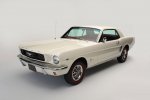
When Scott Meadows brought his 1966 Mustang coupe into Jeff Lilly Restorations in Helote, Texas, the little black 289 V-8-powered “pony” looked like a good “20 footer.” But Jeff Lilly knew better. Little hints, from the twisted bumpers to misaligned fenders, indicated the Mustang had been battered in the past. Lilly’s experience in restoration also told him that multiple repaints can hide a lot of defects on a 45-year-old car, especially when that old car is an early Mustang with a few bumps and bruises.
The recent restoration also set out to correct some of the manufacturing flaws when the car was originally mass produced in 1966. Ford was starting to build its second million run of Mustangs in 1966, offering them in hardtop, convertible and 2+2 fastback models built in plants at Dearborn, Mich.; San Jose, Calif.; and Metuchen, N.J. The cars were available with three- or four-speed manual transmissions or the C-4 automatic behind the 200-cid six-cylinder or one of three 289-cid V-8 engines with V-8 power ratings of 200, 225 or 271 hp. Buyers preferred the V-8 engine, with 58.3 percent of 1966 Mustangs receiving one of the 289 engines.
For 1966, Mustang prices slightly increased with Ford raising the price of the hardtop by $44, the 2+2 by $18 in its second full year on the market and the convertible by $49. That brought the base price of 1966 Mustangs to $2,416 for the hardtop, $2,607 for the 2+2 fastback and $2,653 for the convertible. For 1966, Ford built 607,568 Mustangs, with 72,119 being convertibles, 35,698 of them 2+2 fastbacks and 499,751 of them hardtop coupes, including the project car undertaken by Jeff Lilly Restorations.
Read more.


