1971 Challenger: The "Spare Parts" Car

To those few of us guys who lived by the "t'is far better to repair than replace" creed, those are lightly rusted.
I was pretty decent at filler work, painting, polishing, reassembly, and all that other nonsense, but sheetmetal repair was my Garden of Zen.
 
To those few of us guys who lived by the "t'is far better to repair than replace" creed, those are lightly rusted.
I dunno... the driver's side's pretty hammered. After today, though, I've got most of the plastic out and it's mostly down to original paint or bare metal. I don't think there's anything new left to discover at this point, but she's pretty bad.

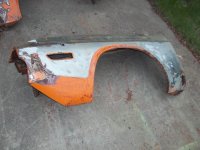
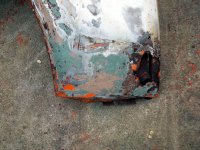
More progress yesterday and today, although it's all further deconstruction of existing paint and damage. Yesterday both fenders got another round of paint stripper rinsed off with the worn "blast" tip of my pressure washer. I got the sides down to the factory Go-Mango paint, and on the driver's side down to the plastic filler in the dogleg area. Paint stripper does a number on plastic filler, as does the pressure washer. I enhanced this picture a bit in Photoshop to better highlight the tracks the pressure washer was making in the filler. If you click on it to enlarge, it's really evident:
100_6008.JPG


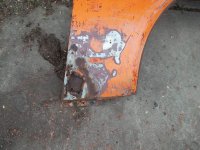
There's not as much evil there as I expected, but I expect most of what's pictured will need to be cut away and replaced with new metal. The passenger's side isn't as bad, but will require surgery nonetheless.
100_6010.JPG

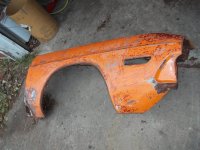
The overall results of yesterday's efforts looked like this today when I started:
100_6009.JPG

100_6007.JPG


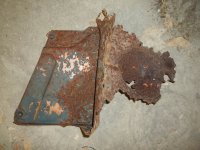
Prior to getting into chemicals and high-pressure rinses, I got after the LH fender with small screwdriver to attack the still-soft filler that was left behind. Here's what I pried free:
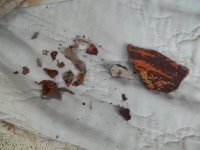
100_6023.JPG


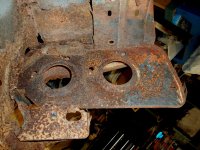
After some attention from a 2" 36-grit disc on the die grinder to move remaining plastic, here's what's left of the LH bumper recess:
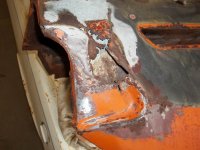
100_6022.JPG


Oof.

After securing a new pressure tip and a couple of scrapers to go after Agnes' roof, I started the chemisty in earnest yet again. My main goal here wasn't to get to bare metal so much as it was to diminish my sanding time. Also with no cap on the container the old paint stripper was starting to crystallize. I needed to use the rest of it prior to it petrifying for good. As I was pouring it, there were large chunks of what looked like rock salt in it that were chunks of solidified stripper. I only needed to work on the tops of the fenders, thank goodness, since I was pretty happy with where I was on the sides. Other than a half-assed round with the stripper and a rinse tip, I'd done very little to the tops.

Chunky-style paint stripper applied. The RH fender is still largely the third coat of orange as evidenced by the remaining stripe above the headlamp area:
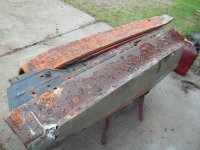
100_6025.JPG


Better living through chemistry. Check out the Dark Burnt Orange beneath the peeling primer. It's hard to tell in the picture, but it was gorgeous (and actually quite shiny). Also notice it's stuck to the back side of the lifted primer:
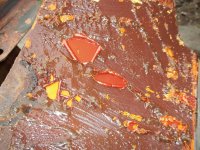
100_6026.JPG


And my results after significant soak time and probably 45 minutes with the pressure washer, still using the worn blast tip:
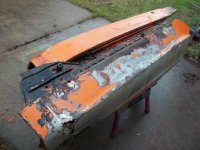
100_6028.JPG


A lot of filler came out of that hole up toward the front of the driver's fender.

Other than the fender tops, the only other place I applied more stripper--because I was literally almost out, so why not--was the forward end of the passenger's side. It's kind of amazing how much worse the driver's side fender is than the passenger's side, considering that the paint trail indicates these fenders have literally spent their lives together. That bumper recess is positively gorgeous by comparison, although not without minor issue:
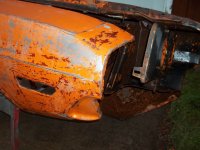
100_6033.JPG

You can also tell a lot more paint is gone from that fender overall even though I only stripped from the area defined by the back edge of the marker lamp forward, and from the center body line to the top edge.
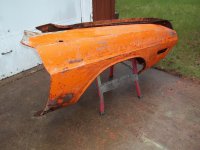
100_6027.JPG


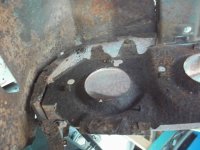
Remember when I said the inner brace behind the headlamp bucket that bolts to the core support is completely shot? Check it out. That line where the two overlap (they're the same piece of metal) should be perpendicular to the bottom edge that meets the outer skin. Yeah, it's bent like that because it's that rotten. The black/dark grey areas are original paint/undercoating, other than the plastic shield bolted to the brace. Thank God these are the same as the later-model fenders!
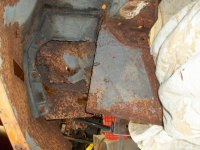
100_6020.JPG


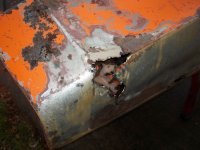
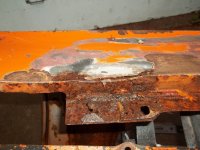
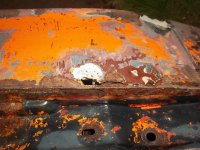
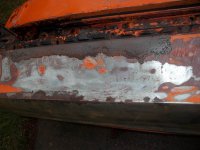
"Highlights" of other damage, all on the driver's side.

Front corner, with multiple shapes and body lines. I can't wait to attempt this:
100_6029.JPG


The rear of the mounting flange, near the hood hinge:
100_6031.JPG


The forward edge of the mounting flange, with a nice hole along the cut line and quite a bit of missing "overlap" metal:
100_6030.JPG


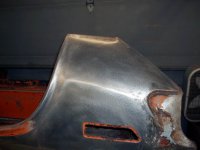
Finally, here's the top of the fender. Coming in from the right, where the orange stops along the upper & lower edges is where the paint also stops. All those dark areas are rust. The pitting is heavy in places but there's very little perforation. I'll either glass bead or soda blast that area and see what's livable and what needs attention.
100_6034.JPG


Overall, I'm very happy with the results of stripping simply because sanding through all that paint would've been nightmarish in terms of both time and cost. I'm gettin' old and discs ain't cheap!

Weather permitting I'll go after 'em again with the sander tomorrow and rattle-can prime to stop flash rusting (which I've already got, visible above). Weather not permitting, I'll work on Agnes' scalp. If the forecast is worth a damn, it'll be Agnes in the AM, fenders later in the day.

 
that passenger fender looks like something we would find here....and honestly something i would buy but haggle hard on....that drivers fender is...uh.....hard pass!..too much bad on too many body lines
 
that drivers fender is...uh.....hard pass!..too much bad on too many body lines
It's only metal. It's not that hard to move around and form. Besides, I have two other front fenders I can use as donors. The bumper recess is the only area that is a bit intimidating, but as a multi-piece patch it shouldn't be too tough. It's just very time-consuming.

What's surprising is that the best fender I have is the passenger's side on that wrecked '74. I'll probably clean and repair that one too, if only for a spare.
 
I'd planned on getting the rest of the LH fender sanded today, and I would've if it weren't for those meddling kids. I started working on Agnes with the garage door open, and some neighborhood kids kept coming up to my driveway trying to get my attention: "HEY!" I dealt with them yesterday and they're decent enough little guys, but I did not feel like wasting time on the finer points of panel refinishing with a 5-year-old or his 7-year-old brother. They couldn't even grasp the concept that repeatedly yelling at someone using an air tool with a compressor running in the background is pointless if they didn't respond to you the first or second time. I waited until they rode up the alley a bit, then proceeded to close the garage door. Sure enough, halfway down I saw tires coming back down the alley and heard "HEY!" one last time.

Since I prefer to sand anything I can outside, preferably on the driveway, that effectively kept me on Agnes until I could sand no further. But, since the fender was sitting on Agnes's decklid anyhow, I did part of the wheel arch and the lower front area below the marker light. It ain't much, but it's something.

100_6044.JPG


Call me an old codger, but when I was that age I'd already been taught that yelling "HEY!" was rude, and that adults deserved more respect. I'm not faulting the children, for the record. Maybe in a few years--when they're past that annoying stage of childhood--if they're still interested, they can maybe learn about this frustration we call a hobby.
 
ok..dumb question time..what makes these fenders better than say..74 fenders? and would it be something more easily graft/transfered over?

i too am not afraid of working over mangled steel or rusted beyond saving..but i thought you had some better fenders?
 
These are the only '71 fenders I have. I also have two pair of '74 fenders, but as we've already discussed those won't work with the '71 grille or marker lamp. They're rusty as well, but in different places depending on which fender we're discussing. Between the two LH '74 fenders I have much of what I need to repair these. The LH that was on the car when I got it is just as bad than this one, but the dog-leg area (including the bolt flange) and the rear part of the upper mounting flange are better. The other '74 LH has a better forward half, including the bumper recess.

I also have two rust-free original '74 fenders, but they're going on the other '74 (the one I bought from @v8440). The best fender I have other than those and a repro '72-'74 I got with that first car is actually the RH fender from the '74 parts car. That one has very little rust a'tall and would be an easy fix, but then again the '71 RH is in pretty good shape itself.
 
Ye Olde Dogue and I took a stroll over to the storage area last night, I with camera in hand to get some pictures of the other four fenders, all of which are 1974 parts. It appears as if the only pieces of the fenders I'll have to actually fabricate from scratch will be the area just above the headlamp on the driver's side (forward of the body line that continues on the hood) and the rear part of the dog-leg on both. There are cleaner dog-legs on a couple of those fenders, but nothing that isn't holed. I'll likely patch all of those areas with sections of my old Challenger roof panel.

The bumper recess area, fender-to-core-support braces, wheel-arch braces, and all other back structure are in much better shape on any of the given '74 fenders. They're all clean along the body lines and have very good to excellent mounting flanges, so those areas of concern should be fairly straightforward repairs.

I kind of hate to cut up fairly reparable fenders to fix a less reparable one, so I'm going to attempt to get everything for the driver's side fender using only one of the '74s. On the passenger's side, I don't need to scavenge anything external, just the inner fender-to-core-support brace. Depending on how that dog-leg looks after sanding, I may cut that area out of the '74 part to retain the lower body line.

I took a bunch of pictures so I'd remember what I have, but those are at home and not particularly interesting other than Hambone (Valentine) photobombing a few of 'em. @restoman may get an e-mail with fender pics resembling a butcher's chart, though. 😄
 
that drivers fender is much like the first 'Cudas fender, dented in the front & the dog leg brace was even gone, & after all that work, since I dipped but didn't E coat it started rerusting in all the double metal, ended up stealing the 74's fender for that when I repainted, 74 got the ill fitting repop, but at least no rust to deal with!
 
E-coating (more correctly known as EDP--Electrostatically Deposited Primer) likely wouldn't have saved you. EDP is really only a temporary coating to prevent flash rust on stored parts. It is not designed to last, nor stop serious corrosion. It has very little resistance to weather or moisture. The guy doing my '74 really wants me to pay ten grand to have the entire car dipped and EDP coated. He drank the EDP Kool-Aid and neither understands its purpose nor grasps its lack of any real value. My pal Kevin, who's got nearly $10K invested in NOS sheetmetal for his '68 Charger (and that's only about 25% of the car), considered it but finally came to the same conclusion: It's simply not worth it.


I took a bunch of pictures so I'd remember what I have, but those are at home and not particularly interesting other than Hambone (Valentine) photobombing a few of 'em.
The Grande Dame at the storage locker last night. She loves going over there, both for the walk and because she's free to snoop around the place once we arrive. She never wanders far these days. Last night she was particularly interested in what I was doing for some reason.

100_6083.JPG

Resize of 100_6084.jpg

14 years, 7 months... and still loses her mind when the leash appears. :)
 
Last edited:
E-coating (more correctly known as EDP--Electrostatically Deposited Primer) likely wouldn't have saved you. EDP is really only a temporary coating to prevent flash rust on stored parts. It is not designed to last, nor stop serious corrosion. It has very little resistance to weather or moisture. The guy doing my '74 really wants me to pay ten grand to have the entire car dipped and EDP coated. He drank the EDP Kool-Aid and neither understands its purpose nor grasps its lack of any real value. My pal Kevin, who's got nearly $10K invested in NOS sheetmetal for his '68 Charger (and that's only about 25% of the car), considered it but finaly came to the same conclusion: It's simply not worth it.


The Grande Dame at the storage locker last night. She loves going over there, both for the walk and because she's free to snoop around the place once we arrive. She never wanders far these days. Last night she was particularly interested in what I was doing for some reason.

View attachment 27937

View attachment 27938

14 years, 7 months... and still loses her mind when the leash appears. :)
In my opinion, dipping an entire body, while a guaranteed way to get rid of all the rust , is such a massive undertaking after the fact that it really only pays dividends on high-end, big dollar restorations.
It does look good when it comes back from the dipper, and everyone who sees that freshly EDP'd product will be thinking "this shop does it the right way...", but the EDP isn't much protection and the resealing and protection of all those hidden areas can be a daunting task.

A good friend recently sent his zero-rust '73 Formula (Arizona desert car) to the dipper in Toronto.
I tried to talk him out of it, but he bought the sales pitch.
He's now looking for a shop to seal and protect all the hidden areas for him. The shop it was in now wants nothing to do with he or the car, as he took it to the dipper against their advice.
Can't blame them... he's all ready trying to cut corners with them due to the $$$ he dropped with the stripper, saying "well, there's no rust to for you to deal with".
 
AMD full quarter panels are ordered. The left is out of stock, They won't ship until they have both, so I'm not sure when they'll arrive. I'm not getting ahead of myself, mind you. It may be quite some time--years?--before I install them, but the odds say they'd be noticeably more expensive if I ordered them when I actually need them. They can live in the storage area until then, all paid-for 'n' stuff.
 
Full quarters, I don't envy doing the separation from the tail panel, When I got the tail panel for the other cuda, it was chopped off the car, both sides still attached, took me hours to get down to the panel!
No fun there.

Looks an awful lot like the "spare parts" car is turning into a full blown resto!
 
Yeah, as always I'm sure I'll take it too far. There's just so much good about this car that it's hard not to want everything right. There'll be a few upgrades along the way, like a 4-barrel, electric windshield washers, and a Rallye dash (a Challenger just isn't a Challenger to me without one) but I don't want to get bonkers with it. Fix what's needed, leave what doesn't, and maybe a little engine massage. I have a factory '71 340 intake and carb, and factory '71 340 exhaust manifolds, all of which will suffice for this particular car. No Six Packs, headers, or boy-racer stuff. Yeah, a 340 swap is very possible but I don't consider it a requirement. That being said, I have like ten of 'em, so...

Of course, if I get a little crazy it's not likely to be a losing proposition since it's a '71. The difference in market values between 1970-'71 and the '72-'74 models is beyond my comprehension. They're essentially the same cars, but the earlier ones command literally tens of thousands of dollars more. :unsure:

I will say that the '71 is growing on me, though. I've softened on the "still the worst of the Challengers" taillamps a little, and I'm liking the grille more as time goes by. I still can't suffer the R/T quarter scoops, but since this isn't an R/T it doesn't really matter.
 
I started on the deconstruction of the driver's fender today, despite the fact that it's not yet fully sanded/de-fillered. The headlamp area was right near where I'd been working so I got after it next.

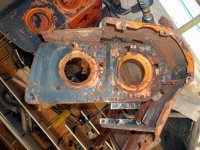
The first thing I did was remove the large brace panel that backs up the headlamp mounts and connects to the core-support. As you can see, this did not require much effort. The area to the right is the clearance dimple for the headlamp mount.

100_6130.JPG


That allowed me nearly full access to the back of the actual headlamp mounting panel. This is going to need some semi-serious reconstruction, especially near the top.

100_6131.JPG

The damage is more evident with the flash disabled:

100_6158.JPG


Those two tabs used to extend up and were spot-welded to the flange on the fender. Both have rotted far enough that they're nowhere near touching anymore. You can also see the missing material around the upper headlamp adjuster. I'll need to fabricate a piece to put there what-fer I can adjust the ol' see-beams.

I removed another brace that once welded to the back of the headlamp mount panel, and the other side welded to a flange in the fender. Spot-weld drilling did not go well here, primarily because of flex. Just when I thought I was getting through the first layer of metal, it would blow through the second as well. On the bright side, two spot welds just weren't holding anymore, and the bottom flange of the mount panel had let go some time ago. I'll clean off what little metal is still welded to that with the angle grinder. It won't take much--it's so rusty it looks like Toaster Strudel. The damage around the headlamp adjuster is visible here as well.

100_6153.JPG


The part still welded to the fender at the front will be reused, although I'm sure the headlamp mount panel will come out for shoring up before I'm done. The next thing I'll probably cut off will be the long mounting flange that sits atop the inner fender and runs nearly the entire length thereof. The wide flange at the front (where the hood bumper and hood pin mount) is in good shape, but the long flange has had it. That probably won't happen until I can get the car near a welder--ain't happenin' at the storage locker.

Regardless, in anticipation of the flange removal, and since the torch was handy from melting lead out of Agnes' roof, I went to work removing most of the undercoating. This process didn't take long, maybe 40 minutes. It'd have gone much more quickly if I wasn't doing other things at the same time. Pretty straightforward work: Scorch with the torch and it peels right off with the scraper. The stuff left on the side of the fender is very thin, and since my working angle wasn't very accomodating--the fender's sitting on Agnes's trunk, along with another fender I'd rather not knock off--I left most of that for later. You can see where I made a few passes through it, though. That's maybe 20 minutes more work.

100_6135.JPG
 

SiteLock

SiteLock
Back
Top