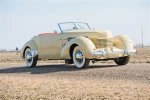
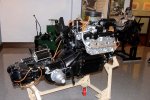
Yeah, I know that Chrysler made 35 fuelie cars with Bendix.. 16 300's, 12 D500's, 2 Furys, and 5 Desotos. Bendix also offered the tech to Buick and Rambler, but Chrysler was the only company to bite. That technology was largely cribbed from airplanes, if I remember correctly.. I also knew about the wax paper capacitors, because airplanes would use the system essentially at idle or WOT, Bendix had to create electronics to adapt the system to different rev ranges. In order to keep all that crap cool, they mounted the electronics in front of the radiator.. which might be fine if they only sold cars in the desert. Rain didn't help the already flawed system, and all 35 cars were recalled. All but one (which may still be in the ether) were replaced with dual quad carbs. Those cars also ran dual distributors. The experiment (brilliant on paper, just not on wax paper) was sold to Bosch. Bosch later released it in (my memory gets fuzzy here) '67 or so on VW squarebacks. It then seeped into Mercedes and Volvos.. The first iteration of the Bosch Injection (that I know of) was D-Jet. "D" standing for "Drück" or "pressure" in Doucheland. This was because while the system used temp sensors, IAC's, TPS's and the like, the system was largely dependent on fuel pressure. D-Jet, despite what some 914 diehards will tell you, was still largely a steaming pile of shit. Most D-Jet cars today get carbs swapped onto them just like they did in the Chrysler days, largely due to the process in troubleshooting, and skyrocketing parts prices and new stock unavailability. However in my previous post, I'd suggested that AMC should have called up Bosch and bought the license to K-Jet, or CIS.. which was an electromechanical system that constantly fired all of the injectors as long as the engine was running, unless the system pressure dropped below 65 PSI or so (bad relay, or fuel pump). By 1984, D-Jet had been put out to pasture, but K-Jet, and later CIS injection had been around and been refined since '74, or thereabouts. It had been used reliably for about ten years on 911's and Volvos, as well as some Benzes. The only real failure points on K-jet cars are vacuum leaks, weak fuel pumps, or in the case of 911s, detonated air boxes.. I have two K-Jet Volvos, and despite one being barely a parts car, both will fire up every time, no matter how long they sit.. I've never had an injection related failure in either car.. my '81 has over 400,000 on it, and my '74 has well over 200,000 on it. I don't maintain either system. They ran with catalytic converters in the eighties, and passed emissions tests here until about '89 or '90. In '84 the only other real option was L-Jet, which was still new and problematic on Alfas and Fiats.. Later and superior Motronic had just been developed for F1 cars, and wouldn't see commercial use until '88 or so. So, yes.. Bosch bought EFI as we know it, and it still took them forty years to make it not suck rocks. I'll end this thought with this.. Even D-Jet would have been far superior to the "computer" controlled carb shit found on eighties AMC and Chrysler garbage. We wanted fuel injection controls to precisely meter a barely metered fuel leak known as a carburetor, and it even continued in the guise of just as crappy TBI.. Drill holes, go multiport, be done.
As for OHC engines, I wasn't supporting the cars they were in, which while many of them give me wood, were largely shit. Just like (let's be realistic) all cars back then were. Short of something handbuilt, or exclusive, like an Imperial, or a Caddy limo, or a Rolls, or a Mercedes Grösser Pullman.. All cars back then were built to be disposed of in three to five years. It was all part of keeping up with the Jones's.. That's why Chrysler didn't waste one drop of paint under a vinyl roof.. However, many of those OHC designs were good enough to last for close to half a century or more in the case of the Mercedes, Jag, Lampredi Fiat/Lancia motor, and the Alfa.. Things controlling the motor and in the car may have been prone to breaking, but all of those architectures were known to be long lived designs both in core reliability and number of years produced. Those companies also needed smaller OHC platforms to make more power out of a smaller motor to fit in a smaller car, to maneuver cramped Euro cities better, I get that.. I was more complaining about our continent (you guys up there in Canuckistan too) were so behind the times in all departments. Brakes and seat belts still come to mind. We had our own advances, sure.. Alternators, Cruise control, self dipping hi beams, record players, etc.. but we were and still are reticent to adopt other people's technology, even when it's been proven for decades. Hell, what happened to our aluminum Buick v8? we abandoned it after three years, the Brits bought the rights, and cranked them out for close to fifty years, all they way up to 4.9 litres. They powered everything from Morgans, to Rovers, to Discos, to Triumphs, and more.. The Hemi was slated to be overhead cam (I've heard), but the concept was cut, and a complicated pushrod design was created instead to keep from confusing service station attendants. The American car industry as a whole, continued to be a worldwide joke, cranked out substandard crap (Cavaliers, Escorts, Sebrings, 200's, etc) largely until the mid aughts. Our materials, workmanship, quality control, power outputs per liter, and so on in our everyday cars were far inferior to the Japanese until just recently.. (I'm done arguing for European cars after the nineties.. I've worked on them.. They can keep them) Go drive a Dodge Caliber, and a Toyota Corolla back to back.. Tell me you'll still buy the Dodge. I'll laugh in your face.. Most people will, and the sales figures are there to prove it. America makes pickups, fleet and rental cars very well.
At any rate, you didn't ruffle my feathers.. Our own industry has. We just keep making junk, and if we shared this continent with a real world market, the big three would go belly up again.. Fiat relies on Chrysler (read, Ram, and Jeep) to keep them floating, Chevy and Ford rely on their world markets and platforms and their pickup trucks to keep afloat. Our everyday, moderate price point cars brewed in house are largely crap. Kudos to ford for the Fiesta. (Which is a world market car, by the way)


 1964 Jeep Wagoneer - $16,500 - Old Bethpage, NY - 1964 Jeep Wagoneer 4Dr 4X4