
Dr.Jass
Pastor of Muppets
I might as well start a thread about that one, too. That was the car that was originally supposed to get finished first anyhow. I actually have most of the parts for this build already, unlike the Challenger, but it's a far-more complex build from the get-go.
Those not familiar with the project, it's an '82 Imperial that is getting its original EFI 318 built into my updated, improved version of an EFI 318. To that end, I'll be using a MegaSquirt II EFI controller I built on my kitchen table along with a modified Holley Strip Dominator intake, billet 1,250CFM Motorvation throttle body, and Siemens/Deka 82lb/hr fuel injectors. "Doc," you ask, "Why so large?" Well, that's where the complexity comes into play: Twin turbocharging. Not only turbocharging, but flex-fuel capability so I can run E85 which will allow the ECM to crank up both the boost and the timing relatively dramatically. I'm using a GM (gasp!) fuel-quality sensor which will let the ECM know exactly how much alcohol (and, coincidentally, water) is in the system and adjust accordingly (if there's more than X% water, it faults and shuts the engine off).
Not complex enough, you say? OK, I'm also running distributorless ignition based on Ford's (gasp!) EDIS-8 system, which is a waste-fire arrangement meaning I've got four ignition coils, two modules of two coils each. That'll be triggered by a 36-1 wheel on the crankshaft, between the harmonic dampener and the lower pulley. A serpentine lower pulley, which will require custom fabrication of just about all the accessories (the fuel rails, thermostat and AC compressor have a difference of opinions about living space).
"Pssssh," you say. "Cake walk."
OK, how about dual air-to-liquid intercoolers using active cooling? That should get your interest, though I'm not going to get much further into detail about that. You'll see.
I'm also converting the car to a 4-speed using a mishmash of factory parts, tossing in an 8¾" rear axle with a 2.94:1 Eaton True Trac differential under the back, and using 1988 Conquest TSi SHP wheels, 16"x8" up front and 16"x9" in the rear (hence the wider E-body axle, rather than the time-honored '65-'70 B-body swap). Shifting will be via a modified '70 B-body console Pistol Grip, poking up through a factory '81 Mirada floor console. I'm also using '87 Conquest TSi front leather buckets, which should be fun to try and mount, because I'd like to keep the factory power seat controls on the door working. Final touches include a Kenwood multi-format stereo system w/Infinity drivers and a heavily-customized dash using Speedhut gauges, small digital pyrometers (I ran out of room for gauges), and possibly a real-time readout for PCM parameters. I'm undecided on the latter, since it's kind of "busy" and there's already going to be a lot happening on the dash... then again, it allows for real-time adjustment without connecting the laptop.
Among other things I was doing in the garage today, I worked on the custom dash. At least, the start of it. I broke out the hole saws and made the stiffener plate for the instrument cluster. It was a lot easier in Photoshop than it was with the drill press, mostly because Photoshop doesn't print out the measurements or grid I used for the layout. It didn't have to be perfect, though, since it's only the backing plate.
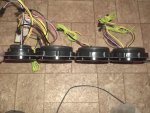
This was after I'd first cut the holes. I'd not yet trimmed the end, which of course I screwed up a little. The one end isn't as clean as it could be, but it is what it is, and it'll be hidden anyhow.

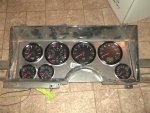
I set the gauges in it prior to going any further with it. If they didn't fit (and they barely do from the back) I'd have had to determine a new plan. For the curious that can't read 'em, the gauges from top left to bottom right: Boost, quad temp/oil/fuel/volts, tachometer, speedometer, A/F ratio (wideband, plugs right into my Innovate controller), oil temp, and 100PSI fuel pressure.

This was one of the reasons I went with the Speedhut gauges: Mounting depth. There's not a lot of room behind where this cluster will mount, and AutoMeter, VDO, etc. are all too deep.
Of course, being able to choose my own font style helped, too, though I'm not 100% satisfied with those results. I chose the font used on early '80s Mopar RWDers, but somehow their art department kind of fucked it up. Ah, well, I'm committed for the time being, though I can replace the faces and bezels on these should I want a different look. This is a very-rough mockup, as I've not yet trimmed the bezel to clear the gauge bezels. As I mentioned, the steel plate is just a stiffener; the final look will be much more befitting an Imperial.
Those not familiar with the project, it's an '82 Imperial that is getting its original EFI 318 built into my updated, improved version of an EFI 318. To that end, I'll be using a MegaSquirt II EFI controller I built on my kitchen table along with a modified Holley Strip Dominator intake, billet 1,250CFM Motorvation throttle body, and Siemens/Deka 82lb/hr fuel injectors. "Doc," you ask, "Why so large?" Well, that's where the complexity comes into play: Twin turbocharging. Not only turbocharging, but flex-fuel capability so I can run E85 which will allow the ECM to crank up both the boost and the timing relatively dramatically. I'm using a GM (gasp!) fuel-quality sensor which will let the ECM know exactly how much alcohol (and, coincidentally, water) is in the system and adjust accordingly (if there's more than X% water, it faults and shuts the engine off).
Not complex enough, you say? OK, I'm also running distributorless ignition based on Ford's (gasp!) EDIS-8 system, which is a waste-fire arrangement meaning I've got four ignition coils, two modules of two coils each. That'll be triggered by a 36-1 wheel on the crankshaft, between the harmonic dampener and the lower pulley. A serpentine lower pulley, which will require custom fabrication of just about all the accessories (the fuel rails, thermostat and AC compressor have a difference of opinions about living space).
"Pssssh," you say. "Cake walk."
OK, how about dual air-to-liquid intercoolers using active cooling? That should get your interest, though I'm not going to get much further into detail about that. You'll see.
I'm also converting the car to a 4-speed using a mishmash of factory parts, tossing in an 8¾" rear axle with a 2.94:1 Eaton True Trac differential under the back, and using 1988 Conquest TSi SHP wheels, 16"x8" up front and 16"x9" in the rear (hence the wider E-body axle, rather than the time-honored '65-'70 B-body swap). Shifting will be via a modified '70 B-body console Pistol Grip, poking up through a factory '81 Mirada floor console. I'm also using '87 Conquest TSi front leather buckets, which should be fun to try and mount, because I'd like to keep the factory power seat controls on the door working. Final touches include a Kenwood multi-format stereo system w/Infinity drivers and a heavily-customized dash using Speedhut gauges, small digital pyrometers (I ran out of room for gauges), and possibly a real-time readout for PCM parameters. I'm undecided on the latter, since it's kind of "busy" and there's already going to be a lot happening on the dash... then again, it allows for real-time adjustment without connecting the laptop.
Among other things I was doing in the garage today, I worked on the custom dash. At least, the start of it. I broke out the hole saws and made the stiffener plate for the instrument cluster. It was a lot easier in Photoshop than it was with the drill press, mostly because Photoshop doesn't print out the measurements or grid I used for the layout. It didn't have to be perfect, though, since it's only the backing plate.
This was after I'd first cut the holes. I'd not yet trimmed the end, which of course I screwed up a little. The one end isn't as clean as it could be, but it is what it is, and it'll be hidden anyhow.
I set the gauges in it prior to going any further with it. If they didn't fit (and they barely do from the back) I'd have had to determine a new plan. For the curious that can't read 'em, the gauges from top left to bottom right: Boost, quad temp/oil/fuel/volts, tachometer, speedometer, A/F ratio (wideband, plugs right into my Innovate controller), oil temp, and 100PSI fuel pressure.
This was one of the reasons I went with the Speedhut gauges: Mounting depth. There's not a lot of room behind where this cluster will mount, and AutoMeter, VDO, etc. are all too deep.
Of course, being able to choose my own font style helped, too, though I'm not 100% satisfied with those results. I chose the font used on early '80s Mopar RWDers, but somehow their art department kind of fucked it up. Ah, well, I'm committed for the time being, though I can replace the faces and bezels on these should I want a different look. This is a very-rough mockup, as I've not yet trimmed the bezel to clear the gauge bezels. As I mentioned, the steel plate is just a stiffener; the final look will be much more befitting an Imperial.