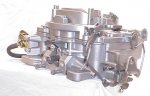
Carburetors

J.C. Corbett

or something.....
I've been pondering a bit lately, and wondered what you all think on this subject. Nearly every car I see these days has an Edelbrock AFB type carb. I have terrible luck with these carbs. One had a warped base out of the box, producing predictable results, and every one since runs okay, but they seem to drain fuel off over a couple of days. Is this the norm? On the other hand, my family has had, and still has, several GM pickups with Quadrajets, and they are the most problem free carbs I've ever dealt with. My 79 Chev pickup, which I've owned since '90 still starts up like new every time, in all temps, and dad's 85 has over 300K on it, and starts the same way. The 85 gets used hard, often in -30 winter temps, and it still fires and goes right up on high idle. The carb on dad's 85 has never been opened up. I've also had a few Dodge pickups with Thermoquads, which acted very similar to Quadrajets. Soooo....my question is, why do the spreadbore carbs, which in my experience are ridiculously reliable, get such a bad rap? I'm not trying to bag on anything or promote GM here, I'm just trying to understand why so many people dump them in favor of AFB style carbs.:huh:
 
the afb's are generaly idiot proof thats why...also if the engine sits for a long period with fuel in the carb its very simple to clean out the bowls ..fact is you can have the top off and blow out the whole carb on the side of the road in 5 mins.....and then there is the jet availibilty...are there even jet kits you can get for those spread bores?...its voodoo to most ppl to tune a spreadbore

i love my afb's ..but i also like dgav webbers and dellorotos ...while ive dinked with the spreadbores over the years i never was a fan..and the holleys and i genneraly dont get along accept for this one 750 tahts been on 6 engines while ive owned it and atleast 3 more prior to that
 
First up, I will say that I picked up a half a second in the quarter by going from a Holley to a QuadraJet on my Trans Am. I also picked up about 7MPG on the highway with a bigger carb.

I have had great luck with both the Q-Jet and the ThermoQuad, and as carbs go they're really my favorites. I think part of the rep they get is from people that don't know how to tune them, which is actually pretty simple on either carb. I made tons of money back in the '90s tuning "Quadra-Junks" because guys had no idea how to get rid of the hesitation. Either carb, properly adjusted, is just awesome assuming the metering rods and jets are right for the engine. The problem you run into with them is tuning parts. I used a '71 or '72 Olds 455 W-30 carb on my 400 Trans Am, and that sucker was literally perfect once I made some minor adjustments. A '75 360 ThermoQuad was equally awesome on my '84 Fifth Avenue once I got rid of the Lean Burn and stuck a 340 distributor in it and a Performer intake I had lying around that was not nice enough to sell (about a year after I sold the car, the thermostat fell into the water crossover :D ).

I like Holleys, but they're actually so adjustable that most guys don't know how to get them right. The adage around here was always, "You can make a Holley run well on the street or run well on the track, but not both." Really? Ever change your pump cam? Do you even know how to size your power valve? Are your accelerator-pump squirters the right size? How'd you figure out your jetting? What air bleeds have you got? What vacuum-secondary spring are you running? Blank stares every time.

I am not a fan of Carter/Edelbrock carbs with the exceptions of the ThermoQuad and the original AVS. The AFB/Performer always seems to run well right out of the box, but the counterweighted air valve has always been an issue. You simply can't make the secondary air doors open more quickly without tricky mods to the counterweights, and if you overdo it, buy a new one and start over. The Edelbrock Thunder Series AVS (simply an AFB with an adjustable air valve, virtually nothing interchanges with an OEM AVS) is definitely an improvement. I have had several Performer carbs apart that had rust in them because they sat with fuel in them for awhile, and Edelbrock puts flimsy steel float baffles in them. The rust goes right into the metering circuit, and good luck getting it out. Trying to get rust off aluminum is like trying to scrub stink off shit. I've tossed at least three in the scrap heap due to this problem.

The wildcard is the spread-bore factory-replacement Holleys (4165s). All the tuneability of a regular Holley with the fuel economy of the Q-Jet or TQ. They're a hard carb not to love if you know your way around a Holley. They're available in both vacuum and mechanical secondaries.

The absolute last carburetor I would choose would be an AFB-style anything... I don't care how nice it is for "bolt on and go", but then again I'm not building a street rod just for looks with a 350 Chevy in it, either.

 
Probably the number one complaint from most people running an AVS/AFB type carb is hard starting after sitting for a for days, or longer. Most times this is either attributed to either a lack of a good insulator type gasket or it is the type with a bowl-vent valve. In this pic the bowl vent is right next to the accelerator pump. And when the throttle is relaxed, it opens the vent, allowing the fuel to evaporate.AVS.jpg Because all AFB/AVS/Edelbrock carbs use an aluminum base, they absorb a lot of heat from the intake. When the engine is running it not a real problem because of airflow and fuel flow. But when the engine is shut off, heat soak causes the fuel to boil in the carb. You need to do a little searching for the right base gasket, but they are out there and they are about 1/4 inch thick. My 68 coronet sedan with the teener has a mis-match of one AVS and one Eddy. They are both 650's, and that car starts sweet whether it sits for one hour or six months. :huh:
 
I too like the Qudra-jet and the T-Quad but I will take the T-quade over the quadra-jet every time. The most importaint thing to remember with any carb tuning is fallow every step exactly and in the correct order. Alot of the "tuning problems" have more to do with linkage that has stretched out of spec. Fallow the steps. make the adjustments (bends) in order and set the air door tension and you have a damn good runing carb engine.

I also love the spred bore holleys. Much like the square bore holleys, they are so tunable that most people dont take the time to olearn how to make them correct for the aplacation they are being used for. Take the time to learn the steps and make the adjustments and you will have a damn fine running carb engine with these too.

It all comes down to learning how to tune them and putting the effort into doing it correctly and all the way through to the end.
 
Thanks for the thoughts, guys. Personally, I have no problem with Holley carbs at all. I love the tunability. The old 65 Belvedere had a 950HP Holley with a blocked power valve in the secondaries, and with no choke whatsoever, the car always started easy, drove great on the street, and ran low 12's. The other easy carb to tune that I'd forgot about is the Autolite 4100. My 64 Galaxie had one, and it took Holley jets and power valves. Super easy to tune.
 

SiteLock

SiteLock
Back
Top