

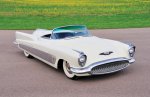

There was a time when the people who ran automobile companies were genuine automotive enthusiasts. Charles A. Chayne, Harley J. Earl and Ned F. Nickles were three of those enthusiasts whose passion for beautiful cars led to the creation of the Buick XP-300 (originally labeled XP-9), a true dream machine.
The year was 1951, a time when it was hard to imagine a 16-foot-long convertible that glided only 6-1/2 inches above the ground. Part sports car and part space ship, the car had an “electric shaver” grille, a wraparound windshield, a tri-finned tail with the electric radio antenna protruding from the center fin and flashy side trim that would have looked right at home on Buck Rogers’ interplanetary cruiser. It even had push-button power seats and windows!
Chayne, in addition to working as Buick chief engineer, was a pioneer American car collector. More than a decade earlier, he and design chief Harley Earl had teamed up to create the first “car of the future,” which was brought to life as the 1938-’39 Buick Y-Job. In overall concept, the Y-Job and the XP-300 are virtually the same; the ’50s dream car was just a more modern interpretation from the sketchpad of Nickles, a self-taught car designer of enormous talent.
Read more.


